




If three vertices of a triangle ABC are $A\left( {{x}_{1}},{{y}_{1}} \right),B\left( {{x}_{2}}{{y}_{2}} \right),C\left( {{x}_{3}},{{y}_{3}} \right)$. $lx+my+n=0$ is an equation of the line $L$. If the centroid of the triangle $ABC$ is at the origin and algebraic sum of the length of the perpendicular from the vertices of triangle $ABC$ on the line $L$ is equal to $1$, then sum of the squares of reciprocals of the intercepts made by $L$ on the coordinate axes is equal to:
A) 0
B) 4
C) 9
D) 16
Answer
 Verified
623.7k+ views
Hint: The perpendicular distance from point $\left( {{x}_{1}}{{y}_{1}} \right)$ to line $ax+by+c=0$ is given as $d=\left| \dfrac{a{{x}_{1}}+b{{y}_{1}}+c}{\sqrt{{{a}^{2}}+{{b}^{2}}}} \right|$.
Complete step-by-step answer:
We are given a triangle $ABC$ whose vertices are given as $A\left( {{x}_{1}}{{y}_{1}} \right),B\left( {{x}_{2}}{{y}_{2}} \right)\And C\left( {{x}_{3}},{{y}_{3}} \right)$ .
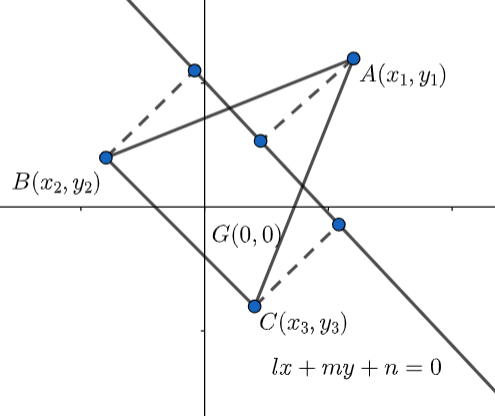
Also , the given equation of the line is
$L\equiv lx+my+n=0$
Now , in the question it is given that the centroid is at the origin i.e. $\left( 0,0 \right)$ .
We know , if a triangle has vertices \[\left( {{x}_{1}},{{y}_{1}} \right),\left( {{x}_{2}},{{y}_{2}} \right)\] and \[\left( {{x}_{3}},{{y}_{3}} \right)\] then , its centroid is given as
\[\left( \left( \dfrac{{{x}_{1}}+{{x}_{2}}+{{x}_{3}}}{3} \right),\left( \dfrac{{{y}_{1}}+{{y}_{2}}+{{y}_{3}}}{3} \right) \right)\] .
So ,$\left( \dfrac{{{x}_{1}}+{{x}_{2}}+{{x}_{3}}}{3},\dfrac{{{y}_{1}}+{{y}_{2}}+{{y}_{3}}}{3} \right)=\left( 0,0 \right)$
\[\Rightarrow \dfrac{{{x}_{1}}+{{x}_{2}}+{{x}_{3}}}{3}=0\]
Or , \[\text{ }{{x}_{1}}+{{x}_{2}}+{{x}_{3}}=0..........\left( i \right)\]
And , \[\dfrac{{{y}_{1}}+{{y}_{2}}+{{y}_{3}}}{3}=0\]
Or , \[{{y}_{1}}+{{y}_{2}}+{{y}_{3}}=0...........\left( ii \right)\]
Now , we know the perpendicular distance of point $\left( {{x}_{1}},{{y}_{1}} \right)$ from the line $ax+by+c=0$ is given by
$\left| \dfrac{a{{x}_{1}}+b{{y}_{1}}+c}{\sqrt{{{a}^{2}}+{{b}^{2}}}} \right|$ .
Now, the given equation of line is $L\equiv lx+my+n=0$ .
In the question , it is given that the algebraic sum of perpendicular distances of the vertices from the line is equal to $1$ .
$\Rightarrow \dfrac{\left( l{{x}_{1}}+m{{y}_{1}}+n \right)}{\sqrt{{{l}^{2}}+{{m}^{2}}}}+\dfrac{\left( l{{x}_{2}}+m{{y}_{2}}+n \right)}{\sqrt{{{l}^{2}}+{{m}^{2}}}}+\dfrac{\left( l{{x}_{3}}+m{{y}_{3}}+n \right)}{\sqrt{{{l}^{2}}+{{m}^{2}}}}=1$
$\Rightarrow \dfrac{l\left( {{x}_{1}}+{{x}_{2}}+{{x}_{3}} \right)+m\left( {{y}_{1}}+{{y}_{2}}+{{y}_{3}} \right)+3n}{\sqrt{{{l}^{2}}+{{m}^{2}}}}=1.........\left( iii \right)$
Now , we will substitute $\left( i \right)$ and $\left( ii \right)$ in equation $\left( iii \right)$ .
On substituting $\left( i \right)$ and $\left( ii \right)$ in equation $\left( iii \right)$ , we get
$\dfrac{3n}{\sqrt{{{l}^{2}}+{{m}^{2}}}}=1$
$\Rightarrow 3n=\sqrt{{{l}^{2}}+{{m}^{2}}}$
Now , we will square both sides .
On squaring both sides , we get
$9{{n}^{2}}={{l}^{2}}+{{m}^{2}}............\left( iv \right)$
Now , the given line is
$\begin{align}
& lx+my+n=0 \\
& \Rightarrow lx+my=-n \\
& \Rightarrow \dfrac{lx}{-n}+\dfrac{my}{-n}=1 \\
& \Rightarrow \dfrac{x}{\left( \dfrac{-n}{l} \right)}+\dfrac{y}{\left( \dfrac{-n}{m} \right)}=1........\left( v \right) \\
\end{align}$
Now we know , if $a$ is the \[x\] -intercept and $b$ is the \[y\] –intercept formed by a line with the coordinate axes, then equation of line is written as
$\dfrac{x}{a}+\dfrac{y}{b}=1$
Comparing with $\left( v \right)$ , we get:
$a=\dfrac{-n}{l}\And b=\dfrac{-n}{m}$
So , sum of squares of reciprocal of the intercept is given as
$\begin{align}
& \dfrac{1}{{{a}^{2}}}+\dfrac{1}{{{b}^{2}}} \\
& =\dfrac{1}{{{\left( \dfrac{-n}{l} \right)}^{2}}}+\dfrac{1}{{{\left( \dfrac{-n}{m} \right)}^{2}}} \\
& =\dfrac{{{l}^{2}}}{{{n}^{2}}}+\dfrac{{{m}^{2}}}{{{n}^{2}}}=\dfrac{{{l}^{2}}+{{m}^{2}}}{{{n}^{2}}}...........\left( vi \right) \\
\end{align}$
Now , from $\left( iv \right)$ we have ${{l}^{2}}+{{m}^{2}}=9{{n}^{2}}$
Substituting in equation $\left( vi \right)$ , we get
$\dfrac{1}{{{a}^{2}}}+\dfrac{1}{{{b}^{2}}}=\dfrac{9{{n}^{2}}}{{{n}^{2}}}=9$
Hence , the sum of the squares of reciprocals of the intercepts made by $L$ on the coordinate axes is equal to \[9\] .
Note: While simplifying the equations, please make sure that sign mistakes do not occur. These mistakes are very common and can cause confusions while solving. Ultimately the answer becomes wrong. So, sign conventions should be carefully taken.
Complete step-by-step answer:
We are given a triangle $ABC$ whose vertices are given as $A\left( {{x}_{1}}{{y}_{1}} \right),B\left( {{x}_{2}}{{y}_{2}} \right)\And C\left( {{x}_{3}},{{y}_{3}} \right)$ .
Also , the given equation of the line is
$L\equiv lx+my+n=0$
Now , in the question it is given that the centroid is at the origin i.e. $\left( 0,0 \right)$ .
We know , if a triangle has vertices \[\left( {{x}_{1}},{{y}_{1}} \right),\left( {{x}_{2}},{{y}_{2}} \right)\] and \[\left( {{x}_{3}},{{y}_{3}} \right)\] then , its centroid is given as
\[\left( \left( \dfrac{{{x}_{1}}+{{x}_{2}}+{{x}_{3}}}{3} \right),\left( \dfrac{{{y}_{1}}+{{y}_{2}}+{{y}_{3}}}{3} \right) \right)\] .
So ,$\left( \dfrac{{{x}_{1}}+{{x}_{2}}+{{x}_{3}}}{3},\dfrac{{{y}_{1}}+{{y}_{2}}+{{y}_{3}}}{3} \right)=\left( 0,0 \right)$
\[\Rightarrow \dfrac{{{x}_{1}}+{{x}_{2}}+{{x}_{3}}}{3}=0\]
Or , \[\text{ }{{x}_{1}}+{{x}_{2}}+{{x}_{3}}=0..........\left( i \right)\]
And , \[\dfrac{{{y}_{1}}+{{y}_{2}}+{{y}_{3}}}{3}=0\]
Or , \[{{y}_{1}}+{{y}_{2}}+{{y}_{3}}=0...........\left( ii \right)\]
Now , we know the perpendicular distance of point $\left( {{x}_{1}},{{y}_{1}} \right)$ from the line $ax+by+c=0$ is given by
$\left| \dfrac{a{{x}_{1}}+b{{y}_{1}}+c}{\sqrt{{{a}^{2}}+{{b}^{2}}}} \right|$ .
Now, the given equation of line is $L\equiv lx+my+n=0$ .
In the question , it is given that the algebraic sum of perpendicular distances of the vertices from the line is equal to $1$ .
$\Rightarrow \dfrac{\left( l{{x}_{1}}+m{{y}_{1}}+n \right)}{\sqrt{{{l}^{2}}+{{m}^{2}}}}+\dfrac{\left( l{{x}_{2}}+m{{y}_{2}}+n \right)}{\sqrt{{{l}^{2}}+{{m}^{2}}}}+\dfrac{\left( l{{x}_{3}}+m{{y}_{3}}+n \right)}{\sqrt{{{l}^{2}}+{{m}^{2}}}}=1$
$\Rightarrow \dfrac{l\left( {{x}_{1}}+{{x}_{2}}+{{x}_{3}} \right)+m\left( {{y}_{1}}+{{y}_{2}}+{{y}_{3}} \right)+3n}{\sqrt{{{l}^{2}}+{{m}^{2}}}}=1.........\left( iii \right)$
Now , we will substitute $\left( i \right)$ and $\left( ii \right)$ in equation $\left( iii \right)$ .
On substituting $\left( i \right)$ and $\left( ii \right)$ in equation $\left( iii \right)$ , we get
$\dfrac{3n}{\sqrt{{{l}^{2}}+{{m}^{2}}}}=1$
$\Rightarrow 3n=\sqrt{{{l}^{2}}+{{m}^{2}}}$
Now , we will square both sides .
On squaring both sides , we get
$9{{n}^{2}}={{l}^{2}}+{{m}^{2}}............\left( iv \right)$
Now , the given line is
$\begin{align}
& lx+my+n=0 \\
& \Rightarrow lx+my=-n \\
& \Rightarrow \dfrac{lx}{-n}+\dfrac{my}{-n}=1 \\
& \Rightarrow \dfrac{x}{\left( \dfrac{-n}{l} \right)}+\dfrac{y}{\left( \dfrac{-n}{m} \right)}=1........\left( v \right) \\
\end{align}$
Now we know , if $a$ is the \[x\] -intercept and $b$ is the \[y\] –intercept formed by a line with the coordinate axes, then equation of line is written as
$\dfrac{x}{a}+\dfrac{y}{b}=1$
Comparing with $\left( v \right)$ , we get:
$a=\dfrac{-n}{l}\And b=\dfrac{-n}{m}$
So , sum of squares of reciprocal of the intercept is given as
$\begin{align}
& \dfrac{1}{{{a}^{2}}}+\dfrac{1}{{{b}^{2}}} \\
& =\dfrac{1}{{{\left( \dfrac{-n}{l} \right)}^{2}}}+\dfrac{1}{{{\left( \dfrac{-n}{m} \right)}^{2}}} \\
& =\dfrac{{{l}^{2}}}{{{n}^{2}}}+\dfrac{{{m}^{2}}}{{{n}^{2}}}=\dfrac{{{l}^{2}}+{{m}^{2}}}{{{n}^{2}}}...........\left( vi \right) \\
\end{align}$
Now , from $\left( iv \right)$ we have ${{l}^{2}}+{{m}^{2}}=9{{n}^{2}}$
Substituting in equation $\left( vi \right)$ , we get
$\dfrac{1}{{{a}^{2}}}+\dfrac{1}{{{b}^{2}}}=\dfrac{9{{n}^{2}}}{{{n}^{2}}}=9$
Hence , the sum of the squares of reciprocals of the intercepts made by $L$ on the coordinate axes is equal to \[9\] .
Note: While simplifying the equations, please make sure that sign mistakes do not occur. These mistakes are very common and can cause confusions while solving. Ultimately the answer becomes wrong. So, sign conventions should be carefully taken.
Recently Updated Pages
Basicity of sulphurous acid and sulphuric acid are

Master Class 11 Business Studies: Engaging Questions & Answers for Success
Master Class 11 Computer Science: Engaging Questions & Answers for Success
Master Class 11 Economics: Engaging Questions & Answers for Success
Master Class 11 Social Science: Engaging Questions & Answers for Success
Master Class 11 English: Engaging Questions & Answers for Success
Trending doubts
One Metric ton is equal to kg A 10000 B 1000 C 100 class 11 physics CBSE
The largest wind power cluster is located in the state class 11 social science CBSE
Explain zero factorial class 11 maths CBSE
What steps did the French revolutionaries take to create class 11 social science CBSE
Which among the following are examples of coming together class 11 social science CBSE
Can anyone list 10 advantages and disadvantages of friction