




If there are 81 million bases in RNA of human cell, then calculate the total number of introns present in cDNA
A. 27 million
B. Zero
C. Equal to ribonucleotides
D. Half the number of ribonucleotides
Answer
 Verified
565.2k+ views
Hint: The human cell is eukaryotic. Eukaryotic genes commonly contain introns (that are essentially non-coding sequences i.e. they do not code for proteins). These are removed after mRNA is synthesized resulting in the formation of the complementary or cDNA.
Complete answer: Introns and exons are nucleotide sequences within a gene. Introns are removed by RNA by a process called splicing, as RNA matures, meaning that they're not expressed within the final messenger RNA (mRNA) product; while exons continue to be covalently bonded to one another so as to make mature mRNA. Introns are often considered as intervening sequences, and exons on the other hand are known as the expressed sequences. Introns are discarded from the pre-mRNA by the activity of a complex known as the spliceosome complex. The spliceosome is formed from proteins and little RNAs that are associated to make protein-RNA enzymes called small nuclear ribonucleoproteins or snRNPs (pronounced SNRNPS). The resulting product is what we know as the complementary DNA (cDNA) is DNA; so, cDNA is devoid of any introns.
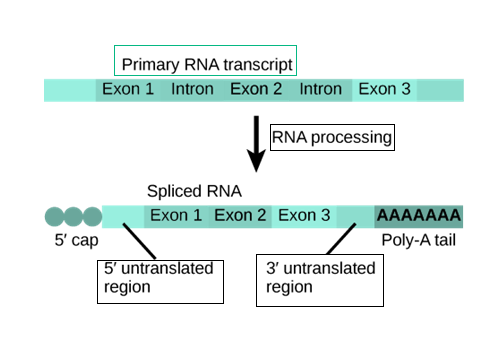
Note: It is vital for the introns to be removed precisely, as any left-over intron nucleotides, or deletion of exon nucleotides, may end in the production of wrong or flawed protein. This may occur because the amino acids that join to form the protein structure follow the sequence of codons strictly, which contains three nucleotides.
Complete answer: Introns and exons are nucleotide sequences within a gene. Introns are removed by RNA by a process called splicing, as RNA matures, meaning that they're not expressed within the final messenger RNA (mRNA) product; while exons continue to be covalently bonded to one another so as to make mature mRNA. Introns are often considered as intervening sequences, and exons on the other hand are known as the expressed sequences. Introns are discarded from the pre-mRNA by the activity of a complex known as the spliceosome complex. The spliceosome is formed from proteins and little RNAs that are associated to make protein-RNA enzymes called small nuclear ribonucleoproteins or snRNPs (pronounced SNRNPS). The resulting product is what we know as the complementary DNA (cDNA) is DNA; so, cDNA is devoid of any introns.
Note: It is vital for the introns to be removed precisely, as any left-over intron nucleotides, or deletion of exon nucleotides, may end in the production of wrong or flawed protein. This may occur because the amino acids that join to form the protein structure follow the sequence of codons strictly, which contains three nucleotides.
Recently Updated Pages
Master Class 12 Economics: Engaging Questions & Answers for Success

Master Class 12 Physics: Engaging Questions & Answers for Success
Master Class 12 English: Engaging Questions & Answers for Success
Master Class 12 Social Science: Engaging Questions & Answers for Success
Master Class 12 Maths: Engaging Questions & Answers for Success
Master Class 12 Business Studies: Engaging Questions & Answers for Success
Trending doubts
Which are the Top 10 Largest Countries of the World?
What are the major means of transport Explain each class 12 social science CBSE
Draw a labelled sketch of the human eye class 12 physics CBSE
Differentiate between insitu conservation and exsitu class 12 biology CBSE
Draw a neat and well labeled diagram of TS of ovary class 12 biology CBSE
Give 10 examples of unisexual and bisexual flowers