




If , then find the value of :
A.\[\dfrac{{\sqrt {1 - {a^2} + a} }}{{\sqrt {1 - {a^2}} }}\]
B.\[\dfrac{{\sqrt {1 - {a^2} + 1} }}{{\sqrt {1 - {a^2}} }}\]
C.\[\dfrac{{a(\sqrt {1 - {a^2}} \, + \,1)}}{{\sqrt {1 - {a^2}} }}\]
D.\[\dfrac{{1 + \sqrt {1 - {a^2}} }}{{\sqrt {1 - {a^2}} }}\]
Answer
 Verified
476.4k+ views
Hint: First, we have to define what the terms we need to solve the problem are.Each degree is then further divided into \[60\] minutes denoted by ‘, for example
\[{10^ \circ }6'\]
Each minute is then further divided into \[60\] seconds denoted by “, for example
This can be pronounced as “Ten degrees six minutes thirty-two seconds”
Here we are given
To find the required answer, we need to find cos and tan in terms of a using
Formula to be used:
\[\sin ({90^ \circ } - \theta ) = \cos \theta \]
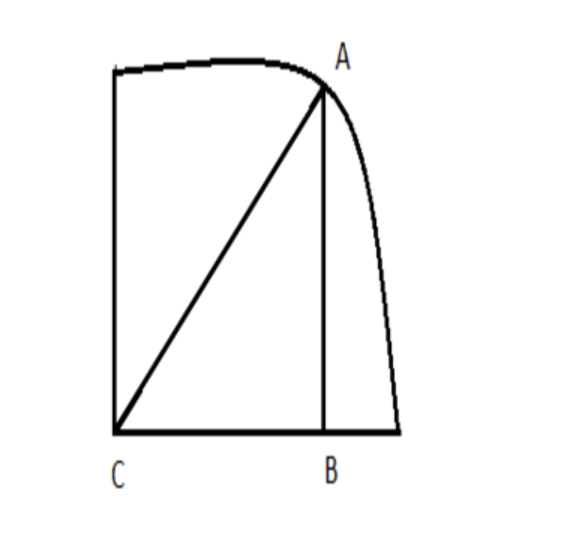
According to Pythagoras theorem
\[A{B^2} + B{C^2} = A{C^2}\]
\[AC = \]hypotenuse
\[AB = \]perpendicular
\[BC = \]base
In trigonometry,
Let \[\angle ACB = \theta \]
\[{\sin ^2}\theta + {\cos ^2}\theta = 1\]
\[\sin \theta = \dfrac{{Perpendicular}}{{Hypotenuse}}\]
\[\cos \theta = \dfrac{{Base}}{{Hypotenuse}}\]
\[\tan \theta = \dfrac{{Perpendicular}}{{Base}}\]
\[\tan \theta = \dfrac{{\sin \theta }}{{\cos \theta }}\]
Complete answer:
It is given that
=\[\dfrac{{Perpendicular}}{{Hypotenuse}}\]
Since,
\[AC = \]hypotenuse
\[AB = \]perpendicular
\[BC = \]base
And,
\[A{B^2} + B{C^2} = A{C^2}\]
We can find the value of the base with this equation and place all the values:
\[B{C^2} = A{C^2} - A{B^2}\]
\[BC = \sqrt {A{C^2} - A{B^2}} \]
\[BC = \sqrt {1 - {a^2}} \]
So the base is \[\sqrt {1 - {a^2}} \]
Now we can find cos value for that same angle \[\theta \], by applying the Pythagoras theorem for trigonometric identities
Since we know, the value of both sin and cos
\[\tan \theta = \dfrac{{\sin \theta }}{{\cos \theta }}\]
So, to find the value of \[\tan \theta \]
And also,
\[\sin ({90^ \circ } - \theta ) = \cos \theta \]
Make sure that the value of minute and second do not exceed $60$.
Now we know the value of and
So adding both we get
Hence, the correct option is (C) \[\dfrac{{a(\sqrt {1 - {a^2}} \, + \,1)}}{{\sqrt {1 - {a^2}} }}\]
Note:
Using the given , we need to apply the Pythagoras theorem. Applying the theorem, we are able to find the value of the base, the perpendicular, and the hypotenuse.
The concept of angle: A circle is divided into \[360\] equal parts. It is known as the degree where there is a sign of negative sign and a degree greater than \[360\] in degree used in trigonometric terms, it is one of the measurement units in angle.
\[{10^ \circ }6'\]
Each minute is then further divided into \[60\] seconds denoted by “, for example
This can be pronounced as “Ten degrees six minutes thirty-two seconds”
Here we are given
To find the required answer, we need to find cos and tan in terms of a using
Formula to be used:
\[\sin ({90^ \circ } - \theta ) = \cos \theta \]
According to Pythagoras theorem
\[A{B^2} + B{C^2} = A{C^2}\]
\[AC = \]hypotenuse
\[AB = \]perpendicular
\[BC = \]base
In trigonometry,
Let \[\angle ACB = \theta \]
\[{\sin ^2}\theta + {\cos ^2}\theta = 1\]
\[\sin \theta = \dfrac{{Perpendicular}}{{Hypotenuse}}\]
\[\cos \theta = \dfrac{{Base}}{{Hypotenuse}}\]
\[\tan \theta = \dfrac{{Perpendicular}}{{Base}}\]
\[\tan \theta = \dfrac{{\sin \theta }}{{\cos \theta }}\]
Complete answer:
It is given that
=\[\dfrac{{Perpendicular}}{{Hypotenuse}}\]
Since,
\[AC = \]hypotenuse
\[AB = \]perpendicular
\[BC = \]base
And,
\[A{B^2} + B{C^2} = A{C^2}\]
We can find the value of the base with this equation and place all the values:
\[B{C^2} = A{C^2} - A{B^2}\]
\[BC = \sqrt {A{C^2} - A{B^2}} \]
\[BC = \sqrt {1 - {a^2}} \]
So the base is \[\sqrt {1 - {a^2}} \]
Now we can find cos value for that same angle \[\theta \], by applying the Pythagoras theorem for trigonometric identities
Since we know, the value of both sin and cos
\[\tan \theta = \dfrac{{\sin \theta }}{{\cos \theta }}\]
So, to find the value of \[\tan \theta \]
And also,
\[\sin ({90^ \circ } - \theta ) = \cos \theta \]
Make sure that the value of minute and second do not exceed $60$.
Now we know the value of and
So adding both we get
Hence, the correct option is (C) \[\dfrac{{a(\sqrt {1 - {a^2}} \, + \,1)}}{{\sqrt {1 - {a^2}} }}\]
Note:
Using the given , we need to apply the Pythagoras theorem. Applying the theorem, we are able to find the value of the base, the perpendicular, and the hypotenuse.
The concept of angle: A circle is divided into \[360\] equal parts. It is known as the degree where there is a sign of negative sign and a degree greater than \[360\] in degree used in trigonometric terms, it is one of the measurement units in angle.
Recently Updated Pages
Master Class 11 Computer Science: Engaging Questions & Answers for Success

Master Class 11 Business Studies: Engaging Questions & Answers for Success
Master Class 11 Economics: Engaging Questions & Answers for Success
Master Class 11 English: Engaging Questions & Answers for Success
Master Class 11 Maths: Engaging Questions & Answers for Success
Master Class 11 Biology: Engaging Questions & Answers for Success
Trending doubts
One Metric ton is equal to kg A 10000 B 1000 C 100 class 11 physics CBSE
There are 720 permutations of the digits 1 2 3 4 5 class 11 maths CBSE
Discuss the various forms of bacteria class 11 biology CBSE
Draw a diagram of a plant cell and label at least eight class 11 biology CBSE
State the laws of reflection of light
Explain zero factorial class 11 maths CBSE