




If the volume of a prism is $1920\sqrt{3}c{{m}^{3}}$and the side of the equilateral base is $16\text{ }cm$, then the height (in cm) of the prism is?
$\begin{align}
& A.\text{ 19} \\
& \text{B}\text{. 20} \\
& \text{C}\text{. 30} \\
& \text{D}\text{. 40} \\
\end{align}$
Answer
 Verified
595.2k+ views
Hint: In the given question volume of a prism and side of the equilateral base is given and we have to find out the height of the prism. So first of all, we have to know about a prism. A prism is a solid whose top and bottom faces are parallel to each other and identical polygons. In the given question the polygon is an equilateral triangle. In a prism if a perpendicular is drawn from the centre of the top face, it passes through the centre of base.
Volume of a prism is equal to the base area multiplied by height of prism.
$V=AH$ where $A$is the base area and $H$ is the height of prism.
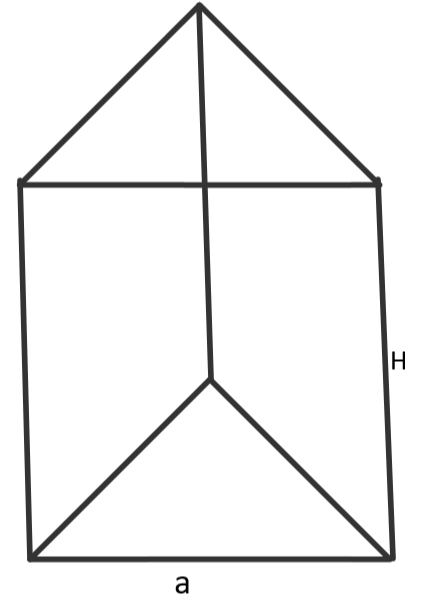
As base of prism is an equilateral triangle so its area can be calculated as
$A=\dfrac{\sqrt{3}}{4}{{a}^{2}}$ where $a$is side of equilateral triangle
So, first calculate the base area of the prism and then use the formula $V=AH$ in order to calculate the height of the prism.
Complete step-by-step answer:
It is given in question side of equilateral base $a=16cm$
So, area of equilateral triangle
$\begin{align}
& A=\dfrac{\sqrt{3}}{4}{{a}^{2}} \\
& A=\dfrac{\sqrt{3}}{4}{{\left( 16 \right)}^{2}} \\
\end{align}$
As we know that volume of prism
$V=AH$
It is given from question
$V=1920\sqrt{3}\text{ }c{{m}^{3}}$
Substituting the given value, we can write
$1920\sqrt{3}\text{ c}{{\text{m}}^{3}}\text{=}\dfrac{\sqrt{3}}{4}{{(16)}^{2}}(H)c{{m}^{2}}$
So, after rearranging we can write
$H=\dfrac{4(1920)(\sqrt{3})c{{m}^{3}}}{\left( \sqrt{3} \right){{(16)}^{2}}c{{m}^{2}}}$
Now we can cancel the common terms we can write
$\begin{align}
& H=\dfrac{1920}{64}cm \\
& H=30cm \\
\end{align}$
Hence the height of the prism is 30 cm. So, option C is correct.
Note: When we talk about prism it means a right prism in general. In such a prism the lateral face of the prism is perpendicular to the base. There are as many lateral faces as there are sides in the base.
Also, \[\text{Lateral Surface area}= \left( \text{Perimeter of base} \right) \left( \text{height of prism} \right)\]
\[\text{Total surface area }=\text{Lateral surface area} +2(\text{Area of base})\]
Volume of a prism is equal to the base area multiplied by height of prism.
$V=AH$ where $A$is the base area and $H$ is the height of prism.
As base of prism is an equilateral triangle so its area can be calculated as
$A=\dfrac{\sqrt{3}}{4}{{a}^{2}}$ where $a$is side of equilateral triangle
So, first calculate the base area of the prism and then use the formula $V=AH$ in order to calculate the height of the prism.
Complete step-by-step answer:
It is given in question side of equilateral base $a=16cm$
So, area of equilateral triangle
$\begin{align}
& A=\dfrac{\sqrt{3}}{4}{{a}^{2}} \\
& A=\dfrac{\sqrt{3}}{4}{{\left( 16 \right)}^{2}} \\
\end{align}$
As we know that volume of prism
$V=AH$
It is given from question
$V=1920\sqrt{3}\text{ }c{{m}^{3}}$
Substituting the given value, we can write
$1920\sqrt{3}\text{ c}{{\text{m}}^{3}}\text{=}\dfrac{\sqrt{3}}{4}{{(16)}^{2}}(H)c{{m}^{2}}$
So, after rearranging we can write
$H=\dfrac{4(1920)(\sqrt{3})c{{m}^{3}}}{\left( \sqrt{3} \right){{(16)}^{2}}c{{m}^{2}}}$
Now we can cancel the common terms we can write
$\begin{align}
& H=\dfrac{1920}{64}cm \\
& H=30cm \\
\end{align}$
Hence the height of the prism is 30 cm. So, option C is correct.
Note: When we talk about prism it means a right prism in general. In such a prism the lateral face of the prism is perpendicular to the base. There are as many lateral faces as there are sides in the base.
Also, \[\text{Lateral Surface area}= \left( \text{Perimeter of base} \right) \left( \text{height of prism} \right)\]
\[\text{Total surface area }=\text{Lateral surface area} +2(\text{Area of base})\]
Recently Updated Pages
Master Class 10 Computer Science: Engaging Questions & Answers for Success

Master Class 10 English: Engaging Questions & Answers for Success
Master Class 10 Social Science: Engaging Questions & Answers for Success
Master Class 10 General Knowledge: Engaging Questions & Answers for Success
Master Class 10 Maths: Engaging Questions & Answers for Success
Master Class 10 Science: Engaging Questions & Answers for Success
Trending doubts
Why is there a time difference of about 5 hours between class 10 social science CBSE
Who Won 36 Oscar Awards? Record Holder Revealed
What is the median of the first 10 natural numbers class 10 maths CBSE
Who gave "Inqilab Zindabad" slogan?
Who was Subhash Chandra Bose Why was he called Net class 10 english CBSE
Write a letter to the principal requesting him to grant class 10 english CBSE