




If the vertices of a triangle are \[\left( {3,2} \right),\] \[\left( { - 4,1} \right)\] and \[\left( { - 5,8} \right)\] then, which of the following is not the orthocentre?
A) \[\left( {4,1} \right)\]
B) \[\left( {4, - 1} \right)\]
C) \[\left( { - 1,4} \right)\]
D) \[\left( { - 4,1} \right)\]
Answer
 Verified
581.1k+ views
Hint: In the question, we are asked to find which are not the orthocentre of the given vertices of the triangle. So we will start with finding the orthocentre of the triangle, for that first we will assume that our orthocentre be (h,k) then on applying the slope formula we get our orthocentre, after that on comparing with the options given, we will get the required answer.
Complete step-by-step answer:
We have been given the vertices of a triangle which are A\[\left( {3,2} \right),\] B\[\left( { - 4,1} \right)\] and C\[\left( { - 5,8} \right),\] we need to find which are not the orthocentre from the given options. So, we will find the orthocentre, and check which are not the orthocentre of the triangle.
Let us understand first with the help of a diagram.
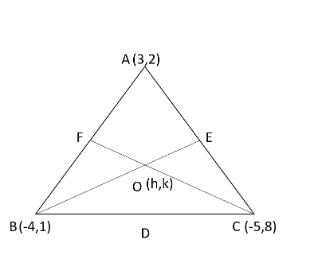
Here, in the diagram O(h,k) is the orthocentre, which is the intersection point of perpendiculars.
To find the orthocentre of the triangle, we will use the formula of slope given below.
Slope $ = \dfrac{{{y_2} - {y_1}}}{{{x_2} - {x_1}}} $
So, slope of line BC $ = \dfrac{{8 - 1}}{{ - 5 + 4}} = \dfrac{{ - 7}}{1} $
Slope of line AC $ = \dfrac{{8 - 2}}{{ - 5 - 3}} = \dfrac{{ - 6}}{8} = \dfrac{{ - 3}}{4} $
Slope of line AB $ = \dfrac{{1 - 2}}{{ - 4 - 3}} = \dfrac{{ - 1}}{{ - 7}} = \dfrac{1}{7} $
Now, OA $ \bot $ BC
Then, (slope of OA)(slope of BC) \[ = {\text{ }} - 1\]
$ (\dfrac{{k - 2}}{{h - 3}})(\dfrac{{ - 7}}{1}) = - 1 $
$
\dfrac{{k - 2}}{{h - 3}} = \dfrac{1}{7} \\
\Rightarrow 7k - 14 = h - 3 \\
\Rightarrow 7k - h = 11....eq.(1) \\
$
Now, OB $ \bot $ AC
Then, (slope of OB)(slope of AC) \[ = {\text{ }} - 1\]
$ (\dfrac{{k - 1}}{{h + 4}})(\dfrac{{ - 3}}{4}) = - 1 $
$
\dfrac{{k - 1}}{{h + 4}} = \dfrac{4}{3} \\
\Rightarrow 3k - 3 = 4h + 16 \\
\Rightarrow 3k - 4h = 19....eq.(2) \\
$
So, we get two equations, $ 7k - h = 11 $ and $ 3k - 4h = 19 $ , now on solving the equations, we get
$
\Rightarrow (7k - h = 11)4 \\
\Rightarrow 3k - 4h = 19 \\
$
$
\Rightarrow 28k - 4h = 44 \\
\Rightarrow 3k - 4h = 19 \\
- - - - - - - - - \\
\Rightarrow 25k = 25 \\
\Rightarrow k = 1 \\
$
On substituting the value of k in \[eq.\left( 2 \right),\]we get
$
\Rightarrow 3(1) - 4h = 19 \\
\Rightarrow 3 - 19 = 4h \\
\Rightarrow h = \dfrac{{ - 16}}{4} \\
\Rightarrow h = - 4 \\
$
So, we get our orthocentre \[\left( { - 4,1} \right).\]
Now on checking with the options, option A), B) and C) are not the orthocentre of the given vertices of the triangle.
Note: There is no direct formula of finding the orthocentre of the triangle, So, we do it by first calculating the slopes of sides of the triangle. Then we take the slope of the perpendicular. We get three equations from it, so, by solving any two of those equations, we can get the orthocentre
Complete step-by-step answer:
We have been given the vertices of a triangle which are A\[\left( {3,2} \right),\] B\[\left( { - 4,1} \right)\] and C\[\left( { - 5,8} \right),\] we need to find which are not the orthocentre from the given options. So, we will find the orthocentre, and check which are not the orthocentre of the triangle.
Let us understand first with the help of a diagram.
Here, in the diagram O(h,k) is the orthocentre, which is the intersection point of perpendiculars.
To find the orthocentre of the triangle, we will use the formula of slope given below.
Slope $ = \dfrac{{{y_2} - {y_1}}}{{{x_2} - {x_1}}} $
So, slope of line BC $ = \dfrac{{8 - 1}}{{ - 5 + 4}} = \dfrac{{ - 7}}{1} $
Slope of line AC $ = \dfrac{{8 - 2}}{{ - 5 - 3}} = \dfrac{{ - 6}}{8} = \dfrac{{ - 3}}{4} $
Slope of line AB $ = \dfrac{{1 - 2}}{{ - 4 - 3}} = \dfrac{{ - 1}}{{ - 7}} = \dfrac{1}{7} $
Now, OA $ \bot $ BC
Then, (slope of OA)(slope of BC) \[ = {\text{ }} - 1\]
$ (\dfrac{{k - 2}}{{h - 3}})(\dfrac{{ - 7}}{1}) = - 1 $
$
\dfrac{{k - 2}}{{h - 3}} = \dfrac{1}{7} \\
\Rightarrow 7k - 14 = h - 3 \\
\Rightarrow 7k - h = 11....eq.(1) \\
$
Now, OB $ \bot $ AC
Then, (slope of OB)(slope of AC) \[ = {\text{ }} - 1\]
$ (\dfrac{{k - 1}}{{h + 4}})(\dfrac{{ - 3}}{4}) = - 1 $
$
\dfrac{{k - 1}}{{h + 4}} = \dfrac{4}{3} \\
\Rightarrow 3k - 3 = 4h + 16 \\
\Rightarrow 3k - 4h = 19....eq.(2) \\
$
So, we get two equations, $ 7k - h = 11 $ and $ 3k - 4h = 19 $ , now on solving the equations, we get
$
\Rightarrow (7k - h = 11)4 \\
\Rightarrow 3k - 4h = 19 \\
$
$
\Rightarrow 28k - 4h = 44 \\
\Rightarrow 3k - 4h = 19 \\
- - - - - - - - - \\
\Rightarrow 25k = 25 \\
\Rightarrow k = 1 \\
$
On substituting the value of k in \[eq.\left( 2 \right),\]we get
$
\Rightarrow 3(1) - 4h = 19 \\
\Rightarrow 3 - 19 = 4h \\
\Rightarrow h = \dfrac{{ - 16}}{4} \\
\Rightarrow h = - 4 \\
$
So, we get our orthocentre \[\left( { - 4,1} \right).\]
Now on checking with the options, option A), B) and C) are not the orthocentre of the given vertices of the triangle.
Note: There is no direct formula of finding the orthocentre of the triangle, So, we do it by first calculating the slopes of sides of the triangle. Then we take the slope of the perpendicular. We get three equations from it, so, by solving any two of those equations, we can get the orthocentre
Recently Updated Pages
Master Class 11 Computer Science: Engaging Questions & Answers for Success

Master Class 11 Business Studies: Engaging Questions & Answers for Success
Master Class 11 Economics: Engaging Questions & Answers for Success
Master Class 11 English: Engaging Questions & Answers for Success
Master Class 11 Maths: Engaging Questions & Answers for Success
Master Class 11 Biology: Engaging Questions & Answers for Success
Trending doubts
One Metric ton is equal to kg A 10000 B 1000 C 100 class 11 physics CBSE
There are 720 permutations of the digits 1 2 3 4 5 class 11 maths CBSE
Discuss the various forms of bacteria class 11 biology CBSE
Draw a diagram of a plant cell and label at least eight class 11 biology CBSE
State the laws of reflection of light
Explain zero factorial class 11 maths CBSE