




If the vertices of a triangle are (1,-3), (4,p) and (-9,7) and its area is 15 sq. units, then find the value (s) of p.
Answer
 Verified
581.1k+ views
Hint: The formula $ar\left( \Delta ABC \right)=\dfrac{1}{2}\left[ {{x}_{1}}\left( {{y}_{2}}-{{y}_{3}} \right)+{{x}_{2}}\left( {{y}_{3}}-{{y}_{1}} \right)+{{x}_{3}}\left( {{y}_{1}}-{{y}_{2}} \right) \right]$ for any three coordinates $A\left( {{x}_{1}},{{y}_{1}} \right),B\left( {{x}_{2}},{{y}_{2}} \right),C\left( {{x}_{3}},{{y}_{3}} \right)$ of a triangle is used to find the value of p after substituting all the given values in the above-mentioned equation.
Complete step by step answer:
Let us consider a triangle ABC with the coordinates A (1, -3), B (4, p) and C (-9,7).
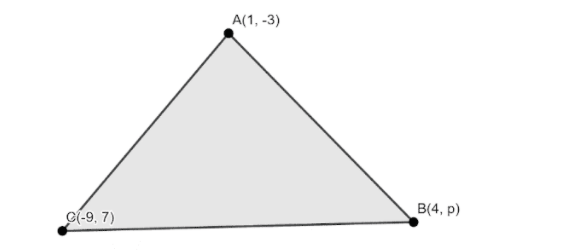
We know, the area of a triangle ABC with the three coordinates $A\left( {{x}_{1}},{{y}_{1}} \right),B\left( {{x}_{2}},{{y}_{2}} \right),C\left( {{x}_{3}},{{y}_{3}} \right)$ is given by the numerical value of the expression
$ar\left( \Delta ABC \right)=\dfrac{1}{2}\left[ {{x}_{1}}\left( {{y}_{2}}-{{y}_{3}} \right)+{{x}_{2}}\left( {{y}_{3}}-{{y}_{1}} \right)+{{x}_{3}}\left( {{y}_{1}}-{{y}_{2}} \right) \right]\ldots \left( i \right)$
Here,
$\begin{align}
& \left( {{x}_{1}},{{y}_{1}} \right)=\left( 1,-3 \right) \\
& \left( {{x}_{2}},{{y}_{2}} \right)=\left( 4,p \right) \\
& \left( {{x}_{3}},{{y}_{3}} \right)=\left( -9,7 \right) \\
& ar\left( \Delta ABC \right)=15 \\
\end{align}$
Substituting these values in equation (i), we get
$15=\dfrac{1}{2}\left[ 1\left( p-7 \right)+4\left( 7-(-3) \right)+-9\left( -3-p \right) \right]$
Solving this, we get
$\begin{align}
& \text{ }\dfrac{1}{2}\left[ \left( p-7 \right)+4\left( 7+3 \right)-9\left( -3-p \right) \right]=15 \\
& \Rightarrow p-7+40+27+9p=30 \\
& \Rightarrow p+9p=30-27+7-40 \\
& \Rightarrow 10p=-30 \\
& \Rightarrow p=-3 \\
\end{align}$
Hence, the value of p is -3.
Note: We should use this formula and do the calculations with utmost care, because a single error will change the answer. Always double-check the formula and calculations after solving. We should keep in mind that area is a measure, that is, it cannot be negative. If the area of a triangle comes out zero, then it means that the three points are collinear points. The best way to remember this formula is to remember the cycle of 1, 2, 3.
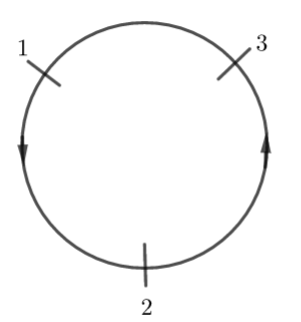
The cycle goes as 1, 2, 3 which means the first expression is ${{x}_{1}}\left( {{y}_{2}}-{{y}_{3}} \right)$.
Then the cycle moves to 2, 3, 1 which means the second expression is ${{x}_{2}}\left( {{y}_{3}}-{{y}_{1}} \right)$. Then the cycle moves further as 3, 2, 1 which means the third expression is ${{x}_{3}}\left( {{y}_{1}}-{{y}_{2}} \right)$. Once we remember these three expressions correctly, then the rest of the formula can be easily remembered.
Complete step by step answer:
Let us consider a triangle ABC with the coordinates A (1, -3), B (4, p) and C (-9,7).
We know, the area of a triangle ABC with the three coordinates $A\left( {{x}_{1}},{{y}_{1}} \right),B\left( {{x}_{2}},{{y}_{2}} \right),C\left( {{x}_{3}},{{y}_{3}} \right)$ is given by the numerical value of the expression
$ar\left( \Delta ABC \right)=\dfrac{1}{2}\left[ {{x}_{1}}\left( {{y}_{2}}-{{y}_{3}} \right)+{{x}_{2}}\left( {{y}_{3}}-{{y}_{1}} \right)+{{x}_{3}}\left( {{y}_{1}}-{{y}_{2}} \right) \right]\ldots \left( i \right)$
Here,
$\begin{align}
& \left( {{x}_{1}},{{y}_{1}} \right)=\left( 1,-3 \right) \\
& \left( {{x}_{2}},{{y}_{2}} \right)=\left( 4,p \right) \\
& \left( {{x}_{3}},{{y}_{3}} \right)=\left( -9,7 \right) \\
& ar\left( \Delta ABC \right)=15 \\
\end{align}$
Substituting these values in equation (i), we get
$15=\dfrac{1}{2}\left[ 1\left( p-7 \right)+4\left( 7-(-3) \right)+-9\left( -3-p \right) \right]$
Solving this, we get
$\begin{align}
& \text{ }\dfrac{1}{2}\left[ \left( p-7 \right)+4\left( 7+3 \right)-9\left( -3-p \right) \right]=15 \\
& \Rightarrow p-7+40+27+9p=30 \\
& \Rightarrow p+9p=30-27+7-40 \\
& \Rightarrow 10p=-30 \\
& \Rightarrow p=-3 \\
\end{align}$
Hence, the value of p is -3.
Note: We should use this formula and do the calculations with utmost care, because a single error will change the answer. Always double-check the formula and calculations after solving. We should keep in mind that area is a measure, that is, it cannot be negative. If the area of a triangle comes out zero, then it means that the three points are collinear points. The best way to remember this formula is to remember the cycle of 1, 2, 3.
The cycle goes as 1, 2, 3 which means the first expression is ${{x}_{1}}\left( {{y}_{2}}-{{y}_{3}} \right)$.
Then the cycle moves to 2, 3, 1 which means the second expression is ${{x}_{2}}\left( {{y}_{3}}-{{y}_{1}} \right)$. Then the cycle moves further as 3, 2, 1 which means the third expression is ${{x}_{3}}\left( {{y}_{1}}-{{y}_{2}} \right)$. Once we remember these three expressions correctly, then the rest of the formula can be easily remembered.
Recently Updated Pages
Master Class 11 Computer Science: Engaging Questions & Answers for Success

Master Class 11 Business Studies: Engaging Questions & Answers for Success
Master Class 11 Economics: Engaging Questions & Answers for Success
Master Class 11 English: Engaging Questions & Answers for Success
Master Class 11 Maths: Engaging Questions & Answers for Success
Master Class 11 Biology: Engaging Questions & Answers for Success
Trending doubts
One Metric ton is equal to kg A 10000 B 1000 C 100 class 11 physics CBSE
There are 720 permutations of the digits 1 2 3 4 5 class 11 maths CBSE
Discuss the various forms of bacteria class 11 biology CBSE
Draw a diagram of a plant cell and label at least eight class 11 biology CBSE
State the laws of reflection of light
Explain zero factorial class 11 maths CBSE