




If the vertex of the parabola is \[\left( 2,0 \right)\] and the extremities of the latus rectum are \[\left( 3,2 \right)\]and \[\left( 3,-2 \right)\] then the equation of the parabola is
\[\begin{align}
& \text{A}\text{. }{{\text{y}}^{2}}=2x-4 \\
& \text{B}\text{. }{{\text{x}}^{2}}=4y-8 \\
& \text{C}\text{. }{{\text{y}}^{2}}=4x-8 \\
& \text{D}\text{. None of these} \\
\end{align}\]
Answer
 Verified
653.7k+ views
Hint: We know that if the latus rectum is perpendicular to y-axis and the vertex of parabola is \[\left( {{x}_{1}},{{y}_{1}} \right)\], then the equation of the parabola is \[{{\left( y-{{y}_{1}} \right)}^{2}}=4a\left( x-{{x}_{1}} \right)\]. In the same way, if the latus rectum is perpendicular to x-axis and the vertex of parabola is \[\left( {{x}_{1}},{{y}_{1}} \right)\], then the equation of the parabola is \[{{\left( x-{{x}_{1}} \right)}^{2}}=4a\left( y-{{y}_{1}} \right)\]. From the question, it is given that the vertex of the parabola is \[\left( 2,0 \right)\] and the extremities of the latus rectum are \[\left( 3,2 \right)\]and \[\left( 3,-2 \right)\]. So, we will find the equation of latus rectum. Then by using the above concept, we will find the equation of parabola.
Complete step-by-step answer:
Before solving the question, we should know that if the latus rectum is perpendicular to y-axis and the vertex of parabola is \[\left( {{x}_{1}},{{y}_{1}} \right)\], then the equation of the parabola is \[{{\left( y-{{y}_{1}} \right)}^{2}}=4a\left( x-{{x}_{1}} \right)\]. In the same way, if the latus rectum is perpendicular to x-axis and the vertex of parabola is \[\left( {{x}_{1}},{{y}_{1}} \right)\], then the equation of the parabola is \[{{\left( x-{{x}_{1}} \right)}^{2}}=4a\left( y-{{y}_{1}} \right)\].
From the question, it is given that the vertex of the parabola is \[\left( 2,0 \right)\] and the extremities of the latus rectum are \[\left( 3,2 \right)\]and \[\left( 3,-2 \right)\].
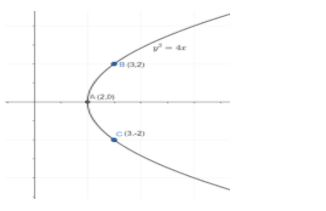
Now we have to find the equation of the latus rectum.
We know that if \[A\left( {{x}_{1}},{{y}_{1}} \right)\] and \[B\left( {{x}_{2}},{{y}_{2}} \right)\] are two points, then the line passing through \[A\left( {{x}_{1}},{{y}_{1}} \right)\] and \[B\left( {{x}_{2}},{{y}_{2}} \right)\] is \[y-{{y}_{1}}=\left( \dfrac{{{y}_{2}}-{{y}_{1}}}{{{x}_{2}}-{{x}_{1}}} \right)\left( x-{{x}_{1}} \right)\].
Now we have to find the equation of line passing through \[\left( 3,2 \right)\]and \[\left( 3,-2 \right)\].
\[\begin{align}
& y-2=\dfrac{-2-2}{3-3}\left( x-3 \right) \\
& \Rightarrow y-2=\dfrac{-4}{0}\left( x-3 \right) \\
& \Rightarrow x=3 \\
\end{align}\]
We know that a line \[x=k\] is perpendicular to the y-axis. Hence, we can say that the latus rectum is perpendicular to y-axis.
We should know that if the latus rectum is perpendicular to y-axis and the vertex of parabola is \[\left( {{x}_{1}},{{y}_{1}} \right)\], then the equation of the parabola is \[{{\left( y-{{y}_{1}} \right)}^{2}}=4a\left( x-{{x}_{1}} \right)\].
So, the equation of parabola whose vertex is \[\left( 2,0 \right)\] is
\[\begin{align}
& {{\left( y-0 \right)}^{2}}=4a\left( x-2 \right) \\
& \Rightarrow {{y}^{2}}=4a\left( x-2 \right).....(1) \\
\end{align}\]
We know that the extremities of the latus rectum passes through the parabola. So, we can say that \[\left( 3,2 \right)\]and \[\left( 3,-2 \right)\] lie on equation (1).
So, let us substitute \[\left( 3,2 \right)\] in equation (1).
\[\begin{align}
& \Rightarrow {{\left( 2 \right)}^{2}}=4a\left( 3-2 \right) \\
& \Rightarrow 4=4\left( a \right) \\
& \Rightarrow a=1....(2) \\
\end{align}\]
Now let us substitute equation (2) in equation (1), then we get
\[\begin{align}
& \Rightarrow {{y}^{2}}=4\left( x-2 \right) \\
& \Rightarrow {{y}^{2}}=4x-8 \\
\end{align}\]
So, the correct answer is “Option C”.
Note: Students may have a misconception that if the latus rectum is perpendicular to x-axis and the vertex of parabola is \[\left( {{x}_{1}},{{y}_{1}} \right)\], then the equation of the parabola is \[{{\left( y-{{y}_{1}} \right)}^{2}}=4a\left( x-{{x}_{1}} \right)\]. In the same way, if the latus rectum is perpendicular to y-axis and the vertex of parabola is \[\left( {{x}_{1}},{{y}_{1}} \right)\], then the equation of the parabola is \[{{\left( x-{{x}_{1}} \right)}^{2}}=4a\left( y-{{y}_{1}} \right)\]. To avoid this conception, students should draw the graph of the parabola. By observing the graph, students may have a clear view.
Complete step-by-step answer:
Before solving the question, we should know that if the latus rectum is perpendicular to y-axis and the vertex of parabola is \[\left( {{x}_{1}},{{y}_{1}} \right)\], then the equation of the parabola is \[{{\left( y-{{y}_{1}} \right)}^{2}}=4a\left( x-{{x}_{1}} \right)\]. In the same way, if the latus rectum is perpendicular to x-axis and the vertex of parabola is \[\left( {{x}_{1}},{{y}_{1}} \right)\], then the equation of the parabola is \[{{\left( x-{{x}_{1}} \right)}^{2}}=4a\left( y-{{y}_{1}} \right)\].
From the question, it is given that the vertex of the parabola is \[\left( 2,0 \right)\] and the extremities of the latus rectum are \[\left( 3,2 \right)\]and \[\left( 3,-2 \right)\].
Now we have to find the equation of the latus rectum.
We know that if \[A\left( {{x}_{1}},{{y}_{1}} \right)\] and \[B\left( {{x}_{2}},{{y}_{2}} \right)\] are two points, then the line passing through \[A\left( {{x}_{1}},{{y}_{1}} \right)\] and \[B\left( {{x}_{2}},{{y}_{2}} \right)\] is \[y-{{y}_{1}}=\left( \dfrac{{{y}_{2}}-{{y}_{1}}}{{{x}_{2}}-{{x}_{1}}} \right)\left( x-{{x}_{1}} \right)\].
Now we have to find the equation of line passing through \[\left( 3,2 \right)\]and \[\left( 3,-2 \right)\].
\[\begin{align}
& y-2=\dfrac{-2-2}{3-3}\left( x-3 \right) \\
& \Rightarrow y-2=\dfrac{-4}{0}\left( x-3 \right) \\
& \Rightarrow x=3 \\
\end{align}\]
We know that a line \[x=k\] is perpendicular to the y-axis. Hence, we can say that the latus rectum is perpendicular to y-axis.
We should know that if the latus rectum is perpendicular to y-axis and the vertex of parabola is \[\left( {{x}_{1}},{{y}_{1}} \right)\], then the equation of the parabola is \[{{\left( y-{{y}_{1}} \right)}^{2}}=4a\left( x-{{x}_{1}} \right)\].
So, the equation of parabola whose vertex is \[\left( 2,0 \right)\] is
\[\begin{align}
& {{\left( y-0 \right)}^{2}}=4a\left( x-2 \right) \\
& \Rightarrow {{y}^{2}}=4a\left( x-2 \right).....(1) \\
\end{align}\]
We know that the extremities of the latus rectum passes through the parabola. So, we can say that \[\left( 3,2 \right)\]and \[\left( 3,-2 \right)\] lie on equation (1).
So, let us substitute \[\left( 3,2 \right)\] in equation (1).
\[\begin{align}
& \Rightarrow {{\left( 2 \right)}^{2}}=4a\left( 3-2 \right) \\
& \Rightarrow 4=4\left( a \right) \\
& \Rightarrow a=1....(2) \\
\end{align}\]
Now let us substitute equation (2) in equation (1), then we get
\[\begin{align}
& \Rightarrow {{y}^{2}}=4\left( x-2 \right) \\
& \Rightarrow {{y}^{2}}=4x-8 \\
\end{align}\]
So, the correct answer is “Option C”.
Note: Students may have a misconception that if the latus rectum is perpendicular to x-axis and the vertex of parabola is \[\left( {{x}_{1}},{{y}_{1}} \right)\], then the equation of the parabola is \[{{\left( y-{{y}_{1}} \right)}^{2}}=4a\left( x-{{x}_{1}} \right)\]. In the same way, if the latus rectum is perpendicular to y-axis and the vertex of parabola is \[\left( {{x}_{1}},{{y}_{1}} \right)\], then the equation of the parabola is \[{{\left( x-{{x}_{1}} \right)}^{2}}=4a\left( y-{{y}_{1}} \right)\]. To avoid this conception, students should draw the graph of the parabola. By observing the graph, students may have a clear view.
Recently Updated Pages
Master Class 11 Social Science: Engaging Questions & Answers for Success

Master Class 11 English: Engaging Questions & Answers for Success
Master Class 11 Accountancy: Engaging Questions & Answers for Success
Master Class 11 Physics: Engaging Questions & Answers for Success
Master Class 11 Computer Science: Engaging Questions & Answers for Success
Master Class 11 Business Studies: Engaging Questions & Answers for Success
Trending doubts
Find the value of the expression given below sin 30circ class 11 maths CBSE
The teeth used for biting and cutting food are called class 11 biology CBSE
Bond order ofO2 O2+ O2 and O22 is in order A O2 langle class 11 chemistry CBSE
Frogs heart when taken out of the body continues to class 11 biology CBSE
10 examples of diffusion in everyday life
Can anyone list 10 advantages and disadvantages of friction