




If the value of \[{{I}_{1}}=\int\limits_{0}^{1}{{{2}^{{{x}^{2}}}}dx}\] and \[{{I}_{2}}=\int\limits_{0}^{1}{{{2}^{{{x}^{3}}}}dx}\] and \[{{I}_{3}}=\int\limits_{1}^{2}{{{2}^{{{x}^{2}}}}dx}\] and \[{{I}_{4}}=\int\limits_{1}^{2}{{{2}^{{{x}^{3}}}}dx}\] then,
\[\left( a \right){{I}_{3}}>{{I}_{4}}\]
\[\left( b \right){{I}_{3}}={{I}_{4}}\]
\[\left( c \right){{I}_{1}}>{{I}_{2}}\]
\[\left( d \right){{I}_{2}}>{{I}_{1}}\]
Answer
 Verified
585k+ views
Hint: To solve this question, we will first consider the integral \[{{I}_{1}}\] and \[{{I}_{2}}\] and observe that the limit of the integral is from 0 to 1, i.e. \[x\in \left[ 0,1 \right)\Rightarrow 0
Complete step-by-step answer:
Let us first find the relation between \[{{I}_{1}}\] and \[{{I}_{2}}.\]
\[{{I}_{1}}=\int\limits_{0}^{1}{{{2}^{{{x}^{2}}}}dx}\]
\[{{I}_{2}}=\int\limits_{0}^{1}{{{2}^{{{x}^{3}}}}dx}\]
Here, as integral varies from 0 to 1, x varies from 0 to 1.
\[\Rightarrow 0\le x\le 1\]
Now, for \[0\le x\le 1\] we have \[{{x}^{2}}>{{x}^{3}}.\]
Example if x = 0.5, then \[{{x}^{2}}={{\left( 0.5 \right)}^{2}}=0.25\] and \[{{x}^{3}}={{\left( 0.5 \right)}^{3}}=0.125\]
So, \[{{x}^{2}}>{{x}^{3}}.\]
Now, as \[{{x}^{2}}>{{x}^{3}}\]
\[\Rightarrow {{2}^{{{x}^{2}}}}>{{2}^{{{x}^{3}}}}\]
Applying the integral on both the sides, we have,
\[\int\limits_{0}^{1}{{{2}^{{{x}^{2}}}}dx}=\int\limits_{0}^{1}{{{2}^{{{x}^{3}}}}dx}\]
\[\Rightarrow {{I}_{1}}>{{I}_{2}}\]
So, we have the option (c) is the correct answer.
Hence, the relation is determined between \[{{I}_{1}}\] and \[{{I}_{2}}.\]
Now, consider \[{{I}_{3}}\] and \[{{I}_{4}}.\]
\[{{I}_{3}}=\int\limits_{1}^{2}{{{2}^{{{x}^{2}}}}dx}\]
\[{{I}_{4}}=\int\limits_{1}^{2}{{{2}^{{{x}^{3}}}}dx}\]
Now, here integral value is between 1 and 2. So, x varies between 1 and 2.
\[\Rightarrow 1\le x\le 2\]
And for this value, \[{{x}^{2}}<{{x}^{3}}\] as \[{{\left( 1.5 \right)}^{2}}<{{\left( 1.5 \right)}^{3}}.\]
\[\Rightarrow {{x}^{2}}<{{x}^{3}}\]
\[\Rightarrow {{2}^{{{x}^{2}}}}<{{2}^{{{x}^{3}}}}\]
Applying integral on both the sides, we get,
\[\Rightarrow \int\limits_{1}^{2}{{{2}^{{{x}^{2}}}}dx}=\int\limits_{1}^{2}{{{2}^{{{x}^{3}}}}dx}\]
\[\Rightarrow {{I}_{3}}<{{I}_{4}}\]
Hence, option (a) is wrong.
So, the correct answer is “Option c”.
Note: A point to note here in this question is now, \[{{x}_{1}}<{{x}_{2}}.\]
\[\Rightarrow {{2}^{{{x}_{1}}}}<{{2}^{{{x}_{2}}}}\]
Consider the function \[{{e}^{x}}\] now as \[e\cong 2.57.\] e and 2 behave similarly. Consider the graph of \[{{e}^{x}}.\]
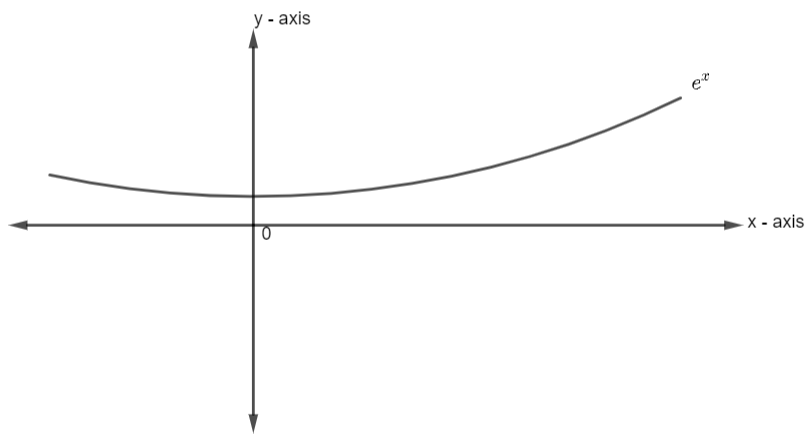
Then we see that for x > 0, if \[{{x}_{1}}>{{x}_{2}},\Rightarrow {{e}^{{{x}_{1}}}}>{{e}^{{{x}_{2}}}}.\] Now, as e and 2 base behaves the same, we can say,
\[\Rightarrow {{x}_{1}}>{{x}_{2}}\]
\[\Rightarrow {{2}^{{{x}_{1}}}}>{{2}^{{{x}_{2}}}}\]
Hence, the confusion is cleared.
Complete step-by-step answer:
Let us first find the relation between \[{{I}_{1}}\] and \[{{I}_{2}}.\]
\[{{I}_{1}}=\int\limits_{0}^{1}{{{2}^{{{x}^{2}}}}dx}\]
\[{{I}_{2}}=\int\limits_{0}^{1}{{{2}^{{{x}^{3}}}}dx}\]
Here, as integral varies from 0 to 1, x varies from 0 to 1.
\[\Rightarrow 0\le x\le 1\]
Now, for \[0\le x\le 1\] we have \[{{x}^{2}}>{{x}^{3}}.\]
Example if x = 0.5, then \[{{x}^{2}}={{\left( 0.5 \right)}^{2}}=0.25\] and \[{{x}^{3}}={{\left( 0.5 \right)}^{3}}=0.125\]
So, \[{{x}^{2}}>{{x}^{3}}.\]
Now, as \[{{x}^{2}}>{{x}^{3}}\]
\[\Rightarrow {{2}^{{{x}^{2}}}}>{{2}^{{{x}^{3}}}}\]
Applying the integral on both the sides, we have,
\[\int\limits_{0}^{1}{{{2}^{{{x}^{2}}}}dx}=\int\limits_{0}^{1}{{{2}^{{{x}^{3}}}}dx}\]
\[\Rightarrow {{I}_{1}}>{{I}_{2}}\]
So, we have the option (c) is the correct answer.
Hence, the relation is determined between \[{{I}_{1}}\] and \[{{I}_{2}}.\]
Now, consider \[{{I}_{3}}\] and \[{{I}_{4}}.\]
\[{{I}_{3}}=\int\limits_{1}^{2}{{{2}^{{{x}^{2}}}}dx}\]
\[{{I}_{4}}=\int\limits_{1}^{2}{{{2}^{{{x}^{3}}}}dx}\]
Now, here integral value is between 1 and 2. So, x varies between 1 and 2.
\[\Rightarrow 1\le x\le 2\]
And for this value, \[{{x}^{2}}<{{x}^{3}}\] as \[{{\left( 1.5 \right)}^{2}}<{{\left( 1.5 \right)}^{3}}.\]
\[\Rightarrow {{x}^{2}}<{{x}^{3}}\]
\[\Rightarrow {{2}^{{{x}^{2}}}}<{{2}^{{{x}^{3}}}}\]
Applying integral on both the sides, we get,
\[\Rightarrow \int\limits_{1}^{2}{{{2}^{{{x}^{2}}}}dx}=\int\limits_{1}^{2}{{{2}^{{{x}^{3}}}}dx}\]
\[\Rightarrow {{I}_{3}}<{{I}_{4}}\]
Hence, option (a) is wrong.
So, the correct answer is “Option c”.
Note: A point to note here in this question is now, \[{{x}_{1}}<{{x}_{2}}.\]
\[\Rightarrow {{2}^{{{x}_{1}}}}<{{2}^{{{x}_{2}}}}\]
Consider the function \[{{e}^{x}}\] now as \[e\cong 2.57.\] e and 2 behave similarly. Consider the graph of \[{{e}^{x}}.\]
Then we see that for x > 0, if \[{{x}_{1}}>{{x}_{2}},\Rightarrow {{e}^{{{x}_{1}}}}>{{e}^{{{x}_{2}}}}.\] Now, as e and 2 base behaves the same, we can say,
\[\Rightarrow {{x}_{1}}>{{x}_{2}}\]
\[\Rightarrow {{2}^{{{x}_{1}}}}>{{2}^{{{x}_{2}}}}\]
Hence, the confusion is cleared.
Recently Updated Pages
Master Class 12 English: Engaging Questions & Answers for Success

Master Class 12 Social Science: Engaging Questions & Answers for Success
Master Class 12 Maths: Engaging Questions & Answers for Success
Master Class 12 Economics: Engaging Questions & Answers for Success
Master Class 12 Physics: Engaging Questions & Answers for Success
Master Class 12 Business Studies: Engaging Questions & Answers for Success
Trending doubts
Draw the diagram showing the germination of pollen class 12 biology CBSE
Draw a neat and well labeled diagram of TS of ovary class 12 biology CBSE
Differentiate between homogeneous and heterogeneous class 12 chemistry CBSE
Write the different structural and functional differences class 12 chemistry CBSE
Explain the process of emasculation and bagging of class 12 biology CBSE
What is Saheb looking for in the garbage dump Where class 12 english CBSE