



If the total surface area of a cylinder is S and height and radius are represented as h and r, then calculate the value of h, when S $=$ 198 and r $=$ 35. (Take $\pi $ to be $\dfrac{22}{7}$ ).
A.2.5
B.5.5
C.7.2
D.9
Answer
 Verified
613.5k+ views
Hint: Total surface area of a cylinder consist of the curved surface area and base area of both the circle, it is given by the formula as
$=2\pi rh+2\pi {{r}^{2}}$
The total surface area from here i.e. using above formula and equate it to given value i.e. ‘S’.
Complete step by step answer:
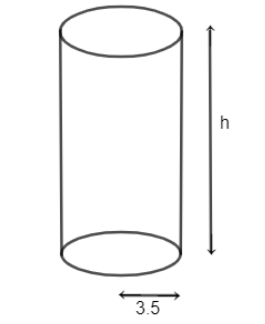
We know the total surface area of the cylinder will include curved surface area and base area of both circles as well. So, we can get (TSA) total surface area of cylinder as
TSA $=2\pi rh+2\pi {{r}^{2}}$ …………………………..(i)
Where r is the radius of the cylinder.
Now, we know the total surface area of the cylinder is given as S i.e. 198 and radius is given as r i.e. 3.5. So, we can calculate total surface area of the cylinder by the equation(i) by putting values of r and h, and hence, equate it to given surface area S. So, we know
$S=198$
$r=3.5$
Hence, TSA of the cylinder is given as
TSA $=2\pi rh+2\pi {{r}^{2}}$
TSA $=2\pi r\left( h+r \right)$
TSA $=2\times \dfrac{22}{7}\times 3.5\left( h+3.5 \right)$ ………………………………….(i)
Now, we can put the total surface area (TSA) of the cylinder as 198, as given in the question. So, we get
$198=2\times \dfrac{22}{7}\times 3.5\left( h+3.5 \right)$
$198=44\times 0.5\left( h+3.5 \right)$
Now, dividing the whole equation by $44\times 0.5$ , we get
$\dfrac{198}{44\times 0.5}=\dfrac{44\times 0.5}{44\times 0.5}\left( h+3.5 \right)$
$\dfrac{198}{22}=1\left( h+3.5 \right)$
$9=h+3.5$
Now, subtract 3.5 from both sides of the equation, we get
$9-3.5=h+3.5-3.5$
$h=5.5m$
So, the height of the cylinder with the given condition is 5.5 m. Therefore, option (B) is correct.
Note: ‘S’ is representing the total surface area of cylinder, so involve the base area of two circles is must, otherwise answer will be wrong and hence, don’t use formula of curved surface area of cylinder i.e. $2\pi rh$ , in place of $\pi {{r}^{2}}h$. So, be clear with the identities and relations.
Don’t use the formula of area of any other solid. As one may use the formula of area of sphere or cone etc, which is wrong. So, be clear and remember the formula of all of them.
$=2\pi rh+2\pi {{r}^{2}}$
The total surface area from here i.e. using above formula and equate it to given value i.e. ‘S’.
Complete step by step answer:
We know the total surface area of the cylinder will include curved surface area and base area of both circles as well. So, we can get (TSA) total surface area of cylinder as
TSA $=2\pi rh+2\pi {{r}^{2}}$ …………………………..(i)
Where r is the radius of the cylinder.
Now, we know the total surface area of the cylinder is given as S i.e. 198 and radius is given as r i.e. 3.5. So, we can calculate total surface area of the cylinder by the equation(i) by putting values of r and h, and hence, equate it to given surface area S. So, we know
$S=198$
$r=3.5$
Hence, TSA of the cylinder is given as
TSA $=2\pi rh+2\pi {{r}^{2}}$
TSA $=2\pi r\left( h+r \right)$
TSA $=2\times \dfrac{22}{7}\times 3.5\left( h+3.5 \right)$ ………………………………….(i)
Now, we can put the total surface area (TSA) of the cylinder as 198, as given in the question. So, we get
$198=2\times \dfrac{22}{7}\times 3.5\left( h+3.5 \right)$
$198=44\times 0.5\left( h+3.5 \right)$
Now, dividing the whole equation by $44\times 0.5$ , we get
$\dfrac{198}{44\times 0.5}=\dfrac{44\times 0.5}{44\times 0.5}\left( h+3.5 \right)$
$\dfrac{198}{22}=1\left( h+3.5 \right)$
$9=h+3.5$
Now, subtract 3.5 from both sides of the equation, we get
$9-3.5=h+3.5-3.5$
$h=5.5m$
So, the height of the cylinder with the given condition is 5.5 m. Therefore, option (B) is correct.
Note: ‘S’ is representing the total surface area of cylinder, so involve the base area of two circles is must, otherwise answer will be wrong and hence, don’t use formula of curved surface area of cylinder i.e. $2\pi rh$ , in place of $\pi {{r}^{2}}h$. So, be clear with the identities and relations.
Don’t use the formula of area of any other solid. As one may use the formula of area of sphere or cone etc, which is wrong. So, be clear and remember the formula of all of them.
Recently Updated Pages
Master Class 9 General Knowledge: Engaging Questions & Answers for Success

Master Class 9 Social Science: Engaging Questions & Answers for Success
Master Class 9 English: Engaging Questions & Answers for Success
Master Class 9 Maths: Engaging Questions & Answers for Success
Master Class 9 Science: Engaging Questions & Answers for Success
Class 9 Question and Answer - Your Ultimate Solutions Guide
Trending doubts
Difference Between Plant Cell and Animal Cell
Fill the blanks with the suitable prepositions 1 The class 9 english CBSE
Who is eligible for RTE class 9 social science CBSE
Which places in India experience sunrise first and class 9 social science CBSE
What is pollution? How many types of pollution? Define it
Name 10 Living and Non living things class 9 biology CBSE