




If the total surface area of a cube is $150c{{m}^{2}}$ , find the edge.
Answer
 Verified
648k+ views
Hint: In order to solve this problem, we need to find the formula of the surface area of the cube in terms of the side of the cube. The formula for the surface area of the cube is given by $\text{Surface area}=6\times {{\left( x \right)}^{2}}$ , where x is the side of the cube. Also, the formula for the area of the square is given by $\text{Area = }{{\left( \text{side} \right)}^{\text{2}}}$ .
Complete step by step answer:
We are given the surface area of the cube.
And we are asked to find the side of the cube.
Let's formulate the surface area in terms of the side of the cube.
Let the side of the cube be x cm.
It can be shown as follows,
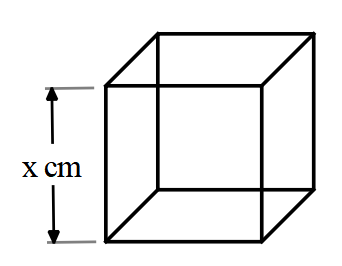
We can see from the diagram a cube is formed by 6 faces.
The six faces are as follows, front, back, left, right, top, bottom.
The property of the cube is that the cube has all the sides of the same length.
Also, we can see that each side of the cube is square.
We already know the area of the square.
Area of the square is given by $\text{Area = }{{\left( \text{side} \right)}^{\text{2}}}$ .
The surface area of the cube is, in fact, the area surrounds the cube.
As it seems that the cube is surrounded by 6 faces.
Hence the surface area would be the sum of all the 6 faces.
Hence, we can say that,
$\text{Surface area}=6\times \text{area of square}$
We also know the area of the square, hence, substituting it we get,
$\text{Surface area}=6\times {{\left( x \right)}^{2}}$
Substituting the values of surface area, we get,
$150=6\times {{x}^{2}}$
Solving the equation, we get,
${{x}^{2}}=\dfrac{150}{6}=25$ .
Taking square root on both sides we get,
x = 25 cm.
Hence, the edge of the cube is 5 cm.
Note: We need to count the sides of the cube properly. Also, in the end, while taking the square root there are two possibilities, that is +5 and -5. But we instead choose +5 because it is the distance of the cube and it can never be negative.
Complete step by step answer:
We are given the surface area of the cube.
And we are asked to find the side of the cube.
Let's formulate the surface area in terms of the side of the cube.
Let the side of the cube be x cm.
It can be shown as follows,
We can see from the diagram a cube is formed by 6 faces.
The six faces are as follows, front, back, left, right, top, bottom.
The property of the cube is that the cube has all the sides of the same length.
Also, we can see that each side of the cube is square.
We already know the area of the square.
Area of the square is given by $\text{Area = }{{\left( \text{side} \right)}^{\text{2}}}$ .
The surface area of the cube is, in fact, the area surrounds the cube.
As it seems that the cube is surrounded by 6 faces.
Hence the surface area would be the sum of all the 6 faces.
Hence, we can say that,
$\text{Surface area}=6\times \text{area of square}$
We also know the area of the square, hence, substituting it we get,
$\text{Surface area}=6\times {{\left( x \right)}^{2}}$
Substituting the values of surface area, we get,
$150=6\times {{x}^{2}}$
Solving the equation, we get,
${{x}^{2}}=\dfrac{150}{6}=25$ .
Taking square root on both sides we get,
x = 25 cm.
Hence, the edge of the cube is 5 cm.
Note: We need to count the sides of the cube properly. Also, in the end, while taking the square root there are two possibilities, that is +5 and -5. But we instead choose +5 because it is the distance of the cube and it can never be negative.
Recently Updated Pages
Class 10 Question and Answer - Your Ultimate Solutions Guide

Master Class 10 Computer Science: Engaging Questions & Answers for Success
Master Class 10 General Knowledge: Engaging Questions & Answers for Success
Master Class 12 Economics: Engaging Questions & Answers for Success
Master Class 12 Social Science: Engaging Questions & Answers for Success
Master Class 12 English: Engaging Questions & Answers for Success
Trending doubts
Explain the Treaty of Vienna of 1815 class 10 social science CBSE
The slogan Jai Hind was given by A Lal Bahadur Shastri class 10 social science CBSE
10 examples of evaporation in daily life with explanations
What is the full form of POSCO class 10 social science CBSE
Five things I will do to build a great India class 10 english CBSE
Identify the feminine form of noun nephew a shenephew class 10 english CBSE