




If the top P of a mountain is observed from A and B at the sea level. IF N is the point vertically below P and ($\angle NAB = \alpha ,\angle NBA = \beta ,\angle NAP = \theta ,\angle NBP = \phi $), then show that,
$\cot \phi \sin \beta = \cot \theta \sin \alpha $.
Answer
 Verified
674.7k+ views
Hint: In this particular type of question first draw the pictorial representation of the problem it will give us a clear picture of what we have to calculate and use the concept that in a right angle triangle tan is the ratio of the perpendicular to base so use these concepts to reach the solution of the question.
Complete step by step solution:
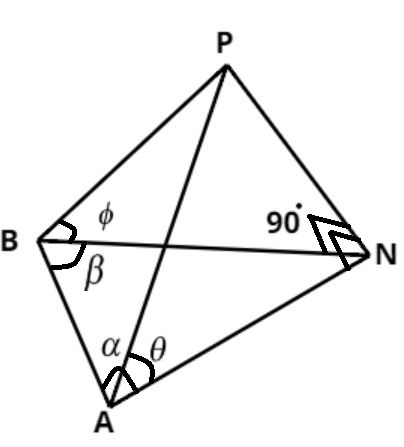
The 2 – D, graphical representation of the above problem is shown above.
A and B are the observers from which top P of the mountain is observed (see figure).
Now it is given that N is a point vertically below P therefore, it makes a 90 degrees with the observer (i.e. angle PNA and PNB are equal to 90 degrees, i.e. PN, NA and NB are all perpendicular to each other in three dimensional) as shown in the above figure.
Now it is given that,
$\angle NAB = \alpha ,\angle NBA = \beta ,\angle NAP = \theta ,\angle NBP = \phi $ (See figure).
Now in triangle PNA, tan is the ratio of perpendicular to the base,
So $\tan \theta = \dfrac{{PN}}{{AN}}$
Therefore, $AN = \dfrac{{PN}}{{\tan \theta }}$
Now as we all know that tan = (1/cot) so we have,
$ \Rightarrow AN = PN\cot \theta $................. (1)
Now in triangle PNB, tan is the ratio of perpendicular to the base,
So $\tan \phi = \dfrac{{PN}}{{BN}}$
Therefore, $BN = \dfrac{{PN}}{{\tan \phi }}$
Now as we all know that tan = (1/cot) so we have,
$ \Rightarrow BN = PN\cot \phi $................. (2)
Now in triangle ABN apply sine rule, i.e. the ratio of the side to the opposite sin angle is always equal.
$ \Rightarrow \dfrac{{AN}}{{\sin \beta }} = \dfrac{{BN}}{{\sin \alpha }}$
Now from equation (1) and (2) substitute the value of AN and BN in the above equation we have,
$ \Rightarrow \dfrac{{PN\cot \theta }}{{\sin \beta }} = \dfrac{{PN\cot \phi }}{{\sin \alpha }}$
Now simplify the above equation we have,
$ \Rightarrow \dfrac{{\cot \theta }}{{\sin \beta }} = \dfrac{{\cot \phi }}{{\sin \alpha }}$
$ \Rightarrow \cot \phi \sin \beta = \cot \theta \sin \alpha $
So this is the required answer.
Hence proved.
Note: Whenever we face such types of questions the key concept we have to remember is that in any triangle the ratio of the side to the opposite sin angle is always equal so first calculate the length of AN and BN as above then apply sin rule in triangle ABN and simplify as above we will get the required result.
Complete step by step solution:
The 2 – D, graphical representation of the above problem is shown above.
A and B are the observers from which top P of the mountain is observed (see figure).
Now it is given that N is a point vertically below P therefore, it makes a 90 degrees with the observer (i.e. angle PNA and PNB are equal to 90 degrees, i.e. PN, NA and NB are all perpendicular to each other in three dimensional) as shown in the above figure.
Now it is given that,
$\angle NAB = \alpha ,\angle NBA = \beta ,\angle NAP = \theta ,\angle NBP = \phi $ (See figure).
Now in triangle PNA, tan is the ratio of perpendicular to the base,
So $\tan \theta = \dfrac{{PN}}{{AN}}$
Therefore, $AN = \dfrac{{PN}}{{\tan \theta }}$
Now as we all know that tan = (1/cot) so we have,
$ \Rightarrow AN = PN\cot \theta $................. (1)
Now in triangle PNB, tan is the ratio of perpendicular to the base,
So $\tan \phi = \dfrac{{PN}}{{BN}}$
Therefore, $BN = \dfrac{{PN}}{{\tan \phi }}$
Now as we all know that tan = (1/cot) so we have,
$ \Rightarrow BN = PN\cot \phi $................. (2)
Now in triangle ABN apply sine rule, i.e. the ratio of the side to the opposite sin angle is always equal.
$ \Rightarrow \dfrac{{AN}}{{\sin \beta }} = \dfrac{{BN}}{{\sin \alpha }}$
Now from equation (1) and (2) substitute the value of AN and BN in the above equation we have,
$ \Rightarrow \dfrac{{PN\cot \theta }}{{\sin \beta }} = \dfrac{{PN\cot \phi }}{{\sin \alpha }}$
Now simplify the above equation we have,
$ \Rightarrow \dfrac{{\cot \theta }}{{\sin \beta }} = \dfrac{{\cot \phi }}{{\sin \alpha }}$
$ \Rightarrow \cot \phi \sin \beta = \cot \theta \sin \alpha $
So this is the required answer.
Hence proved.
Note: Whenever we face such types of questions the key concept we have to remember is that in any triangle the ratio of the side to the opposite sin angle is always equal so first calculate the length of AN and BN as above then apply sin rule in triangle ABN and simplify as above we will get the required result.
Recently Updated Pages
Master Class 10 Computer Science: Engaging Questions & Answers for Success

Differentiate between voluntary action and reflex class 10 biology CBSE
The uses of bleaching powder are A It is used bleaching class 10 chemistry CBSE
Fill in the blanks with abstract nouns of the words class 10 english CBSE
How many threedigit numbers are there class 10 maths CBSE
What is a reflex arc class 10 biology CBSE
Trending doubts
Explain the Treaty of Vienna of 1815 class 10 social science CBSE
10 examples of evaporation in daily life with explanations
Which country is known as "The land of Fire and Ice"?
What is the full form of POSCO class 10 social science CBSE
Make a sketch of the human nerve cell What function class 10 biology CBSE
In which year voting age was reduced from 21 to 18?