




If the tissue has at a given time 1024 cells, how many cycles of mitosis had the original parental single-cell undergone?
(a)512
(b)10
(c)1024
(d)256
Answer
 Verified
586.8k+ views
Hint: The cycles of mitosis that occurs in the original parental single-cell can be calculated with the formula having 2 with the power of a number of cycles, that in turn gives the number of the daughter of daughter cells, written as ${ 2 }^{ n }{ quad =\quad \text{number of daughter cells}\quad }$.
Complete answer:
The mitosis in each of its cycles produces two daughter cells. So, the number of cycles required for the production of 1024 daughter cells can be calculated with the help of the formula ${ 2 }^{ n }{ \quad =\quad \text{number of daughter cells}\quad }$, where n - is the number of cycles taking place. Placing n = 10, we will get ${ 2 }^{ 10 }{ \quad =\quad 1024\quad }$.
Additional Information: -Mitosis is the process that divides a single cell into two identical cells and occurs in eukaryotic cells. It occurs in the nucleus of the body’s normal cells, which is also called as the somatic cells. The body uses mitosis to create new cells and replace old and damaged cells.
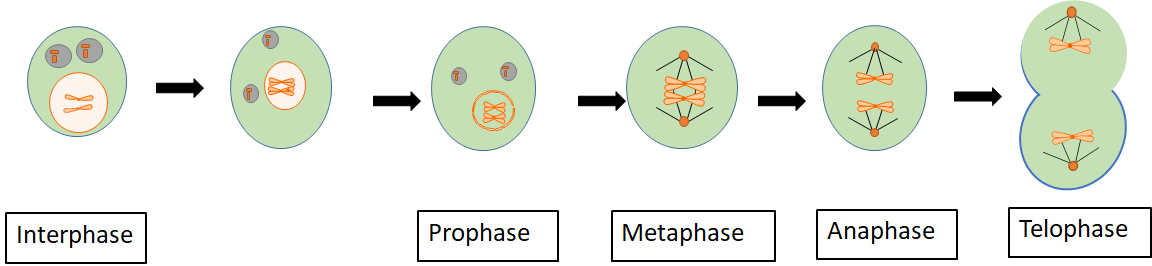
-The process of mitosis is divided into several stages, they are prophase, metaphase, anaphase, and telophase. At the time of meiosis, the chromosomes pull each copy of the chromosome to the opposite poles of the cell. These chromosomes have undergone various processes including duplication, condensation, and lastly attachment to the spindle fibers. The division will result in the formation of the two identical daughter cells.
-The mitosis is classified into two types: open mitosis and closed mitosis. The open mitosis occurs in the animal cell where the chromosome separation is followed by the breaking of the nuclear envelope while the closed mitosis is found in fungi where the chromosomes separate along with the nuclear envelope.
So, the correct answer is ‘10’.
Note: The term mitosis was coined in 1882 by Walther Flemming. The term was derived from the Greek word mitos meaning ‘warp thread'. Another term karyokinesis was introduced in 1878 by Schleicher or equational division coined in 1887 by August Weismann. The term prophase is a Greek word meaning ‘before stage’. In 1873, the mitosis as a cell division was first discovered in certain animal cells including frog, rabbit, and car cornea cells. In 1875, the Polish histologist Waclaw Mayzel first described the process of mitosis. It occurs mostly in the eukaryotic cells. Prokaryotic cells that lack a nucleus, divide by a different process called binary fission.
Complete answer:
The mitosis in each of its cycles produces two daughter cells. So, the number of cycles required for the production of 1024 daughter cells can be calculated with the help of the formula ${ 2 }^{ n }{ \quad =\quad \text{number of daughter cells}\quad }$, where n - is the number of cycles taking place. Placing n = 10, we will get ${ 2 }^{ 10 }{ \quad =\quad 1024\quad }$.
Additional Information: -Mitosis is the process that divides a single cell into two identical cells and occurs in eukaryotic cells. It occurs in the nucleus of the body’s normal cells, which is also called as the somatic cells. The body uses mitosis to create new cells and replace old and damaged cells.
-The process of mitosis is divided into several stages, they are prophase, metaphase, anaphase, and telophase. At the time of meiosis, the chromosomes pull each copy of the chromosome to the opposite poles of the cell. These chromosomes have undergone various processes including duplication, condensation, and lastly attachment to the spindle fibers. The division will result in the formation of the two identical daughter cells.
-The mitosis is classified into two types: open mitosis and closed mitosis. The open mitosis occurs in the animal cell where the chromosome separation is followed by the breaking of the nuclear envelope while the closed mitosis is found in fungi where the chromosomes separate along with the nuclear envelope.
So, the correct answer is ‘10’.
Note: The term mitosis was coined in 1882 by Walther Flemming. The term was derived from the Greek word mitos meaning ‘warp thread'. Another term karyokinesis was introduced in 1878 by Schleicher or equational division coined in 1887 by August Weismann. The term prophase is a Greek word meaning ‘before stage’. In 1873, the mitosis as a cell division was first discovered in certain animal cells including frog, rabbit, and car cornea cells. In 1875, the Polish histologist Waclaw Mayzel first described the process of mitosis. It occurs mostly in the eukaryotic cells. Prokaryotic cells that lack a nucleus, divide by a different process called binary fission.
Recently Updated Pages
Master Class 11 Computer Science: Engaging Questions & Answers for Success

Master Class 11 Business Studies: Engaging Questions & Answers for Success
Master Class 11 Economics: Engaging Questions & Answers for Success
Master Class 11 English: Engaging Questions & Answers for Success
Master Class 11 Maths: Engaging Questions & Answers for Success
Master Class 11 Biology: Engaging Questions & Answers for Success
Trending doubts
One Metric ton is equal to kg A 10000 B 1000 C 100 class 11 physics CBSE
There are 720 permutations of the digits 1 2 3 4 5 class 11 maths CBSE
Discuss the various forms of bacteria class 11 biology CBSE
Draw a diagram of a plant cell and label at least eight class 11 biology CBSE
State the laws of reflection of light
Explain zero factorial class 11 maths CBSE