




If the tangent to the curve, $y={{x}^{3}}+ax-b$ at the point $\left( 1,-5 \right)$ is perpendicular to the line, $-x+y+4=0$ , then which one of the following points lies on the curve?
A. \[\left( -2,2 \right)\]
B. \[\left( 2,-2 \right)\]
C. \[\left( 2,-1 \right)\]
D. \[\left( -2,1 \right)\]
Answer
 Verified
650.1k+ views
Hint: We will start by finding the relation between b and a , this we will do by putting the point $\left( 1,-5 \right)$ in the equation of the curve given in the question. Then we will find the slopes of the tangent at this point and of the line given in the question, we will then apply the condition of perpendicularity on both these slopes and find the value of a and eventually b. Finally we get the equation of the curve and then we will check putting points from the options given and get the answer.
Complete step by step answer:
We are given the equation of curve: $y={{x}^{3}}+ax-b\text{ }.......\text{ Equation 1}\text{.}$ Now given that point $\left( 1,-5 \right)$ lies on the curve as tangent is at that point, therefore we will put this point in the equation no. 1, we have:
$\begin{align}
& \Rightarrow y={{x}^{3}}+ax-b \\
& \Rightarrow \left( -5 \right)={{\left( 1 \right)}^{3}}+a\left( 1 \right)-b\Rightarrow -5=1+a-b \\
& \Rightarrow b-a=6\text{ }........\text{Equation 2}\text{.} \\
\end{align}$
Now we will find the slope ${{m}_{1}}$ of tangent to the curve$y={{x}^{3}}+ax-b$:
${{m}_{1}}=\dfrac{dy}{dx}=~\dfrac{d\left( {{x}^{3}}+ax-b \right)}{dx}$
We will apply the power rule for differentiation that is : $f\left( x \right)={{x}^{n}}\Rightarrow f'\left( x \right)=n{{x}^{n-1}}$
$\therefore {{m}_{1}}=\dfrac{dy}{dx}=~\dfrac{d\left( {{x}^{3}}+ax-b \right)}{dx}\Rightarrow \dfrac{dy}{dx}=~3{{x}^{2}}+a$
We will find the slope at point $\left( 1,-5 \right)$
$\begin{align}
& \Rightarrow {{\left[ {{m}_{1}} \right]}_{\left( 1,-5 \right)}}={{\left[ 3{{x}^{2}}+a \right]}_{\left( 1,-5 \right)}}\Rightarrow {{\left[ {{m}_{1}} \right]}_{\left( 1,-5 \right)}}=3\times {{\left( 1 \right)}^{2}}+a \\
& \Rightarrow {{\left[ {{m}_{1}} \right]}_{\left( 1,-5 \right)}}=3+a \\
\end{align}$
Now we will find the slope ${{m}_{2}}$ of the line given in the question \[-x+y+4=0\]
$\begin{align}
& -x+y+4=0\Rightarrow y=x-4 \\
& {{m}_{2}}=\dfrac{dy}{dx}=1\Rightarrow {{m}_{2}}=1 \\
& \\
\end{align}$
Now we are given that tangent having slope ${{m}_{1}}=a+3$ at the point $\left( 1,-5 \right)$ is perpendicular to the line \[-x+y+4=0\] whose slope is ${{m}_{2}}=1$.
Now we know that according to the condition of perpendicularity, the product of the slopes of the lines is -1 which are perpendicular to each other.
Therefore: ${{m}_{1}}{{m}_{2}}=-1$ now we will be putting values of ${{m}_{1}}$ and ${{m}_{2}}$ in this condition that is ${{m}_{1}}=a+3$ and ${{m}_{2}}=1$:
$\begin{align}
& {{m}_{1}}{{m}_{2}}=-1 \\
& \Rightarrow \left( a+3 \right)\left( 1 \right)=-1\Rightarrow a+3=-1\Rightarrow a=-4 \\
\end{align}$
Now we will put this value of $a$ in equation 2 that is $b-a=6$ ,
$b=6+a\Rightarrow b=6+\left( -4 \right)\Rightarrow b=2$
We got the value of $a=-4$ and $b=2$ , we will now put these values in equation 1 that is $y={{x}^{3}}+ax-b\Rightarrow y={{x}^{3}}+\left( -4 \right)x-\left( 2 \right)\Rightarrow y={{x}^{3}}-4x-2$
So we have the equation of curve: $y={{x}^{3}}-4x-2$
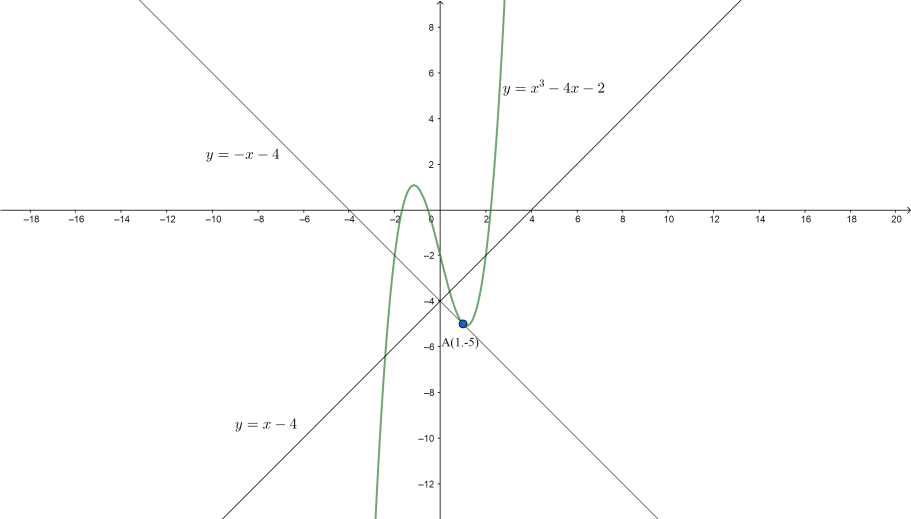
Now, from options we will check and we will find that: $\left( 2,-2 \right)$ lies on it.
So, the correct answer is “Option B”.
Note: When you check the points by putting them in the equation of curve, take care of the sign students can make mistakes there. Note that when it is given that point lies on a given curve that means it will satisfy the given equation.
Complete step by step answer:
We are given the equation of curve: $y={{x}^{3}}+ax-b\text{ }.......\text{ Equation 1}\text{.}$ Now given that point $\left( 1,-5 \right)$ lies on the curve as tangent is at that point, therefore we will put this point in the equation no. 1, we have:
$\begin{align}
& \Rightarrow y={{x}^{3}}+ax-b \\
& \Rightarrow \left( -5 \right)={{\left( 1 \right)}^{3}}+a\left( 1 \right)-b\Rightarrow -5=1+a-b \\
& \Rightarrow b-a=6\text{ }........\text{Equation 2}\text{.} \\
\end{align}$
Now we will find the slope ${{m}_{1}}$ of tangent to the curve$y={{x}^{3}}+ax-b$:
${{m}_{1}}=\dfrac{dy}{dx}=~\dfrac{d\left( {{x}^{3}}+ax-b \right)}{dx}$
We will apply the power rule for differentiation that is : $f\left( x \right)={{x}^{n}}\Rightarrow f'\left( x \right)=n{{x}^{n-1}}$
$\therefore {{m}_{1}}=\dfrac{dy}{dx}=~\dfrac{d\left( {{x}^{3}}+ax-b \right)}{dx}\Rightarrow \dfrac{dy}{dx}=~3{{x}^{2}}+a$
We will find the slope at point $\left( 1,-5 \right)$
$\begin{align}
& \Rightarrow {{\left[ {{m}_{1}} \right]}_{\left( 1,-5 \right)}}={{\left[ 3{{x}^{2}}+a \right]}_{\left( 1,-5 \right)}}\Rightarrow {{\left[ {{m}_{1}} \right]}_{\left( 1,-5 \right)}}=3\times {{\left( 1 \right)}^{2}}+a \\
& \Rightarrow {{\left[ {{m}_{1}} \right]}_{\left( 1,-5 \right)}}=3+a \\
\end{align}$
Now we will find the slope ${{m}_{2}}$ of the line given in the question \[-x+y+4=0\]
$\begin{align}
& -x+y+4=0\Rightarrow y=x-4 \\
& {{m}_{2}}=\dfrac{dy}{dx}=1\Rightarrow {{m}_{2}}=1 \\
& \\
\end{align}$
Now we are given that tangent having slope ${{m}_{1}}=a+3$ at the point $\left( 1,-5 \right)$ is perpendicular to the line \[-x+y+4=0\] whose slope is ${{m}_{2}}=1$.
Now we know that according to the condition of perpendicularity, the product of the slopes of the lines is -1 which are perpendicular to each other.
Therefore: ${{m}_{1}}{{m}_{2}}=-1$ now we will be putting values of ${{m}_{1}}$ and ${{m}_{2}}$ in this condition that is ${{m}_{1}}=a+3$ and ${{m}_{2}}=1$:
$\begin{align}
& {{m}_{1}}{{m}_{2}}=-1 \\
& \Rightarrow \left( a+3 \right)\left( 1 \right)=-1\Rightarrow a+3=-1\Rightarrow a=-4 \\
\end{align}$
Now we will put this value of $a$ in equation 2 that is $b-a=6$ ,
$b=6+a\Rightarrow b=6+\left( -4 \right)\Rightarrow b=2$
We got the value of $a=-4$ and $b=2$ , we will now put these values in equation 1 that is $y={{x}^{3}}+ax-b\Rightarrow y={{x}^{3}}+\left( -4 \right)x-\left( 2 \right)\Rightarrow y={{x}^{3}}-4x-2$
So we have the equation of curve: $y={{x}^{3}}-4x-2$
Now, from options we will check and we will find that: $\left( 2,-2 \right)$ lies on it.
So, the correct answer is “Option B”.
Note: When you check the points by putting them in the equation of curve, take care of the sign students can make mistakes there. Note that when it is given that point lies on a given curve that means it will satisfy the given equation.
Recently Updated Pages
Which will be the least stable resonating structure class 11 chemistry CBSE

How many 5 digit telephone numbers can be construc-class-11-maths-CBSE
How do you find the angle of the resultant vector class 11 physics CBSE
Draw labelled diagram of the following i Gram seed class 11 biology CBSE
What is the need and importance of classification class 11 biology CBSE
The way in which the sparrows expressed their sorrow class 11 english CBSE
Trending doubts
One Metric ton is equal to kg A 10000 B 1000 C 100 class 11 physics CBSE
Find the value of the expression given below sin 30circ class 11 maths CBSE
1 Quintal is equal to a 110 kg b 10 kg c 100kg d 1000 class 11 physics CBSE
Draw a diagram of nephron and explain its structur class 11 biology CBSE
10 examples of friction in our daily life
Proton was discovered by A Thomson B Rutherford C Chadwick class 11 chemistry CBSE