



If the supplement of an angle is ${{65}^{\circ }}$. Then find the complement angle.
Answer
 Verified
574.5k+ views
Hint: We first define the definitions of complement and supplement angles. Based on the given angle we find the supplement angle. Using binary operations, we try to find the complement angles of that solution. We need to check if the solution of the complement angle is positive or negative.
Complete step-by-step solution
The terms supplement and complement are the relations between two angles.
If the sum of two angles is equal to ${{90}^{\circ }}$, then the angles are complementary angles to each other. If the sum is equal to ${{180}^{\circ }}$, then the angles are supplementary angles to each other.
Let’s assume x and y are complementary angles to each other which means $x+y={{90}^{\circ }}$.
And if x and y are supplementary angles to each other which means $x+y={{180}^{\circ }}$.
For our given problem we assume the angle as $\alpha $. So, $\alpha ={{65}^{\circ }}$.
Let the supplement angle of $\alpha $ be $\beta $. This implies $\alpha +\beta ={{180}^{\circ }}$.
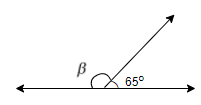
We place the value of $\alpha $ in $\alpha +\beta ={{180}^{\circ }}$.
$\begin{align}
& \Rightarrow \alpha +\beta ={{180}^{\circ }} \\
& \Rightarrow {{65}^{\circ }}+\beta ={{180}^{\circ }} \\
& \Rightarrow \beta ={{180}^{\circ }}-{{65}^{\circ }}={{115}^{\circ }} \\
\end{align}$
So, the angle is ${{115}^{\circ }}$.
Now we need to find the complement angle of ${{115}^{\circ }}$.
Let the angle be $\gamma $. This implies $\beta +\gamma ={{90}^{\circ }}$.
We place the value of $\beta $ in $\beta +\gamma ={{90}^{\circ }}$.
$\begin{align}
& \Rightarrow \beta +\gamma ={{90}^{\circ }} \\
& \Rightarrow {{115}^{\circ }}+\gamma ={{90}^{\circ }} \\
& \Rightarrow \gamma ={{90}^{\circ }}-{{115}^{\circ }}=-{{25}^{\circ }} \\
\end{align}$
The value of the angle can’t be negative.
So, there exists no such angle for which its complement angle will be ${{115}^{\circ }}$.
It has no complement angle. It doesn’t exist.
Note: We learned that if the sum of two angles is equal to ${{90}^{\circ }}$, then the angles are complementary angles to each other. This means we can’t find complementary angles of the angles valued more than ${{90}^{\circ }}$. Similar thing for supplement angles. We can’t find complementary angles of the angles valued more than ${{180}^{\circ }}$.
Complete step-by-step solution
The terms supplement and complement are the relations between two angles.
If the sum of two angles is equal to ${{90}^{\circ }}$, then the angles are complementary angles to each other. If the sum is equal to ${{180}^{\circ }}$, then the angles are supplementary angles to each other.
Let’s assume x and y are complementary angles to each other which means $x+y={{90}^{\circ }}$.
And if x and y are supplementary angles to each other which means $x+y={{180}^{\circ }}$.
For our given problem we assume the angle as $\alpha $. So, $\alpha ={{65}^{\circ }}$.
Let the supplement angle of $\alpha $ be $\beta $. This implies $\alpha +\beta ={{180}^{\circ }}$.
We place the value of $\alpha $ in $\alpha +\beta ={{180}^{\circ }}$.
$\begin{align}
& \Rightarrow \alpha +\beta ={{180}^{\circ }} \\
& \Rightarrow {{65}^{\circ }}+\beta ={{180}^{\circ }} \\
& \Rightarrow \beta ={{180}^{\circ }}-{{65}^{\circ }}={{115}^{\circ }} \\
\end{align}$
So, the angle is ${{115}^{\circ }}$.
Now we need to find the complement angle of ${{115}^{\circ }}$.
Let the angle be $\gamma $. This implies $\beta +\gamma ={{90}^{\circ }}$.
We place the value of $\beta $ in $\beta +\gamma ={{90}^{\circ }}$.
$\begin{align}
& \Rightarrow \beta +\gamma ={{90}^{\circ }} \\
& \Rightarrow {{115}^{\circ }}+\gamma ={{90}^{\circ }} \\
& \Rightarrow \gamma ={{90}^{\circ }}-{{115}^{\circ }}=-{{25}^{\circ }} \\
\end{align}$
The value of the angle can’t be negative.
So, there exists no such angle for which its complement angle will be ${{115}^{\circ }}$.
It has no complement angle. It doesn’t exist.
Note: We learned that if the sum of two angles is equal to ${{90}^{\circ }}$, then the angles are complementary angles to each other. This means we can’t find complementary angles of the angles valued more than ${{90}^{\circ }}$. Similar thing for supplement angles. We can’t find complementary angles of the angles valued more than ${{180}^{\circ }}$.
Recently Updated Pages
Master Class 8 Social Science: Engaging Questions & Answers for Success

Master Class 8 English: Engaging Questions & Answers for Success
Class 8 Question and Answer - Your Ultimate Solutions Guide
Master Class 8 Maths: Engaging Questions & Answers for Success
Master Class 8 Science: Engaging Questions & Answers for Success
Master Class 7 English: Engaging Questions & Answers for Success
Trending doubts
What is BLO What is the full form of BLO class 8 social science CBSE
Citizens of India can vote at the age of A 18 years class 8 social science CBSE
Full form of STD, ISD and PCO
Convert 40circ C to Fahrenheit A 104circ F B 107circ class 8 maths CBSE
Advantages and disadvantages of science
Right to vote is a AFundamental Right BFundamental class 8 social science CBSE