




If the sum of lengths of the hypotenuse and a side of a right triangle is given, then show that the area of triangle is maximum when the angle between them is ${{60}^{\circ }}$
Answer
 Verified
577.2k+ views
Hint: First let us consider the height of the triangle to be x and hypotenuse to be y. Now we know that x + y = p. Hence we can use the Pythagoras theorem to find the value of adjacent sides in terms of p. Now we know that the area of the triangle is $\dfrac{1}{2}\times base\times height$ Hence we will substitute and simplify the equation and find the value of ${{A}^{2}}$ . Now we will differentiate the whole equation with respect to x and hence find the condition for maxima. Now we will take the cos ratio and hence find the required angle.
Complete step by step answer:
Now consider the triangle ABC.
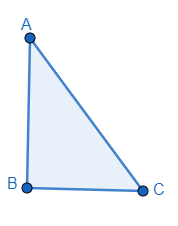
Now let AB = x and AC = y
Then using the Pythagoras theorem we can say that $BC=\sqrt{{{y}^{2}}-{{x}^{2}}}$ .
Now we know that the area of the triangle is given by $\dfrac{1}{2}\times base\times height$ .
Now we have a base of triangle $BC=\sqrt{{{y}^{2}}-{{x}^{2}}}$ and height of triangle AB = x.
Hence area of triangle is $A=\dfrac{x}{2}\sqrt{{{y}^{2}}-{{x}^{2}}}$
Now let x + y = p. using this we get,
$\begin{align}
& A=\dfrac{x}{2}\sqrt{{{\left( p-x \right)}^{2}}-{{x}^{2}}} \\
& \Rightarrow A=\dfrac{x}{2}\sqrt{{{p}^{2}}+{{x}^{2}}-2px-{{x}^{2}}} \\
& \Rightarrow A=\dfrac{x}{2}\sqrt{{{p}^{2}}-2px} \\
& \Rightarrow {{A}^{2}}=\dfrac{{{x}^{2}}}{4}\left( {{p}^{2}}-2px \right) \\
& \Rightarrow {{A}^{2}}=\dfrac{{{p}^{2}}{{x}^{2}}}{4}-\dfrac{p{{x}^{3}}}{2} \\
\end{align}$
Now differentiating the whole equation by x we get,
$\dfrac{d\left( {{A}^{2}} \right)}{dx}=\dfrac{{{p}^{2}}x}{2}-\dfrac{3p{{x}^{2}}}{2}$
Now let us equate this equation for the condition of maxima.
Hence we get
$\begin{align}
& \dfrac{{{p}^{2}}x-3p{{x}^{2}}}{2}=0 \\
& \Rightarrow {{p}^{2}}x=3p{{x}^{2}} \\
& \Rightarrow x=\dfrac{p}{3} \\
\end{align}$
Now substituting this in equation x + y = p we have y = $p-\dfrac{p}{3}=\dfrac{2p}{3}$
Now we have the condition of maxima is $x=\dfrac{p}{3}$ and $y=\dfrac{2p}{3}$ .
We know that cos is the ratio of adjacent sides and hypotenuses.
Hence $\cos \theta =\dfrac{\dfrac{p}{3}}{\dfrac{2p}{3}}=\dfrac{1}{2}$ .
Note: Now note that here we have differentiated the equation of ${{A}^{2}}$ and not A and hence we have the condition for which ${{A}^{2}}$ is maximum. But since A is an area of positive quantity we can state that ${{A}^{2}}$ is maximum when A is maximum. Hence we can use this for simplified calculation.
Complete step by step answer:
Now consider the triangle ABC.
Now let AB = x and AC = y
Then using the Pythagoras theorem we can say that $BC=\sqrt{{{y}^{2}}-{{x}^{2}}}$ .
Now we know that the area of the triangle is given by $\dfrac{1}{2}\times base\times height$ .
Now we have a base of triangle $BC=\sqrt{{{y}^{2}}-{{x}^{2}}}$ and height of triangle AB = x.
Hence area of triangle is $A=\dfrac{x}{2}\sqrt{{{y}^{2}}-{{x}^{2}}}$
Now let x + y = p. using this we get,
$\begin{align}
& A=\dfrac{x}{2}\sqrt{{{\left( p-x \right)}^{2}}-{{x}^{2}}} \\
& \Rightarrow A=\dfrac{x}{2}\sqrt{{{p}^{2}}+{{x}^{2}}-2px-{{x}^{2}}} \\
& \Rightarrow A=\dfrac{x}{2}\sqrt{{{p}^{2}}-2px} \\
& \Rightarrow {{A}^{2}}=\dfrac{{{x}^{2}}}{4}\left( {{p}^{2}}-2px \right) \\
& \Rightarrow {{A}^{2}}=\dfrac{{{p}^{2}}{{x}^{2}}}{4}-\dfrac{p{{x}^{3}}}{2} \\
\end{align}$
Now differentiating the whole equation by x we get,
$\dfrac{d\left( {{A}^{2}} \right)}{dx}=\dfrac{{{p}^{2}}x}{2}-\dfrac{3p{{x}^{2}}}{2}$
Now let us equate this equation for the condition of maxima.
Hence we get
$\begin{align}
& \dfrac{{{p}^{2}}x-3p{{x}^{2}}}{2}=0 \\
& \Rightarrow {{p}^{2}}x=3p{{x}^{2}} \\
& \Rightarrow x=\dfrac{p}{3} \\
\end{align}$
Now substituting this in equation x + y = p we have y = $p-\dfrac{p}{3}=\dfrac{2p}{3}$
Now we have the condition of maxima is $x=\dfrac{p}{3}$ and $y=\dfrac{2p}{3}$ .
We know that cos is the ratio of adjacent sides and hypotenuses.
Hence $\cos \theta =\dfrac{\dfrac{p}{3}}{\dfrac{2p}{3}}=\dfrac{1}{2}$ .
Note: Now note that here we have differentiated the equation of ${{A}^{2}}$ and not A and hence we have the condition for which ${{A}^{2}}$ is maximum. But since A is an area of positive quantity we can state that ${{A}^{2}}$ is maximum when A is maximum. Hence we can use this for simplified calculation.
Recently Updated Pages
Master Class 11 Computer Science: Engaging Questions & Answers for Success

Master Class 11 Business Studies: Engaging Questions & Answers for Success
Master Class 11 Economics: Engaging Questions & Answers for Success
Master Class 11 English: Engaging Questions & Answers for Success
Master Class 11 Maths: Engaging Questions & Answers for Success
Master Class 11 Biology: Engaging Questions & Answers for Success
Trending doubts
One Metric ton is equal to kg A 10000 B 1000 C 100 class 11 physics CBSE
There are 720 permutations of the digits 1 2 3 4 5 class 11 maths CBSE
Discuss the various forms of bacteria class 11 biology CBSE
Draw a diagram of a plant cell and label at least eight class 11 biology CBSE
State the laws of reflection of light
Explain zero factorial class 11 maths CBSE