



If the sides of a triangle are $6$, $10$ and $14$, then the triangle is:
A.Obtuse triangle
B.Acute triangle
C.Right triangle
D.Equilateral triangle
Answer
 Verified
611.4k+ views
Hint: We will use the converse of the Pythagorean Theorem to check the type of triangle. If a, b and c are the sides of a triangle then:
If ${c^2} < {a^2} + {b^2}$, then the triangle is an acute triangle.
If ${c^2} = {a^2} + {b^2}$, then the triangle is a right triangle.
If ${c^2} > {a^2} + {b^2}$, then the triangle is an obtuse triangle.
So, we will check the relation between ${c^2}$ and ${a^2} + {b^2}$ for determining the type of the given triangle.
Complete step-by-step answer:
We are given the sides of a triangle as: $6$, $10$ and $14$.
We are required to determine the type of the triangle they form.
We know that the converse of Pythagorean Theorem states that: For a triangle with sides a, b and c,
(i)If ${c^2} < {a^2} + {b^2}$, then the triangle is an acute triangle.
(ii)If ${c^2} = {a^2} + {b^2}$, then the triangle is a right triangle.
(iii)If ${c^2} > {a^2} + {b^2}$, then the triangle is an obtuse triangle.
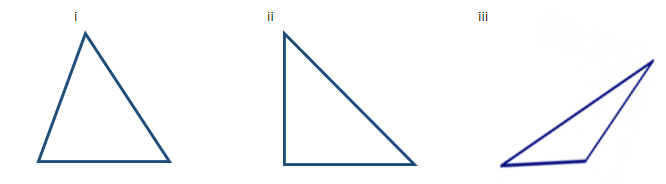
Let $a = 6$, $b = 10$ and $c = 14$.
We will check the relation between ${c^2}$ and ${a^2} + {b^2}$ for determining the type of the given triangle.
Here, ${c^2} = {\left( {14} \right)^2} = 196$ and ${a^2} + {b^2} = {\left( 6 \right)^2} + {\left( {10} \right)^2} = 36 + 100 = 136$.
We can see clearly that $196 > 136$ i.e., ${c^2} > {a^2} + {b^2}$. Hence, the given triangle is an obtuse triangle.
Therefore, option (A) is correct.
Note: In this question, we may get confused in the process of determining the type of triangle using this method. So, we can also use the method of calculating the largest angle of triangle by comparing the area of the triangle calculated by the Heron’s formula ($\sqrt {s\left( {s - a} \right)\left( {s - b} \right)\left( {s - c} \right)} $, where s is the semi-perimeter of the triangle and a, b, c are the sides) with the formula: area of the triangle = $ = \dfrac{1}{2}ab\sin C$ and from here, we can get the value of C and determine the type of the triangle using the value of angle C.
If ${c^2} < {a^2} + {b^2}$, then the triangle is an acute triangle.
If ${c^2} = {a^2} + {b^2}$, then the triangle is a right triangle.
If ${c^2} > {a^2} + {b^2}$, then the triangle is an obtuse triangle.
So, we will check the relation between ${c^2}$ and ${a^2} + {b^2}$ for determining the type of the given triangle.
Complete step-by-step answer:
We are given the sides of a triangle as: $6$, $10$ and $14$.
We are required to determine the type of the triangle they form.
We know that the converse of Pythagorean Theorem states that: For a triangle with sides a, b and c,
(i)If ${c^2} < {a^2} + {b^2}$, then the triangle is an acute triangle.
(ii)If ${c^2} = {a^2} + {b^2}$, then the triangle is a right triangle.
(iii)If ${c^2} > {a^2} + {b^2}$, then the triangle is an obtuse triangle.
Let $a = 6$, $b = 10$ and $c = 14$.
We will check the relation between ${c^2}$ and ${a^2} + {b^2}$ for determining the type of the given triangle.
Here, ${c^2} = {\left( {14} \right)^2} = 196$ and ${a^2} + {b^2} = {\left( 6 \right)^2} + {\left( {10} \right)^2} = 36 + 100 = 136$.
We can see clearly that $196 > 136$ i.e., ${c^2} > {a^2} + {b^2}$. Hence, the given triangle is an obtuse triangle.
Therefore, option (A) is correct.
Note: In this question, we may get confused in the process of determining the type of triangle using this method. So, we can also use the method of calculating the largest angle of triangle by comparing the area of the triangle calculated by the Heron’s formula ($\sqrt {s\left( {s - a} \right)\left( {s - b} \right)\left( {s - c} \right)} $, where s is the semi-perimeter of the triangle and a, b, c are the sides) with the formula: area of the triangle = $ = \dfrac{1}{2}ab\sin C$ and from here, we can get the value of C and determine the type of the triangle using the value of angle C.

Recently Updated Pages
Master Class 7 Science: Engaging Questions & Answers for Success

Master Class 7 English: Engaging Questions & Answers for Success
Master Class 7 Maths: Engaging Questions & Answers for Success
Class 7 Question and Answer - Your Ultimate Solutions Guide
Master Class 5 English: Engaging Questions & Answers for Success
Master Class 5 Maths: Engaging Questions & Answers for Success
Trending doubts
100 million is equal to begingathered A 1 crore B -class-7-maths-CBSE
Full Form of IASDMIPSIFSIRSPOLICE class 7 social science CBSE
Write in numerals Ten lakh ninety thousand nine hundred class 7 maths CBSE
List of coprime numbers from 1 to 100 class 7 maths CBSE
How many thousands make a crore class 7 maths CBSE
Differentiate between map and globe class 7 social science CBSE