




If the resultant of \[3\overrightarrow{p}\] and \[4\overrightarrow{p}\] is a force \[5\overrightarrow{p}\], then the angle between \[3\overrightarrow{p}\] and \[5\overrightarrow{p}\] is
a. \[{{\sin }^{-1}}\left( \dfrac{3}{5} \right)\]
b. \[{{\sin }^{-1}}\left( \dfrac{4}{5} \right)\]
c. \[{{90}^{\circ }}\]
d. None of these
Answer
 Verified
561.9k+ views
Hint: First we will put the values in the resultant formula. Now using this we will find the angle made between the resultant and the forces \[3\overrightarrow{p}\] and \[5\overrightarrow{p}\]. Take angle between \[4\overrightarrow{p}\] and \[5\overrightarrow{p}\] as \[\beta \], \[\alpha \] between \[5\overrightarrow{p}\] and \[3\overrightarrow{p}\]. So, we have the total angle \[\phi =\alpha +\beta \].
Complete step by step answer:
Now consider the figure drawn below,
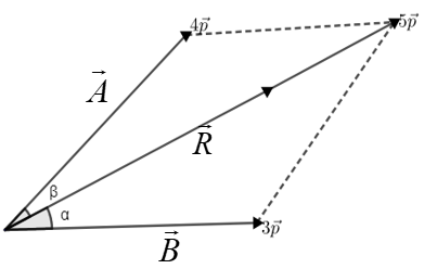
Now the force \[4\overrightarrow{p}\] and force \[3\overrightarrow{p}\] is drawn and the resultant of these two forces is \[5\overrightarrow{p}\] force.
Let the angle made between the \[4\overrightarrow{p}\] force and resultant \[5\overrightarrow{p}\] is \[\beta \] and the angle made between the \[3\overrightarrow{p}\] force and resultant \[5\overrightarrow{p}\] is \[\alpha \].
We know the basic formula where the resultant between 2 vectors \[\overrightarrow{A}\] and \[\overrightarrow{B}\] is given by the equation,
\[{{R}^{2}}={{A}^{2}}+{{B}^{2}}+2AB\cos \phi \]
Let us substitute the value into the equation, Hence we havr resultant \[=R=5\overrightarrow{p}\] \[A=4\overrightarrow{p}\] and \[B=3\overrightarrow{p}\]
Put ,\[\phi =\alpha +\beta \] in the above expression.
\[\begin{align}
& \Rightarrow {{\left( 5\overrightarrow{p} \right)}^{2}}={{\left( 4\overrightarrow{p} \right)}^{2}}+{{\left( 3\overrightarrow{p} \right)}^{2}}+2\left( 4\overrightarrow{p} \right)\left( 3\overrightarrow{p} \right)\cos \left( \alpha +\beta \right) \\
& \Rightarrow 25{{\overrightarrow{p}}^{2}}=16{{\overrightarrow{p}}^{2}}+9{{\overrightarrow{p}}^{2}}+24{{\overrightarrow{p}}^{2}}\cos \left( \alpha +\beta \right) \\
& 25{{\overrightarrow{p}}^{2}}=25{{\overrightarrow{p}}^{2}}+24{{\overrightarrow{p}}^{2}}\cos \left( \alpha +\beta \right) \\
\end{align}\]
Cancel out \[25{{\overrightarrow{p}}^{2}}\] from LHS and RHS.
\[\begin{align}
& \Rightarrow 24{{\overrightarrow{p}}^{2}}\cos \left( \alpha +\beta \right)=0 \\
& \cos \left( \alpha +\beta \right)=0 \\
& \Rightarrow \alpha +\beta ={{\cos }^{-1}}0\left[ \because {{\cos }^{-1}}0={{90}^{\circ }} \right] \\
& \alpha +\beta ={{90}^{\circ }} \\
\end{align}\]
Now, from the figure we can use the sine function to bring out the relation between the resultant and the vectors using the below mentioned formula. Now we can say that $\vec{R}\sin \alpha =\vec{B}\sin \left( \alpha +\beta \right)$ which is nothing but y projection of $\vec{B}$ and $\vec{R}$. Hence we have \[\overrightarrow{B}=\dfrac{\overrightarrow{R}\sin \alpha }{\sin \left( \alpha +\beta \right)}\]
Now substituting the values of \[\overrightarrow{A}=4\overrightarrow{p},\overrightarrow{B}=3\overrightarrow{p},\alpha +\beta ={{90}^{\circ }},\overrightarrow{R}=5\overrightarrow{p}\] we get,
\[\begin{align}
& \Rightarrow 4\overrightarrow{p}=\dfrac{5\overrightarrow{p}\sin \alpha }{\sin 90}\left[ \because \sin 90=1 \right] \\
& \Rightarrow 4\overrightarrow{p}=\dfrac{5\overrightarrow{p}\sin \alpha }{1} \\
& \sin \alpha =\dfrac{4\overrightarrow{p}}{5\overrightarrow{p}} \\
& \Rightarrow \sin \alpha =\dfrac{4}{5} \\
& \therefore \alpha ={{\sin }^{-1}}\left( \dfrac{4}{5} \right) \\
\end{align}\]
So, the correct answer is “Option b”.
Note: The angle between the resultants is taken as \[\alpha \] and \[\beta \], which makes the total angle \[\phi =\alpha +\beta \]. We can solve this in easy way by directly applying the formula,
\[\overrightarrow{B}=\dfrac{\overrightarrow{R}\sin \alpha }{\sin \left( \alpha
+\beta \right)}\].
Complete step by step answer:
Now consider the figure drawn below,
Now the force \[4\overrightarrow{p}\] and force \[3\overrightarrow{p}\] is drawn and the resultant of these two forces is \[5\overrightarrow{p}\] force.
Let the angle made between the \[4\overrightarrow{p}\] force and resultant \[5\overrightarrow{p}\] is \[\beta \] and the angle made between the \[3\overrightarrow{p}\] force and resultant \[5\overrightarrow{p}\] is \[\alpha \].
We know the basic formula where the resultant between 2 vectors \[\overrightarrow{A}\] and \[\overrightarrow{B}\] is given by the equation,
\[{{R}^{2}}={{A}^{2}}+{{B}^{2}}+2AB\cos \phi \]
Let us substitute the value into the equation, Hence we havr resultant \[=R=5\overrightarrow{p}\] \[A=4\overrightarrow{p}\] and \[B=3\overrightarrow{p}\]
Put ,\[\phi =\alpha +\beta \] in the above expression.
\[\begin{align}
& \Rightarrow {{\left( 5\overrightarrow{p} \right)}^{2}}={{\left( 4\overrightarrow{p} \right)}^{2}}+{{\left( 3\overrightarrow{p} \right)}^{2}}+2\left( 4\overrightarrow{p} \right)\left( 3\overrightarrow{p} \right)\cos \left( \alpha +\beta \right) \\
& \Rightarrow 25{{\overrightarrow{p}}^{2}}=16{{\overrightarrow{p}}^{2}}+9{{\overrightarrow{p}}^{2}}+24{{\overrightarrow{p}}^{2}}\cos \left( \alpha +\beta \right) \\
& 25{{\overrightarrow{p}}^{2}}=25{{\overrightarrow{p}}^{2}}+24{{\overrightarrow{p}}^{2}}\cos \left( \alpha +\beta \right) \\
\end{align}\]
Cancel out \[25{{\overrightarrow{p}}^{2}}\] from LHS and RHS.
\[\begin{align}
& \Rightarrow 24{{\overrightarrow{p}}^{2}}\cos \left( \alpha +\beta \right)=0 \\
& \cos \left( \alpha +\beta \right)=0 \\
& \Rightarrow \alpha +\beta ={{\cos }^{-1}}0\left[ \because {{\cos }^{-1}}0={{90}^{\circ }} \right] \\
& \alpha +\beta ={{90}^{\circ }} \\
\end{align}\]
Now, from the figure we can use the sine function to bring out the relation between the resultant and the vectors using the below mentioned formula. Now we can say that $\vec{R}\sin \alpha =\vec{B}\sin \left( \alpha +\beta \right)$ which is nothing but y projection of $\vec{B}$ and $\vec{R}$. Hence we have \[\overrightarrow{B}=\dfrac{\overrightarrow{R}\sin \alpha }{\sin \left( \alpha +\beta \right)}\]
Now substituting the values of \[\overrightarrow{A}=4\overrightarrow{p},\overrightarrow{B}=3\overrightarrow{p},\alpha +\beta ={{90}^{\circ }},\overrightarrow{R}=5\overrightarrow{p}\] we get,
\[\begin{align}
& \Rightarrow 4\overrightarrow{p}=\dfrac{5\overrightarrow{p}\sin \alpha }{\sin 90}\left[ \because \sin 90=1 \right] \\
& \Rightarrow 4\overrightarrow{p}=\dfrac{5\overrightarrow{p}\sin \alpha }{1} \\
& \sin \alpha =\dfrac{4\overrightarrow{p}}{5\overrightarrow{p}} \\
& \Rightarrow \sin \alpha =\dfrac{4}{5} \\
& \therefore \alpha ={{\sin }^{-1}}\left( \dfrac{4}{5} \right) \\
\end{align}\]
So, the correct answer is “Option b”.
Note: The angle between the resultants is taken as \[\alpha \] and \[\beta \], which makes the total angle \[\phi =\alpha +\beta \]. We can solve this in easy way by directly applying the formula,
\[\overrightarrow{B}=\dfrac{\overrightarrow{R}\sin \alpha }{\sin \left( \alpha
+\beta \right)}\].
Recently Updated Pages
Master Class 12 Business Studies: Engaging Questions & Answers for Success

Master Class 12 Biology: Engaging Questions & Answers for Success
Master Class 12 Chemistry: Engaging Questions & Answers for Success
Class 12 Question and Answer - Your Ultimate Solutions Guide
Master Class 11 Social Science: Engaging Questions & Answers for Success
Master Class 11 English: Engaging Questions & Answers for Success
Trending doubts
Which is more stable and why class 12 chemistry CBSE
Which are the Top 10 Largest Countries of the World?
Draw a labelled sketch of the human eye class 12 physics CBSE
Differentiate between homogeneous and heterogeneous class 12 chemistry CBSE
What are the major means of transport Explain each class 12 social science CBSE
Sulphuric acid is known as the king of acids State class 12 chemistry CBSE