




If the ratio of height of the tower and the length of its shadow is $ \sqrt{3}:1 $ . What is the angle of elevation?
Answer
 Verified
609.9k+ views
Hint: In this question, we are given the ratio of the height of the tower to the length of its shadow and we need to find the angle of elevation. For this, we will first draw a diagram to understand our question. After that, we will suppose the common ratio as x and find the length of the tower and shadow in terms of x. Then we will use the formula of $ \tan \theta $ in the right-angled triangle to find our required angle. $ \tan \theta =\dfrac{\text{side perpendicular to }\theta }{\text{side adjacent to }\theta } $ .
Complete step by step answer:
In this question, we are given the ratio of the height of the tower to the length of its shadow as $ \theta $. Let us suppose the angle of elevation as $ \sqrt{3}:1 $ . Let us suppose the common ratio is x. Therefore the length of the tower becomes $ \sqrt{3}x $ and the length of its shadow becomes x. Let us represent the situation diagrammatically.
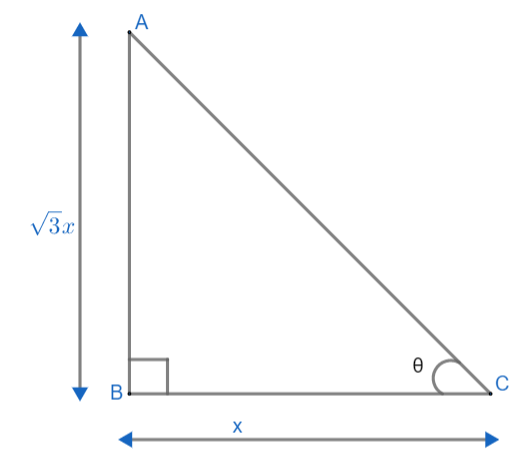
Here AB is the height of the tower which is $ \sqrt{3}x $ and BC is the length of the shadow of the tower which is x. Joining A to C gives us a right-angled triangle at B. Angle of elevation will be at C. So, $ \theta =\angle ACB $. Now, we know that, in a right-angled triangle, $ \tan \theta =\dfrac{\text{side perpendicular to }\theta }{\text{side adjacent to }\theta } $ .
In this $ \Delta ABC $ we see that, side perpendicular to $ \theta $ is AB and side adjacent to $ \theta $ is BC. Hence we get $ \tan \theta =\dfrac{AB}{BC} $ .
Now AB is height of tower i.e. $ \sqrt{3}x $ and BC is length of shadow i.e. x so we get, $ \tan \theta =\dfrac{\sqrt{3}x}{x} $ .
Cancelling x from the numerator and the denominator we get, $ \tan \theta =\sqrt{3} $ .
Now we know from the trigonometric ratio table that $ \tan {{60}^{\circ }}=\sqrt{3} $ so we can say that, $ \tan \theta =\tan {{60}^{\circ }} $ .
Comparing we get, $ \theta ={{60}^{\circ }} $ .
Hence the angle of elevation is $ {{60}^{\circ }} $ .
Note:
Students should note that for $ \tan \theta =\tan \alpha ,\theta =\alpha $ only when we know that $ \theta $ lies in the first quadrant. Here $ \theta $ is the angle of a right angled triangle which is always acute. So we have supposed $ \theta $ as $ \alpha $ . Otherwise for $ \tan \theta =\tan \alpha ,\theta =n\pi \pm \alpha $ where $ n=0,\pm 1,\pm 2,\ldots \ldots $ . Student should know the value from trigonometric ratio table. Don't forget to draw diagrams for these sums.
Complete step by step answer:
In this question, we are given the ratio of the height of the tower to the length of its shadow as $ \theta $. Let us suppose the angle of elevation as $ \sqrt{3}:1 $ . Let us suppose the common ratio is x. Therefore the length of the tower becomes $ \sqrt{3}x $ and the length of its shadow becomes x. Let us represent the situation diagrammatically.
Here AB is the height of the tower which is $ \sqrt{3}x $ and BC is the length of the shadow of the tower which is x. Joining A to C gives us a right-angled triangle at B. Angle of elevation will be at C. So, $ \theta =\angle ACB $. Now, we know that, in a right-angled triangle, $ \tan \theta =\dfrac{\text{side perpendicular to }\theta }{\text{side adjacent to }\theta } $ .
In this $ \Delta ABC $ we see that, side perpendicular to $ \theta $ is AB and side adjacent to $ \theta $ is BC. Hence we get $ \tan \theta =\dfrac{AB}{BC} $ .
Now AB is height of tower i.e. $ \sqrt{3}x $ and BC is length of shadow i.e. x so we get, $ \tan \theta =\dfrac{\sqrt{3}x}{x} $ .
Cancelling x from the numerator and the denominator we get, $ \tan \theta =\sqrt{3} $ .
Now we know from the trigonometric ratio table that $ \tan {{60}^{\circ }}=\sqrt{3} $ so we can say that, $ \tan \theta =\tan {{60}^{\circ }} $ .
Comparing we get, $ \theta ={{60}^{\circ }} $ .
Hence the angle of elevation is $ {{60}^{\circ }} $ .
Note:
Students should note that for $ \tan \theta =\tan \alpha ,\theta =\alpha $ only when we know that $ \theta $ lies in the first quadrant. Here $ \theta $ is the angle of a right angled triangle which is always acute. So we have supposed $ \theta $ as $ \alpha $ . Otherwise for $ \tan \theta =\tan \alpha ,\theta =n\pi \pm \alpha $ where $ n=0,\pm 1,\pm 2,\ldots \ldots $ . Student should know the value from trigonometric ratio table. Don't forget to draw diagrams for these sums.
Recently Updated Pages
Master Class 11 English: Engaging Questions & Answers for Success

Master Class 11 Social Science: Engaging Questions & Answers for Success
Master Class 11 Maths: Engaging Questions & Answers for Success
Master Class 11 Biology: Engaging Questions & Answers for Success
Master Class 11 Physics: Engaging Questions & Answers for Success
Master Class 11 Chemistry: Engaging Questions & Answers for Success