



If the radius of a right circular cylinder open at both the ends is decreasing by \[25\% \] and the height of the cylinder is increased by \[25\% \], then the surface area of the cylinder thus formed is
A) Remains unaltered
B) Increased by \[25\% \]
C) Decreased by \[25\% \]
D) Decreased by \[6.25\% \]
Answer
 Verified
580.2k+ views
Hint: In this question, we have to choose the correct option for the particular required.
The surface area of a cylinder is \[2\pi rh\] where r is the radius of the cylinder and h is the height of the cylinder.
We have to find out both the surface area of the cylinder, first taking two random variables as radius and height and then after decreasing and increasing the respective values. Then we can compare these two and we will get the solution.
Complete step-by-step answer:
It is given that the radius of a right circular cylinder open at both the ends is decreasing by \[25\% \] and the height of the cylinder is increased by \[25\% \].
We need to find whether the surface area of the cylinder thus formed is changed or not.
Let h be the height of the cylinder and r be the radius of the cylinder then the surface area of the cylinder is \[2\pi rh\].
After decreasing the radius by \[25\% \] it will become \[r - \dfrac{{25}}{{100}}r = \dfrac{{100 - 25}}{{100}}r = \dfrac{{75}}{{100}}r = \dfrac{3}{4}r\].
After increasing the height by \[25\% \] it will become \[h + \dfrac{{25}}{{100}}h = \dfrac{{100 + 25}}{{100}}r = \dfrac{{125}}{{100}}r = \dfrac{5}{4}r\].
Then the surface area of the cylinder is \[2\pi \dfrac{{3r}}{4}\dfrac{{5h}}{4} = \dfrac{{15}}{{16}} \times 2\pi rh\].
Since \[\dfrac{{15}}{{16}} < 1\], the surface area is decreased.
The surface area of the cylinder thus formed is decreased by
\[ = \left( {\dfrac{{2\pi rh - \dfrac{{15}}{{16}} \times 2\pi rh}}{{2\pi rh}} \times 100} \right)\% \]
Cancelling the same terms we get,
\[ = \left\{ {\left( {1 - \dfrac{{15}}{{16}}} \right) \times 100} \right\}\% \]
Simplifying we get,
\[ = \left( {\dfrac{{16 - 15}}{{16}} \times 100} \right)\% \]
Subtraction terms,
\[ = \left( {\dfrac{1}{{16}} \times 100} \right)\% \]
Hence the required solution is,
\[ = 6.25\% \]
Hence, the surface area of the cylinder thus formed is decreased by \[6.25\% \].
$\therefore $ The option (D) is the correct option.
Note:
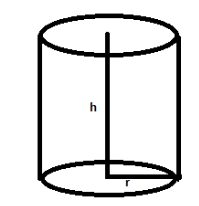
The surface area of a cylinder is \[2\pi rh\] Where r is the radius of the cylinder and h is the height of the cylinder.
Percentage formula:
Increase % = (New surface area – Original surface area)/Original surface area ×100
Decrease % = (Original surface area – new surface area)/Original surface area ×100
The surface area of a cylinder is \[2\pi rh\] where r is the radius of the cylinder and h is the height of the cylinder.
We have to find out both the surface area of the cylinder, first taking two random variables as radius and height and then after decreasing and increasing the respective values. Then we can compare these two and we will get the solution.
Complete step-by-step answer:
It is given that the radius of a right circular cylinder open at both the ends is decreasing by \[25\% \] and the height of the cylinder is increased by \[25\% \].
We need to find whether the surface area of the cylinder thus formed is changed or not.
Let h be the height of the cylinder and r be the radius of the cylinder then the surface area of the cylinder is \[2\pi rh\].
After decreasing the radius by \[25\% \] it will become \[r - \dfrac{{25}}{{100}}r = \dfrac{{100 - 25}}{{100}}r = \dfrac{{75}}{{100}}r = \dfrac{3}{4}r\].
After increasing the height by \[25\% \] it will become \[h + \dfrac{{25}}{{100}}h = \dfrac{{100 + 25}}{{100}}r = \dfrac{{125}}{{100}}r = \dfrac{5}{4}r\].
Then the surface area of the cylinder is \[2\pi \dfrac{{3r}}{4}\dfrac{{5h}}{4} = \dfrac{{15}}{{16}} \times 2\pi rh\].
Since \[\dfrac{{15}}{{16}} < 1\], the surface area is decreased.
The surface area of the cylinder thus formed is decreased by
\[ = \left( {\dfrac{{2\pi rh - \dfrac{{15}}{{16}} \times 2\pi rh}}{{2\pi rh}} \times 100} \right)\% \]
Cancelling the same terms we get,
\[ = \left\{ {\left( {1 - \dfrac{{15}}{{16}}} \right) \times 100} \right\}\% \]
Simplifying we get,
\[ = \left( {\dfrac{{16 - 15}}{{16}} \times 100} \right)\% \]
Subtraction terms,
\[ = \left( {\dfrac{1}{{16}} \times 100} \right)\% \]
Hence the required solution is,
\[ = 6.25\% \]
Hence, the surface area of the cylinder thus formed is decreased by \[6.25\% \].
$\therefore $ The option (D) is the correct option.
Note:
The surface area of a cylinder is \[2\pi rh\] Where r is the radius of the cylinder and h is the height of the cylinder.
Percentage formula:
Increase % = (New surface area – Original surface area)/Original surface area ×100
Decrease % = (Original surface area – new surface area)/Original surface area ×100
Recently Updated Pages
Master Class 9 General Knowledge: Engaging Questions & Answers for Success

Master Class 9 Social Science: Engaging Questions & Answers for Success
Master Class 9 English: Engaging Questions & Answers for Success
Master Class 9 Maths: Engaging Questions & Answers for Success
Master Class 9 Science: Engaging Questions & Answers for Success
Class 9 Question and Answer - Your Ultimate Solutions Guide
Trending doubts
Find the mode and median of the data 13 16 12 14 1-class-9-maths-CBSE
What were the main changes brought about by the Bolsheviks class 9 social science CBSE
What is the theme or message of the poem The road not class 9 english CBSE
What are the major achievements of the UNO class 9 social science CBSE
Explain the importance of pH in everyday life class 9 chemistry CBSE
Differentiate between parenchyma collenchyma and sclerenchyma class 9 biology CBSE