




If the radius and arc length of a sector are 17 cm and 27 cm respectively, then the perimeter is
A. 16 m
B. 61 cm
C. 32 cm
D. 80 cm
Answer
 Verified
638.1k+ views
Hint:To solve this question, we need to know that the sector is nothing but a part of a circle which is enclosed by two radii and an arc. We also need to know that the perimeter of any shape is calculated by calculating the length of the boundary walls of the figure. We can solve this question by using these concepts.
Complete step-by-step answer:
In this question, we have been given a sector of radius 17 cm and arc length of 27 cm and we have been asked to find the perimeter of that sector. Now, we know that sector is a part of a circle that is enclosed by two radii and an arc. We can represent it by the figure as given below.
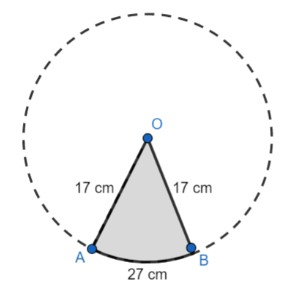
Here, we have represented OA and OB as the radius of the circle which are the part of sector and arc AB as part of the circumference of the circle which is a part of the sector. Now, we know that the perimeter of a shape is the total length of the boundary of that shape. So, we can say that perimeter of sector OAB can be calculated as,
OA + OB + Arc AB
Now, we know that the radius of the sector is 17 cm, which means that, OA = OB = 17 cm. And we have been given that the arc length is 27 cm, that is arc AB = 27 cm. So, we can write the perimeter of the sector OAB as,
17 + 17 + 27 = 61 cm.
Hence, we can say that the perimeter of the sector OAB is 61 cm. Therefore, option B is the correct answer.
Note: We can also solve this question by finding the sector angle, that is angle AOB, by using the relation $\theta =\dfrac{arc\text{ }length}{radius}$ and then to find the perimeter, we can apply the formula, perimeter of sector = $\theta \times radius+2\left( radius \right)$. But as we can see that $\theta \times radius=arc\text{ }length$, so it will indirectly reach the same stage that we reach directly via the conventional method. So, it is better to use the conventional method, if we have all the desired values.
Complete step-by-step answer:
In this question, we have been given a sector of radius 17 cm and arc length of 27 cm and we have been asked to find the perimeter of that sector. Now, we know that sector is a part of a circle that is enclosed by two radii and an arc. We can represent it by the figure as given below.
Here, we have represented OA and OB as the radius of the circle which are the part of sector and arc AB as part of the circumference of the circle which is a part of the sector. Now, we know that the perimeter of a shape is the total length of the boundary of that shape. So, we can say that perimeter of sector OAB can be calculated as,
OA + OB + Arc AB
Now, we know that the radius of the sector is 17 cm, which means that, OA = OB = 17 cm. And we have been given that the arc length is 27 cm, that is arc AB = 27 cm. So, we can write the perimeter of the sector OAB as,
17 + 17 + 27 = 61 cm.
Hence, we can say that the perimeter of the sector OAB is 61 cm. Therefore, option B is the correct answer.
Note: We can also solve this question by finding the sector angle, that is angle AOB, by using the relation $\theta =\dfrac{arc\text{ }length}{radius}$ and then to find the perimeter, we can apply the formula, perimeter of sector = $\theta \times radius+2\left( radius \right)$. But as we can see that $\theta \times radius=arc\text{ }length$, so it will indirectly reach the same stage that we reach directly via the conventional method. So, it is better to use the conventional method, if we have all the desired values.
Recently Updated Pages
Master Class 12 Economics: Engaging Questions & Answers for Success

Master Class 12 English: Engaging Questions & Answers for Success
Master Class 12 Social Science: Engaging Questions & Answers for Success
Master Class 12 Maths: Engaging Questions & Answers for Success
Master Class 12 Physics: Engaging Questions & Answers for Success
Master Class 11 Social Science: Engaging Questions & Answers for Success
Trending doubts
One Metric ton is equal to kg A 10000 B 1000 C 100 class 11 physics CBSE
Difference Between Prokaryotic Cells and Eukaryotic Cells
Two of the body parts which do not appear in MRI are class 11 biology CBSE
1 ton equals to A 100 kg B 1000 kg C 10 kg D 10000 class 11 physics CBSE
Draw a diagram of nephron and explain its structur class 11 biology CBSE
10 examples of friction in our daily life