




If the probability of E is given as \[P\left( E \right)=0.05\] then what is the probability of “not E”?
Answer
 Verified
631.2k+ views
Hint: We solve this problem by converting the given events into sets because sets and probabilities have the same relations and equations. Here, ‘not E’ is nothing but subtracting E from the universal set and we take the probability of the universal set as ‘1’.
Complete step-by-step solution
We are given that the probability of an event ‘E’ as
\[P\left( E \right)=0.05\]
Let us assume that the given event has some set.
Here, we know that any set will always lie in the universal set.
Let us draw a Venn diagram of sets comprising of the universal set and the set E as follows
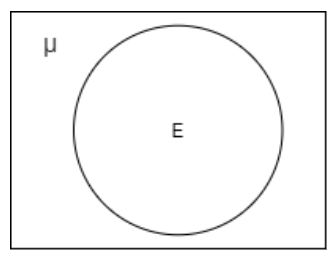
Here, \[ U \] is called the universal set and E is the set that we considered.
Now we have to find the set that is “not E”
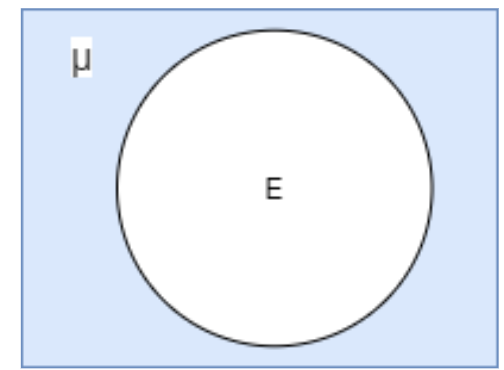
Here, the colored part is the region of “not E”.
Let us assume that the set “not E” as \[\bar{E}\]
So we can write
\[\Rightarrow \bar{E}=U -E\]
Here, as we got the set “not E” let us convert the above equation again back to probability as
\[\Rightarrow P\left( {\bar{E}} \right)=P\left( U \right)-P\left( E \right)\]
We know that the probability of the universal set is ‘1’ and we are given that\[P\left( E \right)=0.05\].
By substituting the required values in above equation we get
\[\begin{align}
& \Rightarrow P\left( {\bar{E}} \right)=1-0.05 \\
& \Rightarrow P\left( {\bar{E}} \right)=0.95 \\
\end{align}\]
So the probability of “not E” is 0.95.
Note: This problem can be solved in other ways.
The standard result of probability is that the probability of an event the probability of not an event adds up to 1. The mathematical form of this statement is
\[\Rightarrow P\left( {\bar{E}} \right)+P\left( E \right)=1\]
By substituting the given value that is \[P\left( E \right)=0.05\] in above equation we get
\[\begin{align}
& \Rightarrow P\left( {\bar{E}} \right)=1-0.05 \\
& \Rightarrow P\left( {\bar{E}} \right)=0.95 \\
\end{align}\]
So the probability of “not E” is 0.95.
Complete step-by-step solution
We are given that the probability of an event ‘E’ as
\[P\left( E \right)=0.05\]
Let us assume that the given event has some set.
Here, we know that any set will always lie in the universal set.
Let us draw a Venn diagram of sets comprising of the universal set and the set E as follows
Here, \[ U \] is called the universal set and E is the set that we considered.
Now we have to find the set that is “not E”
Here, the colored part is the region of “not E”.
Let us assume that the set “not E” as \[\bar{E}\]
So we can write
\[\Rightarrow \bar{E}=U -E\]
Here, as we got the set “not E” let us convert the above equation again back to probability as
\[\Rightarrow P\left( {\bar{E}} \right)=P\left( U \right)-P\left( E \right)\]
We know that the probability of the universal set is ‘1’ and we are given that\[P\left( E \right)=0.05\].
By substituting the required values in above equation we get
\[\begin{align}
& \Rightarrow P\left( {\bar{E}} \right)=1-0.05 \\
& \Rightarrow P\left( {\bar{E}} \right)=0.95 \\
\end{align}\]
So the probability of “not E” is 0.95.
Note: This problem can be solved in other ways.
The standard result of probability is that the probability of an event the probability of not an event adds up to 1. The mathematical form of this statement is
\[\Rightarrow P\left( {\bar{E}} \right)+P\left( E \right)=1\]
By substituting the given value that is \[P\left( E \right)=0.05\] in above equation we get
\[\begin{align}
& \Rightarrow P\left( {\bar{E}} \right)=1-0.05 \\
& \Rightarrow P\left( {\bar{E}} \right)=0.95 \\
\end{align}\]
So the probability of “not E” is 0.95.
Recently Updated Pages
Basicity of sulphurous acid and sulphuric acid are

Master Class 10 Computer Science: Engaging Questions & Answers for Success
Master Class 10 Social Science: Engaging Questions & Answers for Success
Master Class 10 Science: Engaging Questions & Answers for Success
Class 10 Question and Answer - Your Ultimate Solutions Guide
Master Class 10 Maths: Engaging Questions & Answers for Success
Trending doubts
What is the Total Duration of Football Match?
In football, which nation is called "La Roja"?
Why is there a time difference of about 5 hours between class 10 social science CBSE
What is the award for the best player at the FIFA World Cup?
Differentiate between Xylem and phloem class 10 biology CBSE
Draw a circuit diagram showing the cell switch and class 10 physics CBSE