




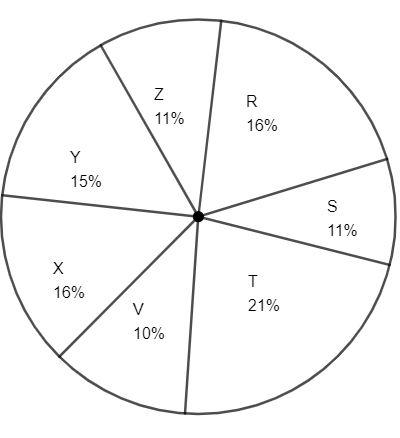
If the population of village R in 1997 was 32000, then what will be the population of village Y below the poverty line in that year?
Village % Population below poverty line X 38 Y 52 Z 42 R 51 S 49 T 46 V 58
(a) 14100
(b) 15600
(c) 16500
(d) 17000
| Village | % Population below poverty line |
| X | 38 |
| Y | 52 |
| Z | 42 |
| R | 51 |
| S | 49 |
| T | 46 |
| V | 58 |
Answer
 Verified
577.8k+ views
Hint: To solve this question, we will first of all, assume a variable for the total population of all seven villages and then by using the given population of R, we will get the value of x. Finally, by using this we will calculate the total population of Y and by using the table we will get the population below the poverty line.
Complete step by step answer:
We are given that the population of village R in 1997 is 32000. Now, observe the pie chart which is given as
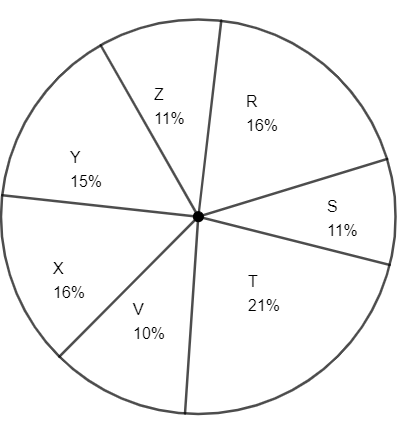
Now let us assume the total population of the seven villages as x. As R has 32000 as population and in the pie chart, R has 16 % of the total population. Therefore, we can write
16% of x = 32000
(As x is the total number)
\[ \dfrac{16}{100}\times x=32000\]
\[\Rightarrow 16\times x=3200000\]
\[\Rightarrow x=\dfrac{3200000}{16}\]
\[\therefore x=200000\]
Therefore, the total population of all the seven villages in 1997 is given to be 200000. Now, we are given the percentage of Y is 15%. Then,
The population of Y = 15% of the total population
\[ \text{Population of Y}=\dfrac{15}{100}\times 200000\]
\[\therefore \text{Population of Y}=30000\]
Hence, the population of Y is 30000. Now, finally, we need to calculate the population of village Y which is below the poverty line. For that, we will refer to the table given in the question.
Here, the percentage of the population of Y below the poverty line is given by 52%.
Therefore, 52% of 30000 gives the population of Y below the poverty line.
The population of village Y below the poverty line is 52% (3000)
\[\Rightarrow \dfrac{52}{100}\times 30000\]
\[\Rightarrow 52\times 300\]
\[\Rightarrow 15600\]
Hence, the population of village Y below the poverty line is 15600.
Therefore, option (b) is the right answer.
Note:
Students should not get confused while multiplying 52% with 30000. Also, do not multiply 52% with 200000. We have 52% as the percentage of the population of village Y below the poverty line, so we need to calculate 52% of the total population of Y and not the total population of all seven villages.
Complete step by step answer:
We are given that the population of village R in 1997 is 32000. Now, observe the pie chart which is given as
Now let us assume the total population of the seven villages as x. As R has 32000 as population and in the pie chart, R has 16 % of the total population. Therefore, we can write
16% of x = 32000
(As x is the total number)
\[ \dfrac{16}{100}\times x=32000\]
\[\Rightarrow 16\times x=3200000\]
\[\Rightarrow x=\dfrac{3200000}{16}\]
\[\therefore x=200000\]
Therefore, the total population of all the seven villages in 1997 is given to be 200000. Now, we are given the percentage of Y is 15%. Then,
The population of Y = 15% of the total population
\[ \text{Population of Y}=\dfrac{15}{100}\times 200000\]
\[\therefore \text{Population of Y}=30000\]
Hence, the population of Y is 30000. Now, finally, we need to calculate the population of village Y which is below the poverty line. For that, we will refer to the table given in the question.
| Village | % Population below the poverty line |
| X | 38 |
| Y | 52 |
| Z | 42 |
| R | 51 |
| S | 49 |
| T | 46 |
| V | 58 |
Here, the percentage of the population of Y below the poverty line is given by 52%.
Therefore, 52% of 30000 gives the population of Y below the poverty line.
The population of village Y below the poverty line is 52% (3000)
\[\Rightarrow \dfrac{52}{100}\times 30000\]
\[\Rightarrow 52\times 300\]
\[\Rightarrow 15600\]
Hence, the population of village Y below the poverty line is 15600.
Therefore, option (b) is the right answer.
Note:
Students should not get confused while multiplying 52% with 30000. Also, do not multiply 52% with 200000. We have 52% as the percentage of the population of village Y below the poverty line, so we need to calculate 52% of the total population of Y and not the total population of all seven villages.
Recently Updated Pages
Master Class 11 Computer Science: Engaging Questions & Answers for Success

Master Class 11 Business Studies: Engaging Questions & Answers for Success
Master Class 11 Economics: Engaging Questions & Answers for Success
Master Class 11 English: Engaging Questions & Answers for Success
Master Class 11 Maths: Engaging Questions & Answers for Success
Master Class 11 Biology: Engaging Questions & Answers for Success
Trending doubts
One Metric ton is equal to kg A 10000 B 1000 C 100 class 11 physics CBSE
There are 720 permutations of the digits 1 2 3 4 5 class 11 maths CBSE
Discuss the various forms of bacteria class 11 biology CBSE
Draw a diagram of a plant cell and label at least eight class 11 biology CBSE
State the laws of reflection of light
10 examples of friction in our daily life