




If the polynomial \[6{x^4} + 8{x^3} + 17{x^2} + 21x + 7\] is divided by another polynomial \[3{x^2} + 4x + 1\] the remainder comes out to be \[ax + b\]. Find \[a\] and \[b\].
A) \[0,1\]
B) \[1,2\]
C) \[1, - 1\]
D) \[ - 1,2\]
Answer
 Verified
575.7k+ views
Hint:
Here, we will use the method of long division and divide the given Dividend by the Divisor to get the required remainder. Comparing the remainder by \[ax + b\], we will get the required values of \[a\] and \[b\] respectively.
Complete step by step solution:
We will use the method of long division to find the required remainder.
According to the question, Dividend i.e. the number which we are required to divide is \[6{x^4} + 8{x^3} + 17{x^2} + 21x + 7\]
And the Divisor, i.e. the number by which the above number is to be divided is \[3{x^2} + 4x + 1\].
Hence, by using long division method:
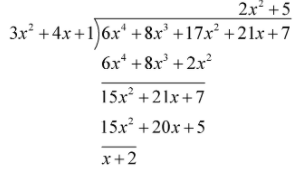
Hence, the quotient is \[2{x^2} + 5\] and the remainder is \[x + 2\]
Now, according to the question, we are given that the remainder comes out to be \[ax + b\].
So, writing the given remainder in \[ax + b\] form, we get
\[x + 2 = \left( 1 \right)x + \left( 2 \right)\]
Now comparing them together he two expression, we get
\[\left( 1 \right)x + \left( 2 \right) = ax + b\]
We can see that, \[a = 1\] and \[b = 2\]
Therefore, the required values of \[a\] and \[b\] are \[1,2\] respectively
Hence, option B is the correct answer.
Note:
We will check whether we have found the correct quotient and remainder or not by using the formula:
Dividend \[ = \] Divisor \[ \times \] Quotient \[ + \] Remainder
Substituting the values in this equation,
\[ \Rightarrow 6{x^4} + 8{x^3} + 17{x^2} + 21x + 7 = \left( {3{x^2} + 4x + 1} \right)\left( {2{x^2} + 5} \right) + x + 2\]
Now, solving for RHS by opening the brackets,
RHS \[ = 3{x^2}\left( {2{x^2} + 5} \right) + 4x\left( {2{x^2} + 5} \right) + 1\left( {2{x^2} + 5} \right) + x + 2\]
\[ \Rightarrow \] RHS \[ = 6{x^4} + 15{x^2} + 8{x^3} + 20x + 2{x^2} + 5 + x + 2\]
Hence, solving further, we get,
RHS \[ = 6{x^4} + 8{x^3} + 17{x^2} + 21x + 7\]
Clearly, RHS \[ = \] LHS (which is the dividend)
Hence, we have verified that our answer is correct.
Therefore, we can always check for our answer using this formula.
Here, we will use the method of long division and divide the given Dividend by the Divisor to get the required remainder. Comparing the remainder by \[ax + b\], we will get the required values of \[a\] and \[b\] respectively.
Complete step by step solution:
We will use the method of long division to find the required remainder.
According to the question, Dividend i.e. the number which we are required to divide is \[6{x^4} + 8{x^3} + 17{x^2} + 21x + 7\]
And the Divisor, i.e. the number by which the above number is to be divided is \[3{x^2} + 4x + 1\].
Hence, by using long division method:
Hence, the quotient is \[2{x^2} + 5\] and the remainder is \[x + 2\]
Now, according to the question, we are given that the remainder comes out to be \[ax + b\].
So, writing the given remainder in \[ax + b\] form, we get
\[x + 2 = \left( 1 \right)x + \left( 2 \right)\]
Now comparing them together he two expression, we get
\[\left( 1 \right)x + \left( 2 \right) = ax + b\]
We can see that, \[a = 1\] and \[b = 2\]
Therefore, the required values of \[a\] and \[b\] are \[1,2\] respectively
Hence, option B is the correct answer.
Note:
We will check whether we have found the correct quotient and remainder or not by using the formula:
Dividend \[ = \] Divisor \[ \times \] Quotient \[ + \] Remainder
Substituting the values in this equation,
\[ \Rightarrow 6{x^4} + 8{x^3} + 17{x^2} + 21x + 7 = \left( {3{x^2} + 4x + 1} \right)\left( {2{x^2} + 5} \right) + x + 2\]
Now, solving for RHS by opening the brackets,
RHS \[ = 3{x^2}\left( {2{x^2} + 5} \right) + 4x\left( {2{x^2} + 5} \right) + 1\left( {2{x^2} + 5} \right) + x + 2\]
\[ \Rightarrow \] RHS \[ = 6{x^4} + 15{x^2} + 8{x^3} + 20x + 2{x^2} + 5 + x + 2\]
Hence, solving further, we get,
RHS \[ = 6{x^4} + 8{x^3} + 17{x^2} + 21x + 7\]
Clearly, RHS \[ = \] LHS (which is the dividend)
Hence, we have verified that our answer is correct.
Therefore, we can always check for our answer using this formula.
Recently Updated Pages
Master Class 9 Social Science: Engaging Questions & Answers for Success

Master Class 9 Science: Engaging Questions & Answers for Success
Master Class 9 Maths: Engaging Questions & Answers for Success
Master Class 9 General Knowledge: Engaging Questions & Answers for Success
Class 9 Question and Answer - Your Ultimate Solutions Guide
Master Class 8 Social Science: Engaging Questions & Answers for Success
Trending doubts
Bruno once got paralysis Why How was he cured class 9 english CBSE
Explain the importance of pH in everyday life class 9 chemistry CBSE
What is the difference between Atleast and Atmost in class 9 maths CBSE
Which of the following is the smallest negative nu-class-9-maths-CBSE
Distinguish between the following Ferrous and nonferrous class 9 social science CBSE
Define one newton force