



If the points \[P(a, - 11),{\text{ }}Q(5,b),{\text{ }}R(2,15)\] and \[S(1,1)\] are the vertices of the parallelogram ABCD, find the values of a and b.
(A) \[a = 5,b = 3\]
(B) \[a = 4,b = 10\]
(C) \[a = 4,b = 3\]
(D) None of these
Answer
 Verified
580.2k+ views
Hint: In this question, we have to find the particular for the parallelogram.
In case of geometry, if four given points P, Q, R and S are vertices of the parallelogram then the diagonals of parallelogram bisect each other.
That is, the coordinate of the midpoint of one diagonal is the same as the other one.
First we need to find out the midpoints of the diagonals then equating these two we will get the required result.
Formula used: The midpoint of two points A\[\left( {{x_1},{y_1}} \right)\] and B\[\left( {{x_2},{y_2}} \right)\] is \[\left( {\dfrac{{{x_1} + {x_2}}}{2},\dfrac{{{y_1} + {y_2}}}{2}} \right)\]
Complete step-by-step answer:
It is given that, the points \[P(a, - 11),{\text{ }}Q(5,b),{\text{ }}R(2,15)\] and \[S(1,1)\] are the vertices of the parallelogram ABCD.
We need to find out the value of a and b.
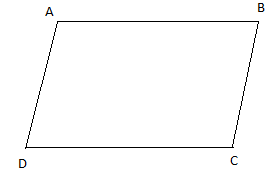
Since \[P(a, - 11), Q(5,b), R(2,15) and S(1,1)\] are the vertices of the parallelogram ABCD, thus the diagonals of the parallelogram are PR and QS.
We know that the diagonals of parallelograms bisect each other.
Therefore the coordinate of the midpoint of one diagonal PR is the same as the other one QS.
Thus we get,\[\left( {\dfrac{{a + 2}}{2},\dfrac{{ - 11 + 15}}{2}} \right) = \left( {\dfrac{{5 + 1}}{2},\dfrac{{b + 1}}{2}} \right)\]
Equating the coordinates we get,
\[\dfrac{{a + 2}}{2} = \dfrac{{5 + 1}}{2}\]
Cancelling the denominator we get,
$\Rightarrow$\[a + 2 = 5 + 1\]
Simplifying we get,
$\Rightarrow$\[a = 6 - 2 = 4\]
And then
\[\dfrac{{ - 11 + 15}}{2} = \dfrac{{b + 1}}{2}\]
Cancelling the denominator we get,
$\Rightarrow$\[ - 11 + 15 = b + 1\]
Simplifying we get,
$\Rightarrow$\[b = 4 - 1 = 3\]
Hence the value of \[a = 4\] and \[b = 3\].
$\therefore $ The option (C) is the correct option.
Note: A parallelogram is a simple quadrilateral with two pairs of parallel sides. The opposite or facing sides of a parallelogram are of equal length and the opposite angles of a parallelogram are of equal measure.
In case of geometry, if four given points P, Q, R and S are vertices of the parallelogram then the diagonals of parallelogram bisect each other.
That is, the coordinate of the midpoint of one diagonal is the same as the other one.
First we need to find out the midpoints of the diagonals then equating these two we will get the required result.
Formula used: The midpoint of two points A\[\left( {{x_1},{y_1}} \right)\] and B\[\left( {{x_2},{y_2}} \right)\] is \[\left( {\dfrac{{{x_1} + {x_2}}}{2},\dfrac{{{y_1} + {y_2}}}{2}} \right)\]
Complete step-by-step answer:
It is given that, the points \[P(a, - 11),{\text{ }}Q(5,b),{\text{ }}R(2,15)\] and \[S(1,1)\] are the vertices of the parallelogram ABCD.
We need to find out the value of a and b.
Since \[P(a, - 11), Q(5,b), R(2,15) and S(1,1)\] are the vertices of the parallelogram ABCD, thus the diagonals of the parallelogram are PR and QS.
We know that the diagonals of parallelograms bisect each other.
Therefore the coordinate of the midpoint of one diagonal PR is the same as the other one QS.
Thus we get,\[\left( {\dfrac{{a + 2}}{2},\dfrac{{ - 11 + 15}}{2}} \right) = \left( {\dfrac{{5 + 1}}{2},\dfrac{{b + 1}}{2}} \right)\]
Equating the coordinates we get,
\[\dfrac{{a + 2}}{2} = \dfrac{{5 + 1}}{2}\]
Cancelling the denominator we get,
$\Rightarrow$\[a + 2 = 5 + 1\]
Simplifying we get,
$\Rightarrow$\[a = 6 - 2 = 4\]
And then
\[\dfrac{{ - 11 + 15}}{2} = \dfrac{{b + 1}}{2}\]
Cancelling the denominator we get,
$\Rightarrow$\[ - 11 + 15 = b + 1\]
Simplifying we get,
$\Rightarrow$\[b = 4 - 1 = 3\]
Hence the value of \[a = 4\] and \[b = 3\].
$\therefore $ The option (C) is the correct option.
Note: A parallelogram is a simple quadrilateral with two pairs of parallel sides. The opposite or facing sides of a parallelogram are of equal length and the opposite angles of a parallelogram are of equal measure.
Recently Updated Pages
Master Class 9 General Knowledge: Engaging Questions & Answers for Success

Master Class 9 Social Science: Engaging Questions & Answers for Success
Master Class 9 English: Engaging Questions & Answers for Success
Master Class 9 Maths: Engaging Questions & Answers for Success
Master Class 9 Science: Engaging Questions & Answers for Success
Class 9 Question and Answer - Your Ultimate Solutions Guide
Trending doubts
Difference Between Plant Cell and Animal Cell
Fill the blanks with the suitable prepositions 1 The class 9 english CBSE
Who is eligible for RTE class 9 social science CBSE
Which places in India experience sunrise first and class 9 social science CBSE
What is pollution? How many types of pollution? Define it
Name 10 Living and Non living things class 9 biology CBSE