




If the points of intersection of the line \[4x-3y-10=0\] and the circle \[{{x}^{2}}+{{y}^{2}}-2x+4y-20=0\] are \[(a,b)\] and \[(c,d)\] where \[a\] and \[b\] are positive and \[c\] and \[d\] are negative, then \[a-c+b+d\] is ____.
Answer
 Verified
636k+ views
Hint: Rewrite the equation of the line in terms of one of the variables and then substitute it in the equation of the circle. Solve the equation to get their points of intersection and thus, the value of \[a-c+b+d\].
Complete step by step answer:
We have the equation of a line \[4x-3y-10=0\] and a circle \[{{x}^{2}}+{{y}^{2}}-2x+4y-20=0\]. We have to find the points of intersection of the two curves.
We will find their point of intersection by substituting the equation of one curve into the equation of another curve and then solving them to find their point of intersection.
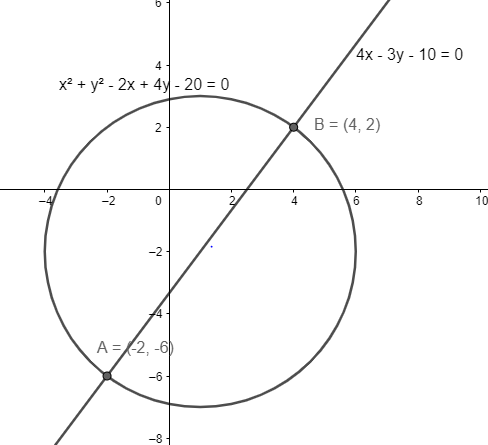
We can rewrite the equation of line by writing \[x\] in terms of \[y\]. Rearranging the terms of the equation of line \[4x-3y-10=0\], we get \[x=\dfrac{3y+10}{4}\].
We will substitute this equation of line in the equation of circle \[{{x}^{2}}+{{y}^{2}}-2x+4y-20=0\].
Thus, we have \[{{\left( \dfrac{3y+10}{4} \right)}^{2}}+{{y}^{2}}-2\left( \dfrac{3y+10}{4} \right)+4y-20=0\] as the equation of circle.
Solving the above equation, we get \[\dfrac{9{{y}^{2}}+100+60y}{16}+{{y}^{2}}-\left( \dfrac{3y+10}{2} \right)+4y-20=0\].
We will further simplify the equation by taking LCM.
Thus, we have \[9{{y}^{2}}+100+60y+16{{y}^{2}}-24y-80+64y-320=0\]
\[\Rightarrow 25{{y}^{2}}+100y-300=0\]
Dividing the equation by \[25\], we get \[{{y}^{2}}+4y-12=0\].
Factorizing the above equation, we have \[{{y}^{2}}+6y-2y-12=0\]
\[\begin{align}
& \Rightarrow y\left( y+6 \right)-2\left( y+6 \right)=0 \\
& \Rightarrow \left( y+6 \right)\left( y-2 \right)=0 \\
& \Rightarrow y=2,-6 \\
\end{align}\]
Substituting the values \[y=2,-6\] in the equation of line \[x=\dfrac{3y+10}{4}\], we get \[x=4,-2\].
Thus, the two points of intersection of the two curves are \[\left( 4,2 \right),\left( -2,-6 \right)\].
We know that \[a\] and \[b\] are positive and \[c\] and \[d\] are negative.
Thus, we have \[a=4,b=2,c=-2,d=-6\].
Now, we have to find the value of \[a-c+b+d\] .
Substituting the values, we get \[a-c+b+d=4+2+2-6=2\].
Hence, the value of \[a-c+b+d\] is \[2\].
Note: We can also solve this question by rearranging the equation of line by writing \[y\] in terms of \[x\] and then substituting it in the equation of circle and solving it to get the required points of intersection.
Complete step by step answer:
We have the equation of a line \[4x-3y-10=0\] and a circle \[{{x}^{2}}+{{y}^{2}}-2x+4y-20=0\]. We have to find the points of intersection of the two curves.
We will find their point of intersection by substituting the equation of one curve into the equation of another curve and then solving them to find their point of intersection.
We can rewrite the equation of line by writing \[x\] in terms of \[y\]. Rearranging the terms of the equation of line \[4x-3y-10=0\], we get \[x=\dfrac{3y+10}{4}\].
We will substitute this equation of line in the equation of circle \[{{x}^{2}}+{{y}^{2}}-2x+4y-20=0\].
Thus, we have \[{{\left( \dfrac{3y+10}{4} \right)}^{2}}+{{y}^{2}}-2\left( \dfrac{3y+10}{4} \right)+4y-20=0\] as the equation of circle.
Solving the above equation, we get \[\dfrac{9{{y}^{2}}+100+60y}{16}+{{y}^{2}}-\left( \dfrac{3y+10}{2} \right)+4y-20=0\].
We will further simplify the equation by taking LCM.
Thus, we have \[9{{y}^{2}}+100+60y+16{{y}^{2}}-24y-80+64y-320=0\]
\[\Rightarrow 25{{y}^{2}}+100y-300=0\]
Dividing the equation by \[25\], we get \[{{y}^{2}}+4y-12=0\].
Factorizing the above equation, we have \[{{y}^{2}}+6y-2y-12=0\]
\[\begin{align}
& \Rightarrow y\left( y+6 \right)-2\left( y+6 \right)=0 \\
& \Rightarrow \left( y+6 \right)\left( y-2 \right)=0 \\
& \Rightarrow y=2,-6 \\
\end{align}\]
Substituting the values \[y=2,-6\] in the equation of line \[x=\dfrac{3y+10}{4}\], we get \[x=4,-2\].
Thus, the two points of intersection of the two curves are \[\left( 4,2 \right),\left( -2,-6 \right)\].
We know that \[a\] and \[b\] are positive and \[c\] and \[d\] are negative.
Thus, we have \[a=4,b=2,c=-2,d=-6\].
Now, we have to find the value of \[a-c+b+d\] .
Substituting the values, we get \[a-c+b+d=4+2+2-6=2\].
Hence, the value of \[a-c+b+d\] is \[2\].
Note: We can also solve this question by rearranging the equation of line by writing \[y\] in terms of \[x\] and then substituting it in the equation of circle and solving it to get the required points of intersection.
Recently Updated Pages
Master Class 11 Social Science: Engaging Questions & Answers for Success

Master Class 11 English: Engaging Questions & Answers for Success
Master Class 11 Maths: Engaging Questions & Answers for Success
Master Class 11 Chemistry: Engaging Questions & Answers for Success
Master Class 11 Biology: Engaging Questions & Answers for Success
Master Class 11 Physics: Engaging Questions & Answers for Success
Trending doubts
Differentiate between an exothermic and an endothermic class 11 chemistry CBSE
One Metric ton is equal to kg A 10000 B 1000 C 100 class 11 physics CBSE
Difference Between Prokaryotic Cells and Eukaryotic Cells
There are 720 permutations of the digits 1 2 3 4 5 class 11 maths CBSE
Two of the body parts which do not appear in MRI are class 11 biology CBSE
Which gas is abundant in air class 11 chemistry CBSE