




If the perpendicular is let fall from the point P on parabola upon its polar. Prove that the distance of the foot of this perpendicular from the focus is equal to the distance of point P from its directrix.
Answer
 Verified
576.6k+ views
Hint: The rough figure drawn based on the given information is
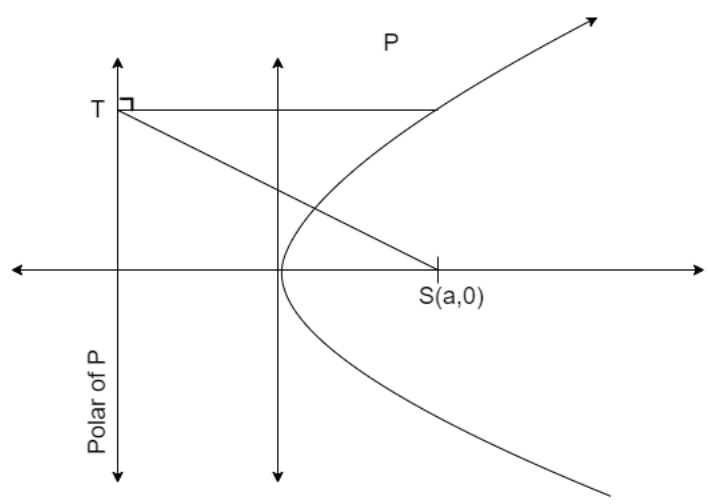
We assume that equation of parabola as \[{{y}^{2}}=4ax\] then equation of directrix is given as
\[x+a=0\] then we assume that point P as \[\left( h,k \right)\] to find the polar of point P with respect to parabola \[S\equiv {{y}^{2}}=4ax\] given as \[{{S}_{1}}=0\] where
\[{{S}_{1}}=yk-2a\left( x+h \right)\]
Then we find the foot of perpendicular of point \[P\left( h,k \right)\] to its polar \[ax+by+c=0\] given as
\[\dfrac{x-h}{a}=\dfrac{y-k}{b}=\dfrac{-\left( ah+bk+c \right)}{{{a}^{2}}+{{b}^{2}}}\]
Then we find the distance between focus ‘S’ and foot of perpendicular ‘T’ using distance formula that is the formula of distance between \[\left( {{x}_{1}},{{y}_{1}} \right),\left( {{x}_{2}},{{y}_{2}} \right)\] is given as
\[ST=\sqrt{{{\left( {{x}_{2}}-{{x}_{1}} \right)}^{2}}+{{\left( {{y}_{2}}-{{y}_{1}} \right)}^{2}}}\]
Then we find the distance of point P to the directrix using perpendicular formula that is the distance of \[P\left( h,k \right)\] to line \[ax+by+c=0\] is given as
\[D=\dfrac{\left| ah+bk+c \right|}{\sqrt{{{a}^{2}}+{{b}^{2}}}}\]
Complete step-by-step solution:
Let us assume that the equation of parabola as
\[\Rightarrow {{y}^{2}}=4ax\]
Let us assume the point P as \[P\left( h,k \right)\]
We know that the equation of polar of point P with respect to parabola \[S\equiv {{y}^{2}}=4ax\] given as \[{{S}_{1}}=0\] where
\[{{S}_{1}}=yk-2a\left( x+h \right)\]
By using the above formula we get the equation of polar of P as
\[\begin{align}
& \Rightarrow yk-2a\left( x+h \right)=0 \\
& \Rightarrow 2ax-ky+2ah=0 \\
\end{align}\]
Now, let us find the foot of perpendicular of \[P\left( h,k \right)\] on its polar which is \['T'\]
We know that we can find the foot of perpendicular of point \[P\left( h,k \right)\] to its polar \[ax+by+c=0\] given as
\[\dfrac{x-h}{a}=\dfrac{y-k}{b}=\dfrac{-\left( ah+bk+c \right)}{{{a}^{2}}+{{b}^{2}}}\]
By using the above formula we get the co – ordinates of point \['T'\] as
\[\begin{align}
& \Rightarrow \dfrac{x-h}{2a}=\dfrac{y-k}{-k}=\dfrac{-\left( 2ah-{{k}^{2}}+2ah \right)}{4{{a}^{2}}+{{k}^{2}}} \\
& \Rightarrow \dfrac{x-h}{2a}=\dfrac{y-k}{-k}=\dfrac{{{k}^{2}}-4ah}{4{{a}^{2}}+{{k}^{2}}} \\
\end{align}\]
By dividing the terms we get the \['x'\] co – ordinate of \['T'\] as
\[\begin{align}
& \Rightarrow \dfrac{x-h}{2a}=\dfrac{{{k}^{2}}-4ah}{4{{a}^{2}}+{{k}^{2}}} \\
& \Rightarrow x=h+\dfrac{2a{{k}^{2}}-8{{a}^{2}}h}{4{{a}^{2}}+{{k}^{2}}} \\
\end{align}\]
By doing the LCM and adding the terms we get
\[\begin{align}
& \Rightarrow x=\dfrac{4{{a}^{2}}h+h{{k}^{2}}+2a{{k}^{2}}-8{{a}^{2}}h}{4{{a}^{2}}+{{k}^{2}}} \\
& \Rightarrow x=\dfrac{h{{k}^{2}}+2a{{k}^{2}}-4{{a}^{2}}h}{4{{a}^{2}}+{{k}^{2}}} \\
\end{align}\]
Similarly, we get the \['y'\] co – ordinate of \['T'\] as
\[\begin{align}
& \Rightarrow \dfrac{y-k}{-k}=\dfrac{{{k}^{2}}-4ah}{4{{a}^{2}}+{{k}^{2}}} \\
& \Rightarrow y=k+\dfrac{-{{k}^{3}}+4ahk}{4{{a}^{2}}+{{k}^{2}}} \\
\end{align}\]
By doing the LCM and adding the terms we get
\[\begin{align}
& \Rightarrow y=\dfrac{4{{a}^{2}}k+{{k}^{3}}-{{k}^{3}}+4ahk}{4{{a}^{2}}+{{k}^{2}}} \\
& \Rightarrow y=\dfrac{4ak\left( h+a \right)}{4{{a}^{2}}+{{k}^{2}}} \\
\end{align}\]
Therefore, the co – ordinates of point \['T'\] are
\[\Rightarrow T=\left( \dfrac{h{{k}^{2}}+2a{{k}^{2}}-4{{a}^{2}}h}{4{{a}^{2}}+{{k}^{2}}},\dfrac{4ak\left( h+a \right)}{4{{a}^{2}}+{{k}^{2}}} \right)\]
Let us find the length of ‘ST’ using the distance formula
We know that the formula of distance between \[\left( {{x}_{1}},{{y}_{1}} \right),\left( {{x}_{2}},{{y}_{2}} \right)\] is given as
\[ST=\sqrt{{{\left( {{x}_{2}}-{{x}_{1}} \right)}^{2}}+{{\left( {{y}_{2}}-{{y}_{1}} \right)}^{2}}}\]
By using the above formula we get
\[\begin{align}
& \Rightarrow ST=\sqrt{{{\left( \dfrac{h{{k}^{2}}+2a{{k}^{2}}-4{{a}^{2}}h}{4{{a}^{2}}+{{k}^{2}}}-a \right)}^{2}}+{{\left( \dfrac{4ak\left( h+a \right)}{4{{a}^{2}}+{{k}^{2}}} \right)}^{2}}} \\
& \Rightarrow ST=\dfrac{1}{4{{a}^{2}}+{{k}^{2}}}\sqrt{{{\left( h{{k}^{2}}+2a{{k}^{2}}-4{{a}^{2}}h-4{{a}^{3}}-a{{k}^{2}} \right)}^{2}}+16{{a}^{2}}{{k}^{2}}{{\left( h+a \right)}^{2}}} \\
\end{align}\]
By taking the common terms from the first term inside the square root we get
\[\begin{align}
& \Rightarrow ST=\dfrac{1}{4{{a}^{2}}+{{k}^{2}}}\sqrt{{{\left( k-4{{a}^{2}} \right)}^{2}}{{\left( h+a \right)}^{2}}+16{{a}^{2}}{{k}^{2}}{{\left( h+a \right)}^{2}}} \\
& \Rightarrow ST=\dfrac{\left( h+a \right)}{4{{a}^{2}}+{{k}^{2}}}\sqrt{{{\left( k-4{{a}^{2}} \right)}^{2}}+16{{a}^{2}}{{k}^{2}}} \\
& \Rightarrow ST=\dfrac{\left( h+a \right)}{4{{a}^{2}}+{{k}^{2}}}\left( 4{{a}^{2}}+{{k}^{2}} \right) \\
& \Rightarrow ST=h+a \\
\end{align}\]
Now let us find the distance of pint P to the directirx
We know that the equation of directrix is given as
\[\Rightarrow x+a=0\]
We know that formula of the distance of \[P\left( h,k \right)\] to line \[ax+by+c=0\] is given as
\[D=\dfrac{\left| ah+bk+c \right|}{\sqrt{{{a}^{2}}+{{b}^{2}}}}\]
By using the above formula the distance of point \[P\left( h,k \right)\] to \[x+a=0\] is given as
\[\begin{align}
& \Rightarrow D=\dfrac{\left| h+0+a \right|}{\sqrt{{{1}^{2}}+{{0}^{2}}}} \\
& \Rightarrow D=h+a \\
\end{align}\]
Here we can see that
\[\Rightarrow ST=D\]
Therefore we can say that the foot of this perpendicular from the focus is equal to distance of point P from its directrix.
Hence the required result has been proved.
Note: There is a shortcut for this solution.
The foot of perpendicular of point P on its polar with respect to curve \[S\equiv {{y}^{2}}=4ax\] will be same as P. that means in the above solution the points \['P'\] and \['T'\] will coincide.
Therefore, if we can prove that \[D=SP\] then we can easily prove the required result.
By using the distance formula the length of SP is
\[\Rightarrow SP=\sqrt{{{\left( h-a \right)}^{2}}+{{k}^{2}}}\]
Since point \[P\left( h,k \right)\] lies on parabola we get
\[\Rightarrow {{k}^{2}}=4ah\]
By substituting the this formula in above equation we get
\[\begin{align}
& \Rightarrow SP=\sqrt{{{\left( h-a \right)}^{2}}+4ah} \\
& \Rightarrow SP=h+a=D \\
\end{align}\]
Hence the required result has been proved.
We assume that equation of parabola as \[{{y}^{2}}=4ax\] then equation of directrix is given as
\[x+a=0\] then we assume that point P as \[\left( h,k \right)\] to find the polar of point P with respect to parabola \[S\equiv {{y}^{2}}=4ax\] given as \[{{S}_{1}}=0\] where
\[{{S}_{1}}=yk-2a\left( x+h \right)\]
Then we find the foot of perpendicular of point \[P\left( h,k \right)\] to its polar \[ax+by+c=0\] given as
\[\dfrac{x-h}{a}=\dfrac{y-k}{b}=\dfrac{-\left( ah+bk+c \right)}{{{a}^{2}}+{{b}^{2}}}\]
Then we find the distance between focus ‘S’ and foot of perpendicular ‘T’ using distance formula that is the formula of distance between \[\left( {{x}_{1}},{{y}_{1}} \right),\left( {{x}_{2}},{{y}_{2}} \right)\] is given as
\[ST=\sqrt{{{\left( {{x}_{2}}-{{x}_{1}} \right)}^{2}}+{{\left( {{y}_{2}}-{{y}_{1}} \right)}^{2}}}\]
Then we find the distance of point P to the directrix using perpendicular formula that is the distance of \[P\left( h,k \right)\] to line \[ax+by+c=0\] is given as
\[D=\dfrac{\left| ah+bk+c \right|}{\sqrt{{{a}^{2}}+{{b}^{2}}}}\]
Complete step-by-step solution:
Let us assume that the equation of parabola as
\[\Rightarrow {{y}^{2}}=4ax\]
Let us assume the point P as \[P\left( h,k \right)\]
We know that the equation of polar of point P with respect to parabola \[S\equiv {{y}^{2}}=4ax\] given as \[{{S}_{1}}=0\] where
\[{{S}_{1}}=yk-2a\left( x+h \right)\]
By using the above formula we get the equation of polar of P as
\[\begin{align}
& \Rightarrow yk-2a\left( x+h \right)=0 \\
& \Rightarrow 2ax-ky+2ah=0 \\
\end{align}\]
Now, let us find the foot of perpendicular of \[P\left( h,k \right)\] on its polar which is \['T'\]
We know that we can find the foot of perpendicular of point \[P\left( h,k \right)\] to its polar \[ax+by+c=0\] given as
\[\dfrac{x-h}{a}=\dfrac{y-k}{b}=\dfrac{-\left( ah+bk+c \right)}{{{a}^{2}}+{{b}^{2}}}\]
By using the above formula we get the co – ordinates of point \['T'\] as
\[\begin{align}
& \Rightarrow \dfrac{x-h}{2a}=\dfrac{y-k}{-k}=\dfrac{-\left( 2ah-{{k}^{2}}+2ah \right)}{4{{a}^{2}}+{{k}^{2}}} \\
& \Rightarrow \dfrac{x-h}{2a}=\dfrac{y-k}{-k}=\dfrac{{{k}^{2}}-4ah}{4{{a}^{2}}+{{k}^{2}}} \\
\end{align}\]
By dividing the terms we get the \['x'\] co – ordinate of \['T'\] as
\[\begin{align}
& \Rightarrow \dfrac{x-h}{2a}=\dfrac{{{k}^{2}}-4ah}{4{{a}^{2}}+{{k}^{2}}} \\
& \Rightarrow x=h+\dfrac{2a{{k}^{2}}-8{{a}^{2}}h}{4{{a}^{2}}+{{k}^{2}}} \\
\end{align}\]
By doing the LCM and adding the terms we get
\[\begin{align}
& \Rightarrow x=\dfrac{4{{a}^{2}}h+h{{k}^{2}}+2a{{k}^{2}}-8{{a}^{2}}h}{4{{a}^{2}}+{{k}^{2}}} \\
& \Rightarrow x=\dfrac{h{{k}^{2}}+2a{{k}^{2}}-4{{a}^{2}}h}{4{{a}^{2}}+{{k}^{2}}} \\
\end{align}\]
Similarly, we get the \['y'\] co – ordinate of \['T'\] as
\[\begin{align}
& \Rightarrow \dfrac{y-k}{-k}=\dfrac{{{k}^{2}}-4ah}{4{{a}^{2}}+{{k}^{2}}} \\
& \Rightarrow y=k+\dfrac{-{{k}^{3}}+4ahk}{4{{a}^{2}}+{{k}^{2}}} \\
\end{align}\]
By doing the LCM and adding the terms we get
\[\begin{align}
& \Rightarrow y=\dfrac{4{{a}^{2}}k+{{k}^{3}}-{{k}^{3}}+4ahk}{4{{a}^{2}}+{{k}^{2}}} \\
& \Rightarrow y=\dfrac{4ak\left( h+a \right)}{4{{a}^{2}}+{{k}^{2}}} \\
\end{align}\]
Therefore, the co – ordinates of point \['T'\] are
\[\Rightarrow T=\left( \dfrac{h{{k}^{2}}+2a{{k}^{2}}-4{{a}^{2}}h}{4{{a}^{2}}+{{k}^{2}}},\dfrac{4ak\left( h+a \right)}{4{{a}^{2}}+{{k}^{2}}} \right)\]
Let us find the length of ‘ST’ using the distance formula
We know that the formula of distance between \[\left( {{x}_{1}},{{y}_{1}} \right),\left( {{x}_{2}},{{y}_{2}} \right)\] is given as
\[ST=\sqrt{{{\left( {{x}_{2}}-{{x}_{1}} \right)}^{2}}+{{\left( {{y}_{2}}-{{y}_{1}} \right)}^{2}}}\]
By using the above formula we get
\[\begin{align}
& \Rightarrow ST=\sqrt{{{\left( \dfrac{h{{k}^{2}}+2a{{k}^{2}}-4{{a}^{2}}h}{4{{a}^{2}}+{{k}^{2}}}-a \right)}^{2}}+{{\left( \dfrac{4ak\left( h+a \right)}{4{{a}^{2}}+{{k}^{2}}} \right)}^{2}}} \\
& \Rightarrow ST=\dfrac{1}{4{{a}^{2}}+{{k}^{2}}}\sqrt{{{\left( h{{k}^{2}}+2a{{k}^{2}}-4{{a}^{2}}h-4{{a}^{3}}-a{{k}^{2}} \right)}^{2}}+16{{a}^{2}}{{k}^{2}}{{\left( h+a \right)}^{2}}} \\
\end{align}\]
By taking the common terms from the first term inside the square root we get
\[\begin{align}
& \Rightarrow ST=\dfrac{1}{4{{a}^{2}}+{{k}^{2}}}\sqrt{{{\left( k-4{{a}^{2}} \right)}^{2}}{{\left( h+a \right)}^{2}}+16{{a}^{2}}{{k}^{2}}{{\left( h+a \right)}^{2}}} \\
& \Rightarrow ST=\dfrac{\left( h+a \right)}{4{{a}^{2}}+{{k}^{2}}}\sqrt{{{\left( k-4{{a}^{2}} \right)}^{2}}+16{{a}^{2}}{{k}^{2}}} \\
& \Rightarrow ST=\dfrac{\left( h+a \right)}{4{{a}^{2}}+{{k}^{2}}}\left( 4{{a}^{2}}+{{k}^{2}} \right) \\
& \Rightarrow ST=h+a \\
\end{align}\]
Now let us find the distance of pint P to the directirx
We know that the equation of directrix is given as
\[\Rightarrow x+a=0\]
We know that formula of the distance of \[P\left( h,k \right)\] to line \[ax+by+c=0\] is given as
\[D=\dfrac{\left| ah+bk+c \right|}{\sqrt{{{a}^{2}}+{{b}^{2}}}}\]
By using the above formula the distance of point \[P\left( h,k \right)\] to \[x+a=0\] is given as
\[\begin{align}
& \Rightarrow D=\dfrac{\left| h+0+a \right|}{\sqrt{{{1}^{2}}+{{0}^{2}}}} \\
& \Rightarrow D=h+a \\
\end{align}\]
Here we can see that
\[\Rightarrow ST=D\]
Therefore we can say that the foot of this perpendicular from the focus is equal to distance of point P from its directrix.
Hence the required result has been proved.
Note: There is a shortcut for this solution.
The foot of perpendicular of point P on its polar with respect to curve \[S\equiv {{y}^{2}}=4ax\] will be same as P. that means in the above solution the points \['P'\] and \['T'\] will coincide.
Therefore, if we can prove that \[D=SP\] then we can easily prove the required result.
By using the distance formula the length of SP is
\[\Rightarrow SP=\sqrt{{{\left( h-a \right)}^{2}}+{{k}^{2}}}\]
Since point \[P\left( h,k \right)\] lies on parabola we get
\[\Rightarrow {{k}^{2}}=4ah\]
By substituting the this formula in above equation we get
\[\begin{align}
& \Rightarrow SP=\sqrt{{{\left( h-a \right)}^{2}}+4ah} \\
& \Rightarrow SP=h+a=D \\
\end{align}\]
Hence the required result has been proved.
Recently Updated Pages
Master Class 11 Computer Science: Engaging Questions & Answers for Success

Master Class 11 Business Studies: Engaging Questions & Answers for Success
Master Class 11 Economics: Engaging Questions & Answers for Success
Master Class 11 English: Engaging Questions & Answers for Success
Master Class 11 Maths: Engaging Questions & Answers for Success
Master Class 11 Biology: Engaging Questions & Answers for Success
Trending doubts
One Metric ton is equal to kg A 10000 B 1000 C 100 class 11 physics CBSE
There are 720 permutations of the digits 1 2 3 4 5 class 11 maths CBSE
Discuss the various forms of bacteria class 11 biology CBSE
Draw a diagram of a plant cell and label at least eight class 11 biology CBSE
State the laws of reflection of light
Explain zero factorial class 11 maths CBSE