




If the perimeter of an isosceles right triangle is (6 + $3\sqrt{2}$) m, then what is the area of the triangle?
(a) 4.5 ${{m}^{2}}$
(b) 5.4 ${{m}^{2}}$
(c) 9 ${{m}^{2}}$
(d) 81 ${{m}^{2}}$
Answer
 Verified
634.2k+ views
Hint: To solve this problem, one must be aware about the basic properties of triangles (isosceles right triangle in this case). We will require the formulas for the perimeter of an isosceles right triangle and its area. The perimeter is given by 2x + y (where x is the length of sides which have equal length and y is the length of the other side). The area of the isosceles right triangle is given by $\dfrac{1}{2}{{x}^{2}}$. We will use this to solve this problem in hand.
Complete step-by-step answer:
Before beginning the problem, we will address a few important things to refer to. We will refer to the right triangle ABC below with AB = BC = x, AC = y and angle ABC = 90 degrees.
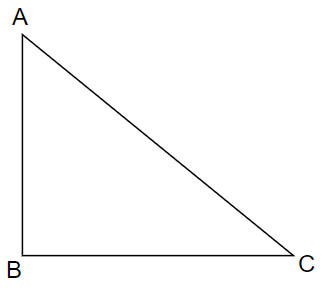
Also, we can use the Pythagoras theorem on this triangle, thus, we get,
$A{{B}^{2}}+B{{C}^{2}}=A{{C}^{2}}$
${{x}^{2}}+{{x}^{2}}={{y}^{2}}$
${{y}^{2}}=2{{x}^{2}}$
y = $\sqrt{2}x$ -- (1)
Now, the perimeter of this triangle is (6 + $3\sqrt{2}$), thus, we have,
Perimeter of ABC = x + x + y
Perimeter of ABC = 2x + $\sqrt{2}x$
(6 + $3\sqrt{2}$) = 2x + $\sqrt{2}x$
x = $\dfrac{6+3\sqrt{2}}{2+\sqrt{2}}$
Dividing the numerator and denominator by $\sqrt{2}$, we get,
x = $\dfrac{3\sqrt{2}+3}{\sqrt{2}+1}$ -- (A)
Now, the area is given by $\dfrac{1}{2}{{x}^{2}}$. Thus, we have,
= $\dfrac{1}{2}{{x}^{2}}$
= $\dfrac{1}{2}{{\left( \dfrac{3\sqrt{2}+3}{\sqrt{2}+1} \right)}^{2}}$
By rationalization, we get,
= $\dfrac{1}{2}{{\left( \left( \dfrac{3\sqrt{2}+3}{\sqrt{2}+1} \right)\left( \dfrac{\sqrt{2}-1}{\sqrt{2}-1} \right) \right)}^{2}}$
= $\dfrac{1}{2}{{\left( 6-3\sqrt{2}+3\sqrt{2}-3 \right)}^{2}}$
= $\dfrac{1}{2}{{\left( 6-3 \right)}^{2}}$
= 4.5
Hence, the correct answer is (a) 4.5 ${{m}^{2}}$.
Note: In the problem, we were given that the triangle is the right isosceles triangle. However, if we were given to find the area of any triangle with no special properties, we use the heron’s formula given by $\sqrt{s(s-a)(s-b)(s-c)}$. Here, s is half the length of the perimeter and a, b and c are the lengths of the respective sides of the triangle.
Complete step-by-step answer:
Before beginning the problem, we will address a few important things to refer to. We will refer to the right triangle ABC below with AB = BC = x, AC = y and angle ABC = 90 degrees.
Also, we can use the Pythagoras theorem on this triangle, thus, we get,
$A{{B}^{2}}+B{{C}^{2}}=A{{C}^{2}}$
${{x}^{2}}+{{x}^{2}}={{y}^{2}}$
${{y}^{2}}=2{{x}^{2}}$
y = $\sqrt{2}x$ -- (1)
Now, the perimeter of this triangle is (6 + $3\sqrt{2}$), thus, we have,
Perimeter of ABC = x + x + y
Perimeter of ABC = 2x + $\sqrt{2}x$
(6 + $3\sqrt{2}$) = 2x + $\sqrt{2}x$
x = $\dfrac{6+3\sqrt{2}}{2+\sqrt{2}}$
Dividing the numerator and denominator by $\sqrt{2}$, we get,
x = $\dfrac{3\sqrt{2}+3}{\sqrt{2}+1}$ -- (A)
Now, the area is given by $\dfrac{1}{2}{{x}^{2}}$. Thus, we have,
= $\dfrac{1}{2}{{x}^{2}}$
= $\dfrac{1}{2}{{\left( \dfrac{3\sqrt{2}+3}{\sqrt{2}+1} \right)}^{2}}$
By rationalization, we get,
= $\dfrac{1}{2}{{\left( \left( \dfrac{3\sqrt{2}+3}{\sqrt{2}+1} \right)\left( \dfrac{\sqrt{2}-1}{\sqrt{2}-1} \right) \right)}^{2}}$
= $\dfrac{1}{2}{{\left( 6-3\sqrt{2}+3\sqrt{2}-3 \right)}^{2}}$
= $\dfrac{1}{2}{{\left( 6-3 \right)}^{2}}$
= 4.5
Hence, the correct answer is (a) 4.5 ${{m}^{2}}$.
Note: In the problem, we were given that the triangle is the right isosceles triangle. However, if we were given to find the area of any triangle with no special properties, we use the heron’s formula given by $\sqrt{s(s-a)(s-b)(s-c)}$. Here, s is half the length of the perimeter and a, b and c are the lengths of the respective sides of the triangle.
Recently Updated Pages
Master Class 12 Social Science: Engaging Questions & Answers for Success

Master Class 12 Physics: Engaging Questions & Answers for Success
Master Class 12 Maths: Engaging Questions & Answers for Success
Master Class 12 Economics: Engaging Questions & Answers for Success
Master Class 12 Chemistry: Engaging Questions & Answers for Success
Master Class 12 Business Studies: Engaging Questions & Answers for Success
Trending doubts
Which are the Top 10 Largest Countries of the World?
Draw a labelled sketch of the human eye class 12 physics CBSE
Explain the structure of megasporangium class 12 biology CBSE
What are the major means of transport Explain each class 12 social science CBSE
How many chromosomes are found in human ovum a 46 b class 12 biology CBSE
The diagram of the section of a maize grain is given class 12 biology CBSE