



If the pair of alternate interior angles are equal then the lines are parallel. If true enter 1 else 0.
Answer
 Verified
628.2k+ views
Hint: We will start by drawing the figure and by proving the corresponding angles to be equal, we can prove that the lines are parallel. For that, we will use the conditions where vertically opposite angles are equal and by using the given condition that alternate interior angles are equal, we can prove that the corresponding angles are equal and hence the lines are parallel.
Complete step-by-step answer:
We are given that the pair of alternate interior angles are equal.
Let us suppose two lines AB and CD. A transversal line PS intersects AB at a point Q and it intersects CD at a point R such that the given condition of the alternate interior angles to be equal is fulfilled i.e., $\angle $BQR = $\angle $CRQ
Let us draw the figure of this arrangement:
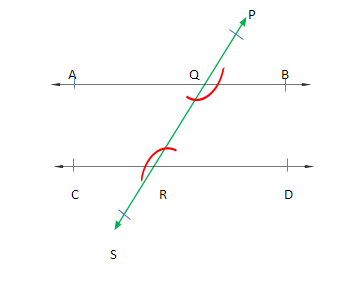
From the figure, for the lines AB and PS we can say that
$\angle $AQP = $\angle $BQR ($\because $Vertically opposite angles)
Also, we are given that $\angle $BQR = $\angle $CRQ from the given condition of the alternate interior angles.
Hence, upon combining the above two conditions (equalities), we can say that
$\therefore $$\angle $AQP = $\angle $CRQ
But from the figure $\angle $AQP and$\angle $ CRQ are corresponding angles. Hence, we can say that the corresponding angles are equal.
Therefore, by the property of the angles that if corresponding angles are equal, then the lines are parallel to each other, we can say that the two lines AB and CD are parallel to each other.
Therefore, the answer will be entered as 1 since the statement is found to be true.
Note: In such questions, you may go wrong while proving the angles to be corresponding angles and equal to each other. You may get confused if you don’t remember the properties properly because there are a lot of properties used while proving the two lines to be parallel.
Complete step-by-step answer:
We are given that the pair of alternate interior angles are equal.
Let us suppose two lines AB and CD. A transversal line PS intersects AB at a point Q and it intersects CD at a point R such that the given condition of the alternate interior angles to be equal is fulfilled i.e., $\angle $BQR = $\angle $CRQ
Let us draw the figure of this arrangement:
From the figure, for the lines AB and PS we can say that
$\angle $AQP = $\angle $BQR ($\because $Vertically opposite angles)
Also, we are given that $\angle $BQR = $\angle $CRQ from the given condition of the alternate interior angles.
Hence, upon combining the above two conditions (equalities), we can say that
$\therefore $$\angle $AQP = $\angle $CRQ
But from the figure $\angle $AQP and$\angle $ CRQ are corresponding angles. Hence, we can say that the corresponding angles are equal.
Therefore, by the property of the angles that if corresponding angles are equal, then the lines are parallel to each other, we can say that the two lines AB and CD are parallel to each other.
Therefore, the answer will be entered as 1 since the statement is found to be true.
Note: In such questions, you may go wrong while proving the angles to be corresponding angles and equal to each other. You may get confused if you don’t remember the properties properly because there are a lot of properties used while proving the two lines to be parallel.
Recently Updated Pages
Master Class 11 English: Engaging Questions & Answers for Success

Master Class 11 Social Science: Engaging Questions & Answers for Success
Master Class 11 Maths: Engaging Questions & Answers for Success
Master Class 11 Biology: Engaging Questions & Answers for Success
Master Class 11 Physics: Engaging Questions & Answers for Success
Master Class 11 Chemistry: Engaging Questions & Answers for Success
Trending doubts