




If the median of a triangle meet at $\left( 0,-3 \right)$ and the two vertices are at $\left( -1,4 \right)$ and $\left( 5,2 \right)$ then the third vertex is at _____. \[\]
Answer
 Verified
616.2k+ views
Hint: We first find the coordinates of the midpoint M of side joining the given vertices $B\left( -1,4 \right),C\left( 5,2 \right)$ using the section formula for internal division with ratio 1:1. We then assume the coordinate of the third vertex as $A\left( x,y \right)$ . We know that centroid where the medians meet O$\left( 0,-3 \right)$ divides AM with ratio 2:1. We use the section formula again and find the unknowns $x,y$. \[\]
Complete step by step answer:
A median is the line joining the vertex of a triangle to the midpoint of the opposite side . The centroid of a triangle is the point of intersection of the medians.
Section Formula: Any point $P(x,y)$ which divides a line segment internally $\overline{AB}$ in a ratio$AP:PB=m:n$ with endpoints $A({{x}_{1}},{{y}_{2}})\text{ and B(}{{\text{x}}_{2}}\text{,}{{\text{y}}_{2}}\text{)}$ then the coordinates of P are
\[x=\dfrac{m{{x}_{2}}+n{{x}_{1}}}{m+n},y=\dfrac{m{{y}_{2}}+n{{y}_{1}}}{m+n}\]
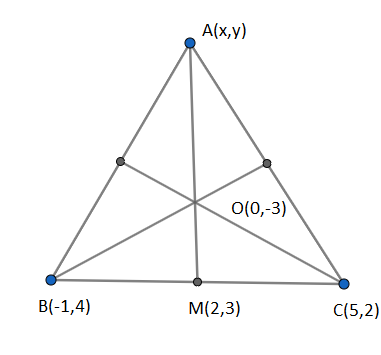
We denote the given vertices as $B\left( -1,4 \right),C\left( 5,2 \right)$. We denote the midpoint of BC as M. We join AM and now AM is median. We know that midpoint divides any line segment in a ratio 1:1. So M divides BC with ratio 1:1. We have the coordinates of M using section formula as
\[M=\left( \dfrac{1\left( -1 \right)+1\cdot 5}{2},\dfrac{1\cdot 4+1\times 2}{2} \right)=\left( \dfrac{4}{2},\dfrac{6}{2} \right)=\left( 2,3 \right)\]
We denote the centroid as O whose coordinates are given in the question as$\left( 0,-3 \right)$. We also know that the centroid divides the median in a ratio 2:1 where the distance from the vertex to the centroid is twice the distance from the midpoint on the opposite side to the said vertex. We assume the coordinate of A as$\left( x,y \right)$. We have O dividing A$\left( x,y \right)=\left( {{x}_{1}},{{y}_{1}} \right)$ and M $\left( 2,3 \right)=\left( {{x}_{2}},{{y}_{2}} \right)$ with ratio $AO:OM=m:n=2:1$. We use section formula and have,
\[\begin{align}
& 0=\dfrac{2\times 2+1\times x}{3},-3=\dfrac{2\times 3+1\times y}{3} \\
& \Rightarrow 0=4+x,-9=6+y \\
& \Rightarrow x=-4,y=-15 \\
\end{align}\]
So the coordinates of the third vertex A is $A\left( -4,-15 \right)$\[\]
Note: We need to be careful of the confusion of internal division for external division which is given by$x=\dfrac{m{{x}_{2}}-n{{x}_{1}}}{m-n},y=\dfrac{m{{y}_{2}}-n{{y}_{1}}}{m-n}$. We can alternatively solve directly using the coordinates of centroid $\left( \dfrac{{{x}_{1}}+{{x}_{2}}+{{x}_{3}}}{3},\dfrac{{{y}_{1}}+{{y}_{2}}+{{y}_{3}}}{3} \right)$ where $\left( {{x}_{1}},{{y}_{1}} \right),\left( {{x}_{2}},{{y}_{2}} \right),\left( {{x}_{3}},{{y}_{3}} \right)$ are coordinates of the vertices of the triangle.
Complete step by step answer:
A median is the line joining the vertex of a triangle to the midpoint of the opposite side . The centroid of a triangle is the point of intersection of the medians.
Section Formula: Any point $P(x,y)$ which divides a line segment internally $\overline{AB}$ in a ratio$AP:PB=m:n$ with endpoints $A({{x}_{1}},{{y}_{2}})\text{ and B(}{{\text{x}}_{2}}\text{,}{{\text{y}}_{2}}\text{)}$ then the coordinates of P are
\[x=\dfrac{m{{x}_{2}}+n{{x}_{1}}}{m+n},y=\dfrac{m{{y}_{2}}+n{{y}_{1}}}{m+n}\]
We denote the given vertices as $B\left( -1,4 \right),C\left( 5,2 \right)$. We denote the midpoint of BC as M. We join AM and now AM is median. We know that midpoint divides any line segment in a ratio 1:1. So M divides BC with ratio 1:1. We have the coordinates of M using section formula as
\[M=\left( \dfrac{1\left( -1 \right)+1\cdot 5}{2},\dfrac{1\cdot 4+1\times 2}{2} \right)=\left( \dfrac{4}{2},\dfrac{6}{2} \right)=\left( 2,3 \right)\]
We denote the centroid as O whose coordinates are given in the question as$\left( 0,-3 \right)$. We also know that the centroid divides the median in a ratio 2:1 where the distance from the vertex to the centroid is twice the distance from the midpoint on the opposite side to the said vertex. We assume the coordinate of A as$\left( x,y \right)$. We have O dividing A$\left( x,y \right)=\left( {{x}_{1}},{{y}_{1}} \right)$ and M $\left( 2,3 \right)=\left( {{x}_{2}},{{y}_{2}} \right)$ with ratio $AO:OM=m:n=2:1$. We use section formula and have,
\[\begin{align}
& 0=\dfrac{2\times 2+1\times x}{3},-3=\dfrac{2\times 3+1\times y}{3} \\
& \Rightarrow 0=4+x,-9=6+y \\
& \Rightarrow x=-4,y=-15 \\
\end{align}\]
So the coordinates of the third vertex A is $A\left( -4,-15 \right)$\[\]
Note: We need to be careful of the confusion of internal division for external division which is given by$x=\dfrac{m{{x}_{2}}-n{{x}_{1}}}{m-n},y=\dfrac{m{{y}_{2}}-n{{y}_{1}}}{m-n}$. We can alternatively solve directly using the coordinates of centroid $\left( \dfrac{{{x}_{1}}+{{x}_{2}}+{{x}_{3}}}{3},\dfrac{{{y}_{1}}+{{y}_{2}}+{{y}_{3}}}{3} \right)$ where $\left( {{x}_{1}},{{y}_{1}} \right),\left( {{x}_{2}},{{y}_{2}} \right),\left( {{x}_{3}},{{y}_{3}} \right)$ are coordinates of the vertices of the triangle.
Recently Updated Pages
Master Class 11 English: Engaging Questions & Answers for Success

Master Class 11 Social Science: Engaging Questions & Answers for Success
Master Class 11 Maths: Engaging Questions & Answers for Success
Master Class 11 Biology: Engaging Questions & Answers for Success
Master Class 11 Physics: Engaging Questions & Answers for Success
Master Class 11 Chemistry: Engaging Questions & Answers for Success
Trending doubts
Explain the Treaty of Vienna of 1815 class 10 social science CBSE
What is the full form of CNG A Complete Natural Gas class 10 social science CBSE
In cricket, what is a "Yorker" designed to do?
What is the full form of POSCO class 10 social science CBSE
Define Potential, Developed, Stock and Reserved resources
What were the majoritarian measures taken in Sri Lanka class 10 social science CBSE