




If the length of the latus rectum of an ellipse is 4 units and the distance between a focus and its nearest vertex on the major axis is 3/2 units, then its eccentricity is?
${\text{A}}{\text{. }}\dfrac{1}{2}$
${\text{B}}{\text{. }}\dfrac{2}{3}$
${\text{C}}{\text{. }}\dfrac{1}{9}$
${\text{D}}{\text{. }}\dfrac{1}{3}$
Answer
 Verified
649.2k+ views
Hint – We know the Focus = (ae, 0) and vertex = (a, 0) and the distance between focus and vertex = a(1-e) and eccentricity of the ellipse ${e^2} = 1 - \dfrac{{{b^2}}}{{{a^2}}}$. Use this to find the answer.
Complete step-by-step answer:
Now, according to the question,
Length of the latus rectum of an ellipse = 4 units.
Distance between a focus and its nearest vertex on the major axis is 3/2 units.
For better understanding refer the figure below-
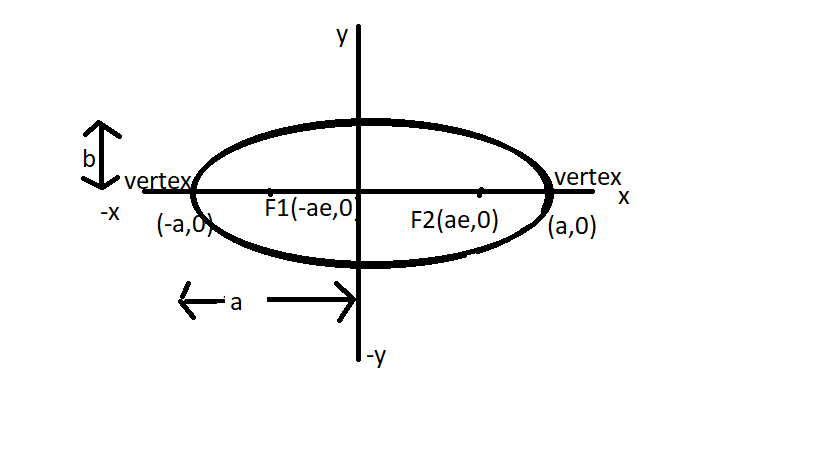
Now we know that the Focus = (ae, 0) and vertex = (a, 0) and the distance between focus and vertex = a(1-e).
Now,
$
a(1 - e) = \dfrac{3}{2} \\
\Rightarrow a - ae = \dfrac{3}{2} \\
\Rightarrow a - \dfrac{3}{2} = ae \to (1) \\
$
Squaring the above equation, we get-
$ \Rightarrow {a^2} + \dfrac{9}{4} - 3a = {a^2}{e^2} \to (2)$
Now, using the length of the latus rectum is given by $\dfrac{{2{b^2}}}{a}$.
We know the length of the latus rectum as given in the question is 4 units.
Therefore, $
\dfrac{{2{b^2}}}{a} = 4 \\
\Rightarrow {b^2} = 2a \to (3) \\
$
Now, we know eccentricity $
{e^2} = 1 - \dfrac{{{b^2}}}{{{a^2}}} \\
= 1 - \dfrac{{2a}}{{{a^2}}} \\
${from equation (3)}
$ \Rightarrow {e^2} = 1 - \dfrac{2}{a} \to (4)$
Substituting this in equation (2), we get-
$
\Rightarrow {a^2} + \dfrac{9}{4} - 3a = {a^2}\left( {1 - \dfrac{2}{a}} \right) \\
\Rightarrow {a^2} + \dfrac{9}{4} - 3a = {a^2} - 2a \\
\Rightarrow a = \dfrac{9}{4} \\
$
Therefore,
$
\Rightarrow {e^2} = 1 - \dfrac{2}{a} \\
\Rightarrow {e^2} = 1 - \dfrac{2}{{\dfrac{9}{4}}} \\
\Rightarrow {e^2} = 1 - \dfrac{2}{9} \times 4 \\
\Rightarrow {e^2} = 1 - \dfrac{8}{9} = \dfrac{1}{9} \\
\Rightarrow e = \dfrac{1}{3} \\
$
Hence, the eccentricity of the given ellipse is $e = \dfrac{1}{3}$.
Note – Whenever such types of questions appear, then write the given things in the question and then by using the standard formula of the distance between focus and vertex = a(1-e) = 3/2. Squaring both the sides, we get, ${a^2} + \dfrac{9}{4} - 3a = {a^2}{e^2}$ and then using the standard formula of eccentricity of the ellipse ${e^2} = 1 - \dfrac{{{b^2}}}{{{a^2}}}$, find the value of e.
Complete step-by-step answer:
Now, according to the question,
Length of the latus rectum of an ellipse = 4 units.
Distance between a focus and its nearest vertex on the major axis is 3/2 units.
For better understanding refer the figure below-
Now we know that the Focus = (ae, 0) and vertex = (a, 0) and the distance between focus and vertex = a(1-e).
Now,
$
a(1 - e) = \dfrac{3}{2} \\
\Rightarrow a - ae = \dfrac{3}{2} \\
\Rightarrow a - \dfrac{3}{2} = ae \to (1) \\
$
Squaring the above equation, we get-
$ \Rightarrow {a^2} + \dfrac{9}{4} - 3a = {a^2}{e^2} \to (2)$
Now, using the length of the latus rectum is given by $\dfrac{{2{b^2}}}{a}$.
We know the length of the latus rectum as given in the question is 4 units.
Therefore, $
\dfrac{{2{b^2}}}{a} = 4 \\
\Rightarrow {b^2} = 2a \to (3) \\
$
Now, we know eccentricity $
{e^2} = 1 - \dfrac{{{b^2}}}{{{a^2}}} \\
= 1 - \dfrac{{2a}}{{{a^2}}} \\
${from equation (3)}
$ \Rightarrow {e^2} = 1 - \dfrac{2}{a} \to (4)$
Substituting this in equation (2), we get-
$
\Rightarrow {a^2} + \dfrac{9}{4} - 3a = {a^2}\left( {1 - \dfrac{2}{a}} \right) \\
\Rightarrow {a^2} + \dfrac{9}{4} - 3a = {a^2} - 2a \\
\Rightarrow a = \dfrac{9}{4} \\
$
Therefore,
$
\Rightarrow {e^2} = 1 - \dfrac{2}{a} \\
\Rightarrow {e^2} = 1 - \dfrac{2}{{\dfrac{9}{4}}} \\
\Rightarrow {e^2} = 1 - \dfrac{2}{9} \times 4 \\
\Rightarrow {e^2} = 1 - \dfrac{8}{9} = \dfrac{1}{9} \\
\Rightarrow e = \dfrac{1}{3} \\
$
Hence, the eccentricity of the given ellipse is $e = \dfrac{1}{3}$.
Note – Whenever such types of questions appear, then write the given things in the question and then by using the standard formula of the distance between focus and vertex = a(1-e) = 3/2. Squaring both the sides, we get, ${a^2} + \dfrac{9}{4} - 3a = {a^2}{e^2}$ and then using the standard formula of eccentricity of the ellipse ${e^2} = 1 - \dfrac{{{b^2}}}{{{a^2}}}$, find the value of e.
Recently Updated Pages
Master Class 11 English: Engaging Questions & Answers for Success

Master Class 11 Social Science: Engaging Questions & Answers for Success
Master Class 11 Maths: Engaging Questions & Answers for Success
Master Class 11 Chemistry: Engaging Questions & Answers for Success
Master Class 11 Biology: Engaging Questions & Answers for Success
Master Class 11 Physics: Engaging Questions & Answers for Success
Trending doubts
One Metric ton is equal to kg A 10000 B 1000 C 100 class 11 physics CBSE
Difference Between Prokaryotic Cells and Eukaryotic Cells
Find the value of the expression given below sin 30circ class 11 maths CBSE
1 ton equals to A 100 kg B 1000 kg C 10 kg D 10000 class 11 physics CBSE
Two of the body parts which do not appear in MRI are class 11 biology CBSE
What are hard magnetic materials class 11 physics CBSE