




If the length of the diagonal of a cube is \[6\sqrt{3}cm\], find the edge of the cube.
Answer
 Verified
650.7k+ views
Hint: Equate the given length of diagonal of cube to the formula for calculating the diagonal of cube which says that the diagonal of a cube is of length \[\sqrt{3}a\] units when the length of edge of cube is a units. Simplify the expression to get the length of the edge of the cube.
Complete step-by-step answer:
We have a cube, the length of whose diagonal is \[6\sqrt{3}\] cm. We have to evaluate the length of the edge of the cube. Let’s assume that the length of the edge of the cube is a unit.
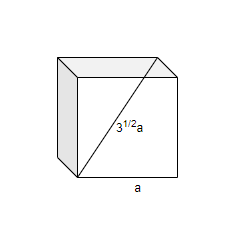
We know that if the length of the edge of the cube is a unit, then the length of the diagonal of the cube is \[\sqrt{3}a\] units.
Thus, we have \[\sqrt{3}a=6\sqrt{3}\].
Simplifying the above expression, we have \[a=\dfrac{6\sqrt{3}}{\sqrt{3}}=6\] cm.
Hence, the length of the edge of the cube whose diagonal is of length \[6\sqrt{3}cm\] is 6cm.
Note: Cube is a three dimensional solid object bounded by six square faces, with three meeting at each vertex. The cube is the only regular hexahedron. It has 6 faces, 12 edges and 8 vertices. It is the only convex polyhedron whose faces are all squares. The volume of the cube, whose length of each edge is a unit is \[{{a}^{3}}\]. The length of any face diagonal of a cube, whose edge is of length a is \[\sqrt{2}a\]. The total surface area of the cube whose edge length is a is given by \[6{{a}^{2}}\]. While solving this question, one must keep in mind that we have to consider the space diagonal of the cube and not the face diagonal. If we consider the face diagonal to solve the question, we will get an incorrect answer.
Complete step-by-step answer:
We have a cube, the length of whose diagonal is \[6\sqrt{3}\] cm. We have to evaluate the length of the edge of the cube. Let’s assume that the length of the edge of the cube is a unit.
We know that if the length of the edge of the cube is a unit, then the length of the diagonal of the cube is \[\sqrt{3}a\] units.
Thus, we have \[\sqrt{3}a=6\sqrt{3}\].
Simplifying the above expression, we have \[a=\dfrac{6\sqrt{3}}{\sqrt{3}}=6\] cm.
Hence, the length of the edge of the cube whose diagonal is of length \[6\sqrt{3}cm\] is 6cm.
Note: Cube is a three dimensional solid object bounded by six square faces, with three meeting at each vertex. The cube is the only regular hexahedron. It has 6 faces, 12 edges and 8 vertices. It is the only convex polyhedron whose faces are all squares. The volume of the cube, whose length of each edge is a unit is \[{{a}^{3}}\]. The length of any face diagonal of a cube, whose edge is of length a is \[\sqrt{2}a\]. The total surface area of the cube whose edge length is a is given by \[6{{a}^{2}}\]. While solving this question, one must keep in mind that we have to consider the space diagonal of the cube and not the face diagonal. If we consider the face diagonal to solve the question, we will get an incorrect answer.
Recently Updated Pages
Master Class 11 English: Engaging Questions & Answers for Success

Master Class 11 Social Science: Engaging Questions & Answers for Success
Master Class 11 Maths: Engaging Questions & Answers for Success
Master Class 11 Biology: Engaging Questions & Answers for Success
Master Class 11 Physics: Engaging Questions & Answers for Success
Master Class 11 Chemistry: Engaging Questions & Answers for Success
Trending doubts
Explain the Treaty of Vienna of 1815 class 10 social science CBSE
First Cotton Mill of India
In which year voting age was reduced from 21 to 18?
What planets have no moons Which one has only one moon class 10 physics CBSE
What is the full form of POSCO class 10 social science CBSE
Define Potential, Developed, Stock and Reserved resources