




If the length of 3 sides of a Trapezium(other than base) are equal to 10cm, then find the area of the trapezium when it is maximum.
Answer
 Verified
675.6k+ views
Hint: Mark the 3 sides of 10cm. Now drop perpendiculars from the known parallel side to the unknown one. Now assume variable x to the extra part after perpendiculars. Now assume foot of perpendicular to P, Q. Thus apply formula for area of trapezium. Find its height by using Pythagoras theorem. Then you get area as a function of x. Now differentiate it to find the points of maximum by equating it to \[2\omega \]. By substituting back into area get the maximum area.
Complete step by step solution:
Given condition of trapezium in the question is written as:
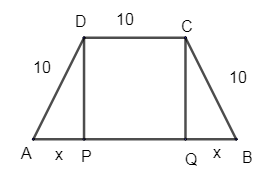
AD = DC = CB = 10
Draw perpendiculars DP & CQ on AB.
Let AP = x, by symmetry QB = x.
Let A be an area of trapezium. By formula we can say it as:
\[\Rightarrow A=\dfrac{1}{2}\times \] (sum of parallel sides) \[\times \] (height) – (1)
As triangle ADP is right angle by applying Pythagoras theorem we can write equation,
\[\Rightarrow A{{D}^{2}}=A{{P}^{2}}+D{{P}^{2}}\]
By substituting the value of sides into equation:
\[\Rightarrow {{10}^{2}}={{x}^{2}}+D{{P}^{2}}\]
By subtracting \[{{x}^{2}}\] on both sides we get it as:
\[\Rightarrow {{x}^{2}}+D{{P}^{2}}-{{x}^{2}}={{10}^{2}}-{{x}^{2}}\]
By cancelling common terms, we get it as follows here:
\[\Rightarrow D{{P}^{2}}={{10}^{2}}-{{x}^{2}}\]
By simplifying terms on right hand side, we get it as:
\[\Rightarrow D{{P}^{2}}=100-{{x}^{2}}\]
By applying square root on both sides, we get it as:
\[\Rightarrow \sqrt{D{{P}^{2}}}=\sqrt{100-{{x}^{2}}}\]
By simplifying the above equation of DP, we get it as:
\[\Rightarrow DP=\sqrt{100-{{x}^{2}}}\]
From diagram, we can see that DP = height, by this we get:
Height = \[\sqrt{100-{{x}^{2}}}\] - (2)
From the diagram we can see PQ = DC because of perpendiculars:
\[\Rightarrow \] PQ = DC = 10cm
By dividing AB by points P, Q points, we get it as:
\[\Rightarrow \] AB = AP + PQ + PB
By substituting the values of sides, we get it as:
\[\Rightarrow \] AB = x + 10 + x
By adding the term DC on both sides, we get it as:
\[\Rightarrow \] AB + DC = x + 10 + x + 10
By simplifying on right hand side, we get it as:
\[\Rightarrow \] AB + DC = 2 (x + 10)
By diagram we can say this is sum of parallel sides:
Sum of parallel sides = 2 (x + 10) – (3)
So, by this we found sum, height so we can find the area.
By substituting equation (2), (3) in equation (1), we get it as:
\[\Rightarrow A=\dfrac{1}{2}\times 2\left( x+10 \right)\times \sqrt{100-{{x}^{2}}}\]
By simplifying the terms, we can say the A to be:
\[\Rightarrow A=\left( x+10 \right)\times \sqrt{100-{{x}^{2}}}\] - (4)
We need to find the area of trapezium, at its maximum.
So, we need to maximize area, i.e. we need \[\dfrac{dA}{dx}=0\].
By differentiating on both sides with respect to x, we get:
\[\Rightarrow \dfrac{dA}{dx}=\dfrac{d}{dx}\left[ \left( x+10 \right)\sqrt{100-{{x}^{2}}} \right]\]
By basic knowledge of differentiation, u.v rule is said:
\[\Rightarrow d\left( u.v \right)=vdu+udv\]
By applying u.v rule here, we get the equation as:
\[\Rightarrow \dfrac{dA}{dx}=\sqrt{100-{{x}^{2}}}\dfrac{d}{dx}\left( x+10 \right)+\left( x+10 \right)\dfrac{d}{dx}\left( \sqrt{100-{{x}^{2}}} \right)\]
By basic knowledge of differentiation, we know that:
\[\Rightarrow \dfrac{d}{dx}\left( x \right)=1;\dfrac{d}{dx}\left( \sqrt{y} \right)=\dfrac{1}{2\sqrt{y}}\dfrac{dy}{dx}\]
By substituting these into the above equation, we get it as:
\[\Rightarrow \dfrac{dA}{dx}=\sqrt{100-{{x}^{2}}}.\left( 1 \right)+\left( x+10 \right)\dfrac{1}{2\sqrt{100-{{x}^{2}}}}.\dfrac{d}{dx}\left( 100-{{x}^{2}} \right)\]
By basic knowledge of differentiation, we know the formula:
\[\Rightarrow \dfrac{d}{dx}\left( k \right)=0\], k = constant, \[\dfrac{d}{dx}\left( -{{x}^{2}} \right)=-2x\].
By substituting these into above equation, we get it as:
\[\Rightarrow \dfrac{dA}{dx}=\sqrt{100-{{x}^{2}}}+\dfrac{\left( x+10 \right)}{2\sqrt{100-{{x}^{2}}}}\left( -2x \right)\]
By simplifying the second term, we get it as follows:
\[\Rightarrow \dfrac{dA}{dx}=\sqrt{100-{{x}^{2}}}-\dfrac{{{x}^{2}}+10x}{\sqrt{100-{{x}^{2}}}}\]
By taking least common multiple on left sides, we get it as:
\[\Rightarrow \dfrac{dA}{dx}=\dfrac{100-{{x}^{2}}-{{x}^{2}}-10x}{\sqrt{100-{{x}^{2}}}}\]
By substituting \[\dfrac{dA}{dx}=0\] and cross multiply we get it as:
\[\Rightarrow -2{{x}^{2}}-10x+100=0\]
By taking -2 as common, and writing 5x as 10x – 5x we get:
\[\Rightarrow {{x}^{2}}+10x-5x+50=0\]
Taking x common in first two terms and -5 common in next two terms we get:
\[\Rightarrow x\left( x+10 \right)-5\left( x+10 \right)=0\Rightarrow \left( x-5 \right)\left( x+10 \right)=0\]
By equation above, we can say the roots are given by:
x = 5 or x = 10 are the critical points. We have differentiation as:
\[\Rightarrow \dfrac{dA}{dx}=\dfrac{100-{{x}^{2}}-{{x}^{2}}-10x}{\sqrt{100-{{x}^{2}}}}\]
Now we need to differentiate again. By differentiating on both sides, we get:
\[\Rightarrow \dfrac{{{d}^{2}}A}{d{{x}^{2}}}=\dfrac{d\left( \dfrac{100-2{{x}^{2}}-10x}{\sqrt{100-{{x}^{2}}}} \right)}{dx}\]
Now by u, v rule, we can write it as:
\[\dfrac{d\left( \dfrac{u}{v} \right)}{dx}=\dfrac{vdu-udv}{{{v}^{2}}}\]
By substituting this equation, we get it in the form of:
\[\Rightarrow \dfrac{{{d}^{2}}A}{d{{x}^{2}}}=\dfrac{\sqrt{100-{{x}^{2}}}\left( d\left( -2{{x}^{2}}-10x+100 \right) \right)-\left( -2{{x}^{2}}-10x+100 \right)\left( d\left( \sqrt{100-{{x}^{2}}} \right) \right)}{100-{{x}^{2}}}\]
We know:
\[d\left( -2{{x}^{2}}-10x+100 \right)=-4x-10\]
\[d\left( \sqrt{100-{{x}^{2}}} \right)=\dfrac{-x}{\sqrt{100-{{x}^{2}}}}\]
By substituting this into above equation, we can write it as:
\[\Rightarrow \dfrac{{{d}^{2}}A}{d{{x}^{2}}}=\dfrac{\sqrt{100-{{x}^{2}}}\left( -4x-10 \right)-\left( -2{{x}^{2}}-10x+100 \right)\left( \dfrac{-x}{\sqrt{100-{{x}^{2}}}} \right)}{100-{{x}^{2}}}\]
By simplifying the above equation, we can write it as:
\[\Rightarrow \dfrac{{{d}^{2}}A}{d{{x}^{2}}}=\dfrac{\left( 100-{{x}^{2}} \right)\left( -4x-10 \right)-\left( -2{{x}^{2}}-10x+100 \right)\left( -x \right)}{\left( 100-{{x}^{2}} \right)\left( \sqrt{100-{{x}^{2}}} \right)}\]
By simplifying the numerator, we can write it as:
\[\Rightarrow \dfrac{{{d}^{2}}A}{d{{x}^{2}}}=\dfrac{\left( 4{{x}^{3}}-400x-1000+10{{x}^{2}} \right)-\left( 2{{x}^{3}}+10{{x}^{2}}-100x \right)}{\left( 100-{{x}^{2}} \right)\left( \sqrt{100-{{x}^{2}}} \right)}\]
By cancelling common terms we can write second differentiation as:
\[\Rightarrow \dfrac{{{d}^{2}}A}{d{{x}^{2}}}=\dfrac{2{{x}^{3}}-300x-1000}{\left( 100-{{x}^{2}} \right)\left( \sqrt{100-{{x}^{2}}} \right)}\]
If we substitute x = 5, we get it as:
\[\Rightarrow {{\left( \dfrac{{{d}^{2}}A}{d{{x}^{2}}} \right)}_{x=5}}=\dfrac{2{{\left( 5 \right)}^{3}}-300\left( 5 \right)-1000}{\left( 100-{{\left( 5 \right)}^{2}} \right)\left( \sqrt{100-{{\left( 5 \right)}^{2}}} \right)}\]
By simplifying above, we can say it as:
\[\Rightarrow {{\left( \dfrac{{{d}^{2}}A}{d{{x}^{2}}} \right)}_{x=5}}=\dfrac{-2250}{75\sqrt{75}}\]
Finally we can say value of it as:
\[\Rightarrow {{\left( \dfrac{{{d}^{2}}A}{d{{x}^{2}}} \right)}_{x=5}}=\dfrac{-30}{\sqrt{75}}\]
So, the second differentiation of A at x=5 is negative:
\[\Rightarrow {{\left( \dfrac{{{d}^{2}}A}{d{{x}^{2}}} \right)}_{x=5}}<0\Rightarrow \] x = 5 is maximum.
So, x = 5 is maximum. Substitute 5 in A, we get:
\[\Rightarrow A=\left( 5+10 \right)\sqrt{100-25}=15\sqrt{75}\]
By simplifying, we say it as: \[A=75\sqrt{3}\].
Therefore, the maximum area possible is \[75\sqrt{3}{{m}^{2}}\].
Note: The idea of dropping perpendiculars to divide A is because to maximize the area we need a variable whole AB can be assumed as variable. But then you want to get height in terms of assumed variables. So, this assumption we took here is the best one to solve it easily. After differentiating, find the critical parts carefully to get the correct result.
Complete step by step solution:
Given condition of trapezium in the question is written as:
AD = DC = CB = 10
Draw perpendiculars DP & CQ on AB.
Let AP = x, by symmetry QB = x.
Let A be an area of trapezium. By formula we can say it as:
\[\Rightarrow A=\dfrac{1}{2}\times \] (sum of parallel sides) \[\times \] (height) – (1)
As triangle ADP is right angle by applying Pythagoras theorem we can write equation,
\[\Rightarrow A{{D}^{2}}=A{{P}^{2}}+D{{P}^{2}}\]
By substituting the value of sides into equation:
\[\Rightarrow {{10}^{2}}={{x}^{2}}+D{{P}^{2}}\]
By subtracting \[{{x}^{2}}\] on both sides we get it as:
\[\Rightarrow {{x}^{2}}+D{{P}^{2}}-{{x}^{2}}={{10}^{2}}-{{x}^{2}}\]
By cancelling common terms, we get it as follows here:
\[\Rightarrow D{{P}^{2}}={{10}^{2}}-{{x}^{2}}\]
By simplifying terms on right hand side, we get it as:
\[\Rightarrow D{{P}^{2}}=100-{{x}^{2}}\]
By applying square root on both sides, we get it as:
\[\Rightarrow \sqrt{D{{P}^{2}}}=\sqrt{100-{{x}^{2}}}\]
By simplifying the above equation of DP, we get it as:
\[\Rightarrow DP=\sqrt{100-{{x}^{2}}}\]
From diagram, we can see that DP = height, by this we get:
Height = \[\sqrt{100-{{x}^{2}}}\] - (2)
From the diagram we can see PQ = DC because of perpendiculars:
\[\Rightarrow \] PQ = DC = 10cm
By dividing AB by points P, Q points, we get it as:
\[\Rightarrow \] AB = AP + PQ + PB
By substituting the values of sides, we get it as:
\[\Rightarrow \] AB = x + 10 + x
By adding the term DC on both sides, we get it as:
\[\Rightarrow \] AB + DC = x + 10 + x + 10
By simplifying on right hand side, we get it as:
\[\Rightarrow \] AB + DC = 2 (x + 10)
By diagram we can say this is sum of parallel sides:
Sum of parallel sides = 2 (x + 10) – (3)
So, by this we found sum, height so we can find the area.
By substituting equation (2), (3) in equation (1), we get it as:
\[\Rightarrow A=\dfrac{1}{2}\times 2\left( x+10 \right)\times \sqrt{100-{{x}^{2}}}\]
By simplifying the terms, we can say the A to be:
\[\Rightarrow A=\left( x+10 \right)\times \sqrt{100-{{x}^{2}}}\] - (4)
We need to find the area of trapezium, at its maximum.
So, we need to maximize area, i.e. we need \[\dfrac{dA}{dx}=0\].
By differentiating on both sides with respect to x, we get:
\[\Rightarrow \dfrac{dA}{dx}=\dfrac{d}{dx}\left[ \left( x+10 \right)\sqrt{100-{{x}^{2}}} \right]\]
By basic knowledge of differentiation, u.v rule is said:
\[\Rightarrow d\left( u.v \right)=vdu+udv\]
By applying u.v rule here, we get the equation as:
\[\Rightarrow \dfrac{dA}{dx}=\sqrt{100-{{x}^{2}}}\dfrac{d}{dx}\left( x+10 \right)+\left( x+10 \right)\dfrac{d}{dx}\left( \sqrt{100-{{x}^{2}}} \right)\]
By basic knowledge of differentiation, we know that:
\[\Rightarrow \dfrac{d}{dx}\left( x \right)=1;\dfrac{d}{dx}\left( \sqrt{y} \right)=\dfrac{1}{2\sqrt{y}}\dfrac{dy}{dx}\]
By substituting these into the above equation, we get it as:
\[\Rightarrow \dfrac{dA}{dx}=\sqrt{100-{{x}^{2}}}.\left( 1 \right)+\left( x+10 \right)\dfrac{1}{2\sqrt{100-{{x}^{2}}}}.\dfrac{d}{dx}\left( 100-{{x}^{2}} \right)\]
By basic knowledge of differentiation, we know the formula:
\[\Rightarrow \dfrac{d}{dx}\left( k \right)=0\], k = constant, \[\dfrac{d}{dx}\left( -{{x}^{2}} \right)=-2x\].
By substituting these into above equation, we get it as:
\[\Rightarrow \dfrac{dA}{dx}=\sqrt{100-{{x}^{2}}}+\dfrac{\left( x+10 \right)}{2\sqrt{100-{{x}^{2}}}}\left( -2x \right)\]
By simplifying the second term, we get it as follows:
\[\Rightarrow \dfrac{dA}{dx}=\sqrt{100-{{x}^{2}}}-\dfrac{{{x}^{2}}+10x}{\sqrt{100-{{x}^{2}}}}\]
By taking least common multiple on left sides, we get it as:
\[\Rightarrow \dfrac{dA}{dx}=\dfrac{100-{{x}^{2}}-{{x}^{2}}-10x}{\sqrt{100-{{x}^{2}}}}\]
By substituting \[\dfrac{dA}{dx}=0\] and cross multiply we get it as:
\[\Rightarrow -2{{x}^{2}}-10x+100=0\]
By taking -2 as common, and writing 5x as 10x – 5x we get:
\[\Rightarrow {{x}^{2}}+10x-5x+50=0\]
Taking x common in first two terms and -5 common in next two terms we get:
\[\Rightarrow x\left( x+10 \right)-5\left( x+10 \right)=0\Rightarrow \left( x-5 \right)\left( x+10 \right)=0\]
By equation above, we can say the roots are given by:
x = 5 or x = 10 are the critical points. We have differentiation as:
\[\Rightarrow \dfrac{dA}{dx}=\dfrac{100-{{x}^{2}}-{{x}^{2}}-10x}{\sqrt{100-{{x}^{2}}}}\]
Now we need to differentiate again. By differentiating on both sides, we get:
\[\Rightarrow \dfrac{{{d}^{2}}A}{d{{x}^{2}}}=\dfrac{d\left( \dfrac{100-2{{x}^{2}}-10x}{\sqrt{100-{{x}^{2}}}} \right)}{dx}\]
Now by u, v rule, we can write it as:
\[\dfrac{d\left( \dfrac{u}{v} \right)}{dx}=\dfrac{vdu-udv}{{{v}^{2}}}\]
By substituting this equation, we get it in the form of:
\[\Rightarrow \dfrac{{{d}^{2}}A}{d{{x}^{2}}}=\dfrac{\sqrt{100-{{x}^{2}}}\left( d\left( -2{{x}^{2}}-10x+100 \right) \right)-\left( -2{{x}^{2}}-10x+100 \right)\left( d\left( \sqrt{100-{{x}^{2}}} \right) \right)}{100-{{x}^{2}}}\]
We know:
\[d\left( -2{{x}^{2}}-10x+100 \right)=-4x-10\]
\[d\left( \sqrt{100-{{x}^{2}}} \right)=\dfrac{-x}{\sqrt{100-{{x}^{2}}}}\]
By substituting this into above equation, we can write it as:
\[\Rightarrow \dfrac{{{d}^{2}}A}{d{{x}^{2}}}=\dfrac{\sqrt{100-{{x}^{2}}}\left( -4x-10 \right)-\left( -2{{x}^{2}}-10x+100 \right)\left( \dfrac{-x}{\sqrt{100-{{x}^{2}}}} \right)}{100-{{x}^{2}}}\]
By simplifying the above equation, we can write it as:
\[\Rightarrow \dfrac{{{d}^{2}}A}{d{{x}^{2}}}=\dfrac{\left( 100-{{x}^{2}} \right)\left( -4x-10 \right)-\left( -2{{x}^{2}}-10x+100 \right)\left( -x \right)}{\left( 100-{{x}^{2}} \right)\left( \sqrt{100-{{x}^{2}}} \right)}\]
By simplifying the numerator, we can write it as:
\[\Rightarrow \dfrac{{{d}^{2}}A}{d{{x}^{2}}}=\dfrac{\left( 4{{x}^{3}}-400x-1000+10{{x}^{2}} \right)-\left( 2{{x}^{3}}+10{{x}^{2}}-100x \right)}{\left( 100-{{x}^{2}} \right)\left( \sqrt{100-{{x}^{2}}} \right)}\]
By cancelling common terms we can write second differentiation as:
\[\Rightarrow \dfrac{{{d}^{2}}A}{d{{x}^{2}}}=\dfrac{2{{x}^{3}}-300x-1000}{\left( 100-{{x}^{2}} \right)\left( \sqrt{100-{{x}^{2}}} \right)}\]
If we substitute x = 5, we get it as:
\[\Rightarrow {{\left( \dfrac{{{d}^{2}}A}{d{{x}^{2}}} \right)}_{x=5}}=\dfrac{2{{\left( 5 \right)}^{3}}-300\left( 5 \right)-1000}{\left( 100-{{\left( 5 \right)}^{2}} \right)\left( \sqrt{100-{{\left( 5 \right)}^{2}}} \right)}\]
By simplifying above, we can say it as:
\[\Rightarrow {{\left( \dfrac{{{d}^{2}}A}{d{{x}^{2}}} \right)}_{x=5}}=\dfrac{-2250}{75\sqrt{75}}\]
Finally we can say value of it as:
\[\Rightarrow {{\left( \dfrac{{{d}^{2}}A}{d{{x}^{2}}} \right)}_{x=5}}=\dfrac{-30}{\sqrt{75}}\]
So, the second differentiation of A at x=5 is negative:
\[\Rightarrow {{\left( \dfrac{{{d}^{2}}A}{d{{x}^{2}}} \right)}_{x=5}}<0\Rightarrow \] x = 5 is maximum.
So, x = 5 is maximum. Substitute 5 in A, we get:
\[\Rightarrow A=\left( 5+10 \right)\sqrt{100-25}=15\sqrt{75}\]
By simplifying, we say it as: \[A=75\sqrt{3}\].
Therefore, the maximum area possible is \[75\sqrt{3}{{m}^{2}}\].
Note: The idea of dropping perpendiculars to divide A is because to maximize the area we need a variable whole AB can be assumed as variable. But then you want to get height in terms of assumed variables. So, this assumption we took here is the best one to solve it easily. After differentiating, find the critical parts carefully to get the correct result.
Recently Updated Pages
Master Class 10 Computer Science: Engaging Questions & Answers for Success

Differentiate between voluntary action and reflex class 10 biology CBSE
The uses of bleaching powder are A It is used bleaching class 10 chemistry CBSE
Fill in the blanks with abstract nouns of the words class 10 english CBSE
How many threedigit numbers are there class 10 maths CBSE
What is a reflex arc class 10 biology CBSE
Trending doubts
Explain the Treaty of Vienna of 1815 class 10 social science CBSE
In basketball, how many quarters are played in an NBA game?
10 examples of evaporation in daily life with explanations
Which country is known as "The land of Fire and Ice"?
What is the full form of POSCO class 10 social science CBSE
In which year voting age was reduced from 21 to 18?