




If the image formed by a spherical mirror for all positions of the object placed in front of it is always erect and diminished, what type of mirror is it? Draw a labelled ray diagram to support your answer.
Answer
 Verified
666k+ views
Hint: The image should be erect and diminished at all conditions. We need to consider the possibility that the image can be virtual as well.
Formula Used:
For a spherical mirror the formula is,
$\dfrac{1}{v}+\dfrac{1}{u}=\dfrac{1}{f}$
Where,
$u$ is the distance of the object from the pole
$v$ is the distance of the image from the pole,
$f$ is the focal length of the spherical mirror.
Complete step by step answer:
We will consider the two spherical mirrors - convex and concave mirror.
Concave mirror can form magnified images. So, the criteria is not fulfilled.
However, we need to check whether the given criteria can be fulfilled for Convex mirrors. Convex mirrors always form virtual nature because of the diverging nature of light after getting reflected.
The following figure shows the convex mirror clearly,
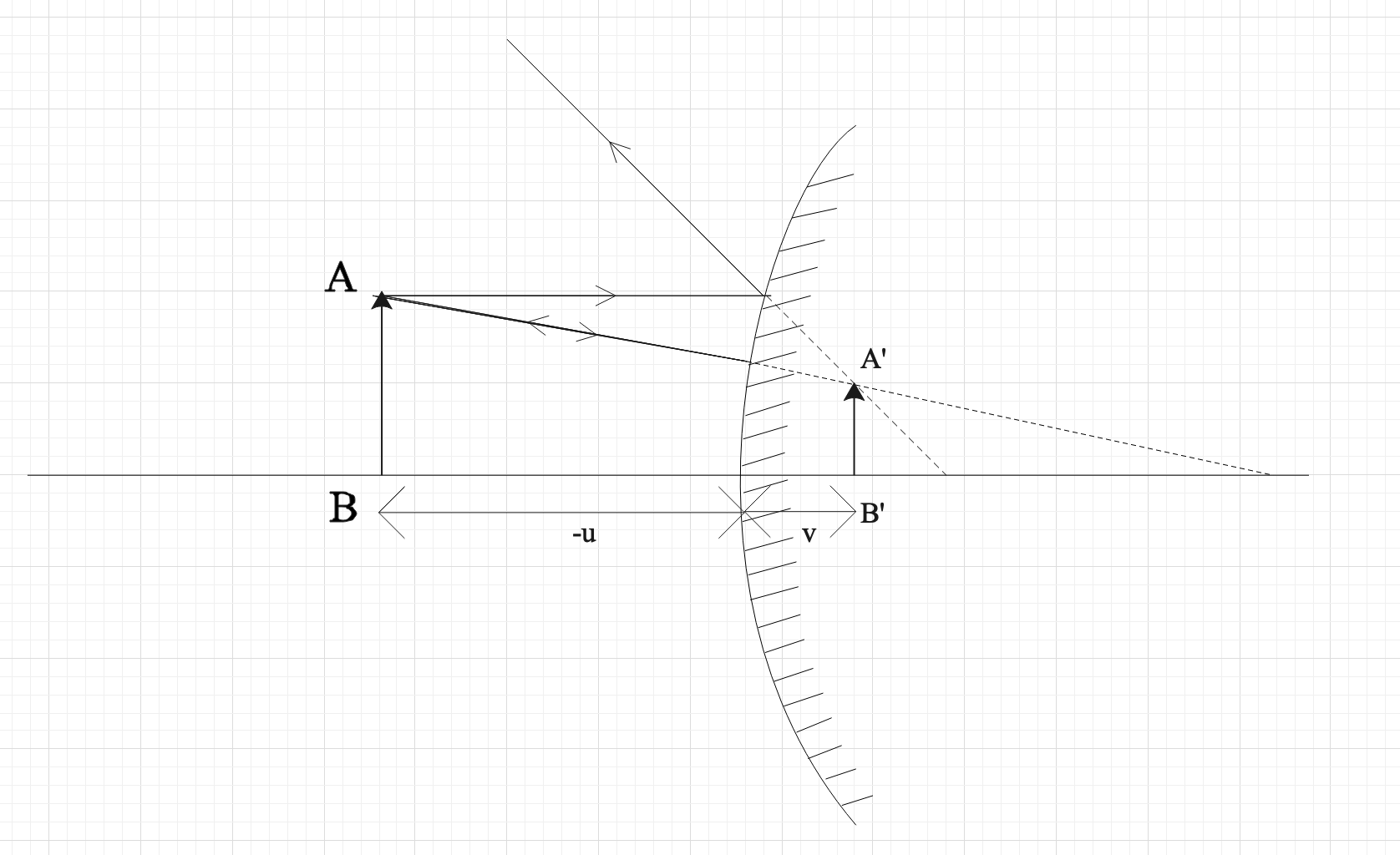
Let’s assume the distance of the object is u.
And the distance of the virtual image is v.
As the object is on the right, we will consider the distance to be (-u).
Hence, we can write,
$\dfrac{1}{v}+\dfrac{1}{-u}=\dfrac{1}{f}$
Convex mirror has a positive focal length. Hence, we can write,
$\dfrac{1}{v}-\dfrac{1}{u} > 0$
$\Rightarrow \dfrac{1}{v} > \dfrac{1}{u}$
$\Rightarrow \dfrac{v}{u} < 1$ (v is positive as per convention)
Hence, the magnification will be less than 1.
So, the image will be diminished.
Hence, all the criteria are established.
So, the answer is - a convex mirror will always produce a virtual, erect, and diminished image of real objects.
Note: Convex mirrors cannot produce a real image of a real object. Light diverges after reflecting on the reflecting surface of the convex mirror.
You should approach this problem empirically, as shown in the solution. You need to make sure that the conditions are followed in general. Otherwise, ‘Always’ statements cannot be verified.
Formula Used:
For a spherical mirror the formula is,
$\dfrac{1}{v}+\dfrac{1}{u}=\dfrac{1}{f}$
Where,
$u$ is the distance of the object from the pole
$v$ is the distance of the image from the pole,
$f$ is the focal length of the spherical mirror.
Complete step by step answer:
We will consider the two spherical mirrors - convex and concave mirror.
Concave mirror can form magnified images. So, the criteria is not fulfilled.
However, we need to check whether the given criteria can be fulfilled for Convex mirrors. Convex mirrors always form virtual nature because of the diverging nature of light after getting reflected.
The following figure shows the convex mirror clearly,
Let’s assume the distance of the object is u.
And the distance of the virtual image is v.
As the object is on the right, we will consider the distance to be (-u).
Hence, we can write,
$\dfrac{1}{v}+\dfrac{1}{-u}=\dfrac{1}{f}$
Convex mirror has a positive focal length. Hence, we can write,
$\dfrac{1}{v}-\dfrac{1}{u} > 0$
$\Rightarrow \dfrac{1}{v} > \dfrac{1}{u}$
$\Rightarrow \dfrac{v}{u} < 1$ (v is positive as per convention)
Hence, the magnification will be less than 1.
So, the image will be diminished.
Hence, all the criteria are established.
So, the answer is - a convex mirror will always produce a virtual, erect, and diminished image of real objects.
Note: Convex mirrors cannot produce a real image of a real object. Light diverges after reflecting on the reflecting surface of the convex mirror.
You should approach this problem empirically, as shown in the solution. You need to make sure that the conditions are followed in general. Otherwise, ‘Always’ statements cannot be verified.
Recently Updated Pages
Write any three differences between metals and nonmetals class 10 social science CBSE

Amit standing on a horizontal plane finds a bird flying class 10 maths CBSE
Two circles of radii 5 cm and 3 cm intersect at two class 10 maths CBSE
Solve the following i John and Jivanti together have class 10 maths CBSE
What is the relation between orthocenter circumcentre class 10 maths CBSE
Two plane mirrors are inclined at 70circ A ray incident class 10 physics CBSE
Trending doubts
Explain the Treaty of Vienna of 1815 class 10 social science CBSE
Which country is known as "The land of Fire and Ice"?
1 GB equals how many MB?
10 examples of evaporation in daily life with explanations
What is the full form of POSCO class 10 social science CBSE
Make a sketch of the human nerve cell What function class 10 biology CBSE