




If the height of an equilateral triangle is 9, what is its area?
(a) 27
(b) 54
(c) 81
(d) \[27\sqrt{3}\]
(e) \[54\sqrt{3}\]
Answer
 Verified
652.8k+ views
Hint: Considering \[\Delta ABC\], we get that AD is the height, h = 9cm. Using Pythagoras theorem, we can find the side of the triangle, taken as ‘a’. Now we know that the area of the triangle = \[\dfrac{1}{2}\times \] base \[\times \] height. Thus, we can substitute the values and get the area.
Complete step-by-step solution -
Let us take our given equilateral triangle as ABC. We know that in an equilateral triangle all the sides are equal. Thus let us take the sides as ‘a’. In an equilateral triangle, the height is also the median, so let us take height. Let AD be the height or median of the triangle. Hence AD is perpendicular to the side BC and divides it into two equal halves, which are,
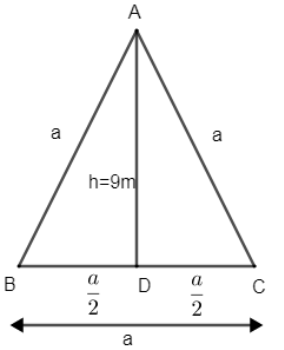
\[\Rightarrow BD=DC=\dfrac{a}{2}\] [from figure]
Thus, we can say that from figure \[\Delta ABD\] is equal to \[\Delta ADC\] as per SSS congruence criteria.
i.e. AB = AC {sides of an equilateral triangle is equal}
AD = AD {common side}
BD = DC {We have proved it above}
Thus we can say that three sides of \[\Delta ABD\] are equal to three sides of \[\Delta ADC\]. Hence they are similar.
\[\therefore \Delta ABD\cong \Delta ADC\]
Now let us use Pythagoras theorem in \[\Delta ABD\].
In \[\Delta ABD\], applying Pythagoras theorem, we get,
\[\Rightarrow A{{D}^{2}}+B{{D}^{2}}=A{{B}^{2}}\]
Put, AD = h, BD = \[\dfrac{a}{2}\] and AB = a [from figure]
\[\begin{align}
& \therefore {{h}^{2}}+{{\left( \dfrac{a}{2} \right)}^{2}}={{a}^{2}} \\
& \Rightarrow {{h}^{2}}={{a}^{2}}-\dfrac{{{a}^{2}}}{4}\Rightarrow {{h}^{2}}=\dfrac{4{{a}^{2}}-{{a}^{2}}}{4} \\
& \therefore {{h}^{2}}=\dfrac{3{{a}^{2}}}{4} \\
\end{align}\]
We have been given the height as 9m. Hence, put h = 9m.
\[\begin{align}
& \Rightarrow \dfrac{3{{a}^{2}}}{4}={{h}^{2}}\Rightarrow {{a}^{2}}=\dfrac{{{9}^{2}}\times 4}{3} \\
& a=\sqrt{\dfrac{{{9}^{2}}\times 4}{3}}=\dfrac{9\times 2}{\sqrt{3}}=\dfrac{18}{\sqrt{3}} \\
\end{align}\]
Hence we got, \[a=\dfrac{18}{\sqrt{3}}\]. Let us take its conjugate i.e. multiply by \[\sqrt{3}\] in numerator and denominator.
\[a=\dfrac{18\times \sqrt{3}}{\sqrt{3}\times \sqrt{3}}=\dfrac{18\sqrt{3}}{3}=6\sqrt{3}\]
Thus we know the side of the equilateral triangle = a = \[6\sqrt{3}\].
We know that area of a triangle = \[\dfrac{1}{2}\times \] base \[\times \] height
\[\therefore \] Area of \[\Delta ABC=\dfrac{1}{2}\times a\times h\]
Area of \[\Delta ABC\] = \[\dfrac{1}{2}\times 6\sqrt{3}\times 9=27\sqrt{3}\]cm.
Thus we found the height of the equilateral triangle as \[27\sqrt{3}\]cm.
\[\therefore \] Option (d) is the correct answer.
Note: We can have another approach while computing the side of the equilateral triangle. We know that in an equilateral triangle all angles are the same i.e. \[{{60}^{\circ }}\] or \[\dfrac{\pi }{3}\].
Hence from \[\Delta ABC\], we can write that
\[\begin{align}
& \Rightarrow \tan \dfrac{\pi }{3}=\dfrac{AD}{BD}=\dfrac{h}{\dfrac{a}{2}}=\dfrac{2h}{a} \\
& \therefore \tan \dfrac{\pi }{3}=\dfrac{2\times 9}{a} \\
& \therefore a=\dfrac{2\times 9}{\tan \dfrac{\pi }{3}} \\
& \therefore a=\dfrac{18}{\sqrt{3}}=6\sqrt{3} \\
\end{align}\]
Thus we get the side as a = \[6\sqrt{3}\].
Complete step-by-step solution -
Let us take our given equilateral triangle as ABC. We know that in an equilateral triangle all the sides are equal. Thus let us take the sides as ‘a’. In an equilateral triangle, the height is also the median, so let us take height. Let AD be the height or median of the triangle. Hence AD is perpendicular to the side BC and divides it into two equal halves, which are,
\[\Rightarrow BD=DC=\dfrac{a}{2}\] [from figure]
Thus, we can say that from figure \[\Delta ABD\] is equal to \[\Delta ADC\] as per SSS congruence criteria.
i.e. AB = AC {sides of an equilateral triangle is equal}
AD = AD {common side}
BD = DC {We have proved it above}
Thus we can say that three sides of \[\Delta ABD\] are equal to three sides of \[\Delta ADC\]. Hence they are similar.
\[\therefore \Delta ABD\cong \Delta ADC\]
Now let us use Pythagoras theorem in \[\Delta ABD\].
In \[\Delta ABD\], applying Pythagoras theorem, we get,
\[\Rightarrow A{{D}^{2}}+B{{D}^{2}}=A{{B}^{2}}\]
Put, AD = h, BD = \[\dfrac{a}{2}\] and AB = a [from figure]
\[\begin{align}
& \therefore {{h}^{2}}+{{\left( \dfrac{a}{2} \right)}^{2}}={{a}^{2}} \\
& \Rightarrow {{h}^{2}}={{a}^{2}}-\dfrac{{{a}^{2}}}{4}\Rightarrow {{h}^{2}}=\dfrac{4{{a}^{2}}-{{a}^{2}}}{4} \\
& \therefore {{h}^{2}}=\dfrac{3{{a}^{2}}}{4} \\
\end{align}\]
We have been given the height as 9m. Hence, put h = 9m.
\[\begin{align}
& \Rightarrow \dfrac{3{{a}^{2}}}{4}={{h}^{2}}\Rightarrow {{a}^{2}}=\dfrac{{{9}^{2}}\times 4}{3} \\
& a=\sqrt{\dfrac{{{9}^{2}}\times 4}{3}}=\dfrac{9\times 2}{\sqrt{3}}=\dfrac{18}{\sqrt{3}} \\
\end{align}\]
Hence we got, \[a=\dfrac{18}{\sqrt{3}}\]. Let us take its conjugate i.e. multiply by \[\sqrt{3}\] in numerator and denominator.
\[a=\dfrac{18\times \sqrt{3}}{\sqrt{3}\times \sqrt{3}}=\dfrac{18\sqrt{3}}{3}=6\sqrt{3}\]
Thus we know the side of the equilateral triangle = a = \[6\sqrt{3}\].
We know that area of a triangle = \[\dfrac{1}{2}\times \] base \[\times \] height
\[\therefore \] Area of \[\Delta ABC=\dfrac{1}{2}\times a\times h\]
Area of \[\Delta ABC\] = \[\dfrac{1}{2}\times 6\sqrt{3}\times 9=27\sqrt{3}\]cm.
Thus we found the height of the equilateral triangle as \[27\sqrt{3}\]cm.
\[\therefore \] Option (d) is the correct answer.
Note: We can have another approach while computing the side of the equilateral triangle. We know that in an equilateral triangle all angles are the same i.e. \[{{60}^{\circ }}\] or \[\dfrac{\pi }{3}\].
Hence from \[\Delta ABC\], we can write that
\[\begin{align}
& \Rightarrow \tan \dfrac{\pi }{3}=\dfrac{AD}{BD}=\dfrac{h}{\dfrac{a}{2}}=\dfrac{2h}{a} \\
& \therefore \tan \dfrac{\pi }{3}=\dfrac{2\times 9}{a} \\
& \therefore a=\dfrac{2\times 9}{\tan \dfrac{\pi }{3}} \\
& \therefore a=\dfrac{18}{\sqrt{3}}=6\sqrt{3} \\
\end{align}\]
Thus we get the side as a = \[6\sqrt{3}\].
Recently Updated Pages
Basicity of sulphurous acid and sulphuric acid are

Master Class 12 Economics: Engaging Questions & Answers for Success
Master Class 12 Biology: Engaging Questions & Answers for Success
Master Class 11 English: Engaging Questions & Answers for Success
Master Class 11 Physics: Engaging Questions & Answers for Success
Master Class 11 Computer Science: Engaging Questions & Answers for Success
Trending doubts
What is the Total Duration of Football Match?
Explain the Treaty of Vienna of 1815 class 10 social science CBSE
In football, which nation is called "La Roja"?
Why is there a time difference of about 5 hours between class 10 social science CBSE
10 examples of evaporation in daily life with explanations
What is the full form of POSCO class 10 social science CBSE