




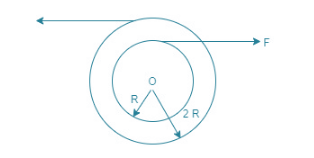
If the ground is sufficiently rough to ensure rolling, what is the kinetic energy of the body now in the given time interval of 2s?
Answer
 Verified
550.5k+ views
Hint: The rolling motion is one of the most common motions observed in daily life. For any disc to roll without slipping, the essential condition is
$ \overrightarrow{{{V}_{cm}}}=R\omega $
$ {{\overrightarrow{\text{V}}}_{\text{cm}}} $ =Translational velocity of disc
$ \omega = $ Velocity of center of mass
R = Radius
Kinetic energy of rolling motion
$ \text{K=}{{\text{K}}_{\text{T}}}+{{\text{K}}_{\text{R}}} $
$ {{\text{K}}_{\text{T}}} $ =translational K.E
$ {{\text{K}}_{\text{R}}} $ =Rotational K.E
$ {{\text{K}}_{\text{T}}}=\dfrac{1}{2}\text{ m}{{\text{v}}^{2}}_{\text{cm}} $
$ {{K}_{R}}=\dfrac{1}{2}I{{\omega }^{2}} $
Total energy will become
$ \therefore $ $ K=\dfrac{1}{2}mv_{cm}^{2}+\dfrac{1}{2}I{{\omega }^{2}} $
To solve this type of problem, keep in mind that it contains both kinetic energies. Therefore we will find out total kinetic energy. To find kinetic energy, we should have a value of translational velocity and angular velocity. To find out the value of velocities we will use the equation of motion. An equation of motion acceleration is also present. So, to find out the value of acceleration we will use Newton’s law of motion.
Complete step by step solution
We know that K.E of rolling motion is given by:
$ K=\dfrac{1}{2}mv_{cm}^{2}+\dfrac{1}{2}I{{\omega }^{2}} $
$ \overrightarrow{{{V}_{cm}}}=R\omega $
To find out $ {{\text{V}}_{\text{cm}}} $ and we will use equation of motion
$ \text{V}=\text{u}+\text{at} $
In case of V and In case of $ \omega $
$ {{\text{V}}_{\text{f}}}={{\text{V}}_{\text{i}}}+\text{a t} $ ….. (A) $ {{\text{w}}_{\text{f}}}={{\text{w}}_{\text{i}}}+\text{a t} $ …. (B)
We know that
F=ma
$ {{a}_{1}}=\dfrac{f}{m} $ (Translational motion)................. (1)
And $ {{\text{a}}_{2}}=\dfrac{\text{FR}-\text{f}\left( 2\text{R} \right)}{\text{I}} $ (rotational motion)................(2)
In the above expression, it is a moment of inertia.
For pure rolling $ {{a}_{1}}={{a}_{2}}R $
$ \therefore $ $ \dfrac{f}{m}=\left( \dfrac{FR-f(2R)}{I} \right) $
Now, we will find moment of inertia by using following equation:
$ \begin{align}
& \text{I}=\dfrac{1}{2}\text{ m}{{\text{r}}^{2}} \\
& \text{ }=\dfrac{1}{2}\times 2\times {{\left( 2 \right)}^{2}} \\
& \text{ }=4 \\
\end{align} $
Given values: $ f=10 $ R=1, I=4, $ m=2 $
$ \Rightarrow \dfrac{f}{m}=\left( \dfrac{10\times 1-2f}{4} \right) $
$ \Rightarrow \dfrac{f}{2}=\dfrac{10-2f}{4} $
$ \Rightarrow \left( f \right)\left( 4 \right)=2\left( 10-2f \right) $
$ \Rightarrow 4f=20-4f $
$ \begin{align}
& \Rightarrow 4f+4f=20 \\
& \Rightarrow 8f=20 \\
& \Rightarrow f=\dfrac{20}{8}=2.5N \\
\end{align} $
And
$ a=\dfrac{f}{m} $
$ \begin{align}
& \Rightarrow a=\dfrac{2.5}{2} \\
& \Rightarrow 1.25m/{{s}^{2}} \\
\end{align} $
In case of rotational motion
$ {{\text{a}}_{2}}=\dfrac{\text{FR}-\text{f}\left( 2\text{R} \right)}{\text{I}} $
Putting all values
$ \begin{align}
& \Rightarrow \dfrac{10\times 1-\left( 2\cdot 5 \right)\left( 2 \right)}{4} \\
& \Rightarrow \dfrac{5}{4}{{\text{s}}^{-2}} \\
\end{align} $
Now putting all values in (A) and (B)
$ {{\text{V}}_{\text{f}}}={{\text{V}}_{\text{i}}}+\text{a t} $ $ {{\text{w}}_{\text{f}}}={{\text{w}}_{\text{i}}}+\text{a t} $
$ \Rightarrow \text{0}+\left( 1\cdot 25 \right)\times \left( 2 \right) $ $ \Rightarrow 0\times \dfrac{5}{4}\times 2 $
$ {{\text{V}}_{\text{f}}}=2\cdot 5\text{ m/s} $ $ {{\text{w}}_{\text{f}}}=2\cdot 5\text{ m/}{{\text{s}}^{-1}} $
Now, use
$ \begin{align}
& \text{K}\text{.E}=\dfrac{1}{2}\text{m}{{\text{v}}^{2}}+\dfrac{1}{2}\text{ I}{{\text{w}}^{2}} \\
& \Rightarrow \dfrac{1}{2}\times 2\times {{\left( 2\cdot 5 \right)}^{2}}+\dfrac{1}{2}\times 4\times {{\left( 2\cdot 5 \right)}^{2}} \\
& \Rightarrow 18\cdot 75\text{ J} \\
\end{align} $
Therefore, kinetic energy is 18.75J.
Note
We have laws of rotational motion. While solving problems regarding rotational motion use them. Keep in mind that when a body rolls on the ground it contains both kinetic energy that is total kinetic energy is the sum of kinetic energy of translational motion of center of mass and kinetic energy of rotational motion about center of mass.
$ \overrightarrow{{{V}_{cm}}}=R\omega $
$ {{\overrightarrow{\text{V}}}_{\text{cm}}} $ =Translational velocity of disc
$ \omega = $ Velocity of center of mass
R = Radius
Kinetic energy of rolling motion
$ \text{K=}{{\text{K}}_{\text{T}}}+{{\text{K}}_{\text{R}}} $
$ {{\text{K}}_{\text{T}}} $ =translational K.E
$ {{\text{K}}_{\text{R}}} $ =Rotational K.E
$ {{\text{K}}_{\text{T}}}=\dfrac{1}{2}\text{ m}{{\text{v}}^{2}}_{\text{cm}} $
$ {{K}_{R}}=\dfrac{1}{2}I{{\omega }^{2}} $
Total energy will become
$ \therefore $ $ K=\dfrac{1}{2}mv_{cm}^{2}+\dfrac{1}{2}I{{\omega }^{2}} $
To solve this type of problem, keep in mind that it contains both kinetic energies. Therefore we will find out total kinetic energy. To find kinetic energy, we should have a value of translational velocity and angular velocity. To find out the value of velocities we will use the equation of motion. An equation of motion acceleration is also present. So, to find out the value of acceleration we will use Newton’s law of motion.
Complete step by step solution
We know that K.E of rolling motion is given by:
$ K=\dfrac{1}{2}mv_{cm}^{2}+\dfrac{1}{2}I{{\omega }^{2}} $
$ \overrightarrow{{{V}_{cm}}}=R\omega $
To find out $ {{\text{V}}_{\text{cm}}} $ and we will use equation of motion
$ \text{V}=\text{u}+\text{at} $
In case of V and In case of $ \omega $
$ {{\text{V}}_{\text{f}}}={{\text{V}}_{\text{i}}}+\text{a t} $ ….. (A) $ {{\text{w}}_{\text{f}}}={{\text{w}}_{\text{i}}}+\text{a t} $ …. (B)
We know that
F=ma
$ {{a}_{1}}=\dfrac{f}{m} $ (Translational motion)................. (1)
And $ {{\text{a}}_{2}}=\dfrac{\text{FR}-\text{f}\left( 2\text{R} \right)}{\text{I}} $ (rotational motion)................(2)
In the above expression, it is a moment of inertia.
For pure rolling $ {{a}_{1}}={{a}_{2}}R $
$ \therefore $ $ \dfrac{f}{m}=\left( \dfrac{FR-f(2R)}{I} \right) $
Now, we will find moment of inertia by using following equation:
$ \begin{align}
& \text{I}=\dfrac{1}{2}\text{ m}{{\text{r}}^{2}} \\
& \text{ }=\dfrac{1}{2}\times 2\times {{\left( 2 \right)}^{2}} \\
& \text{ }=4 \\
\end{align} $
Given values: $ f=10 $ R=1, I=4, $ m=2 $
$ \Rightarrow \dfrac{f}{m}=\left( \dfrac{10\times 1-2f}{4} \right) $
$ \Rightarrow \dfrac{f}{2}=\dfrac{10-2f}{4} $
$ \Rightarrow \left( f \right)\left( 4 \right)=2\left( 10-2f \right) $
$ \Rightarrow 4f=20-4f $
$ \begin{align}
& \Rightarrow 4f+4f=20 \\
& \Rightarrow 8f=20 \\
& \Rightarrow f=\dfrac{20}{8}=2.5N \\
\end{align} $
And
$ a=\dfrac{f}{m} $
$ \begin{align}
& \Rightarrow a=\dfrac{2.5}{2} \\
& \Rightarrow 1.25m/{{s}^{2}} \\
\end{align} $
In case of rotational motion
$ {{\text{a}}_{2}}=\dfrac{\text{FR}-\text{f}\left( 2\text{R} \right)}{\text{I}} $
Putting all values
$ \begin{align}
& \Rightarrow \dfrac{10\times 1-\left( 2\cdot 5 \right)\left( 2 \right)}{4} \\
& \Rightarrow \dfrac{5}{4}{{\text{s}}^{-2}} \\
\end{align} $
Now putting all values in (A) and (B)
$ {{\text{V}}_{\text{f}}}={{\text{V}}_{\text{i}}}+\text{a t} $ $ {{\text{w}}_{\text{f}}}={{\text{w}}_{\text{i}}}+\text{a t} $
$ \Rightarrow \text{0}+\left( 1\cdot 25 \right)\times \left( 2 \right) $ $ \Rightarrow 0\times \dfrac{5}{4}\times 2 $
$ {{\text{V}}_{\text{f}}}=2\cdot 5\text{ m/s} $ $ {{\text{w}}_{\text{f}}}=2\cdot 5\text{ m/}{{\text{s}}^{-1}} $
Now, use
$ \begin{align}
& \text{K}\text{.E}=\dfrac{1}{2}\text{m}{{\text{v}}^{2}}+\dfrac{1}{2}\text{ I}{{\text{w}}^{2}} \\
& \Rightarrow \dfrac{1}{2}\times 2\times {{\left( 2\cdot 5 \right)}^{2}}+\dfrac{1}{2}\times 4\times {{\left( 2\cdot 5 \right)}^{2}} \\
& \Rightarrow 18\cdot 75\text{ J} \\
\end{align} $
Therefore, kinetic energy is 18.75J.
Note
We have laws of rotational motion. While solving problems regarding rotational motion use them. Keep in mind that when a body rolls on the ground it contains both kinetic energy that is total kinetic energy is the sum of kinetic energy of translational motion of center of mass and kinetic energy of rotational motion about center of mass.
Recently Updated Pages
Master Class 11 Computer Science: Engaging Questions & Answers for Success

Master Class 11 Business Studies: Engaging Questions & Answers for Success
Master Class 11 Economics: Engaging Questions & Answers for Success
Master Class 11 English: Engaging Questions & Answers for Success
Master Class 11 Maths: Engaging Questions & Answers for Success
Master Class 11 Biology: Engaging Questions & Answers for Success
Trending doubts
One Metric ton is equal to kg A 10000 B 1000 C 100 class 11 physics CBSE
There are 720 permutations of the digits 1 2 3 4 5 class 11 maths CBSE
Discuss the various forms of bacteria class 11 biology CBSE
Draw a diagram of a plant cell and label at least eight class 11 biology CBSE
State the laws of reflection of light
Explain zero factorial class 11 maths CBSE