



If the frequency of the wave is 100 Hz then the particles of the medium cross the mean position in 1 s will be
A. 50 times
B. 100 times
C. 200 times
D. 400 times
Answer
 Verified
584.4k+ views
Hint: The frequency is nothing but the number of oscillations in one second. OR. The number of waves that pass a fixed point in a given amount of time is called the frequency. The mean position of a wave is the horizontal line around which it oscillates while carrying energy.
Complete answer:
Considering that a wave starts to oscillate from the point of origin, thus, one complete oscillation crosses the mean position 2 times.
The wave oscillation diagram is:
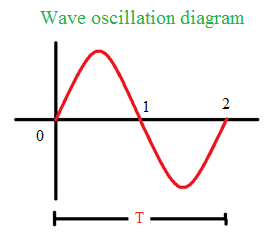
The above figure represents the number of times the wave crosses the mean position in one oscillation.
The point of origin should not be considered as the wave starts to oscillate from that point.
\[100\,Hz\] refers to the 100 oscillations.
As for \[1\] oscillation, the wave crosses the mean position \[2\] times, thus, for \[100\] oscillations, the wave crosses the mean position \[2\times 100=200\] times.
The number of times the particles of the medium cross the mean position in\[1\,s\] will be \[200\] times.
As the number of times the particles of the medium cross the mean position in \[1\,s\] will be \[200\] times.
So, the correct answer is “Option C”.
Note:
The things to be on your figure tips for further information on solving these types of problems are:
While counting for the number of times the mean position is crossed by the wave, the point of origin should not be taken into consideration, as the motion starts from that point itself.
Complete answer:
Considering that a wave starts to oscillate from the point of origin, thus, one complete oscillation crosses the mean position 2 times.
The wave oscillation diagram is:
The above figure represents the number of times the wave crosses the mean position in one oscillation.
The point of origin should not be considered as the wave starts to oscillate from that point.
\[100\,Hz\] refers to the 100 oscillations.
As for \[1\] oscillation, the wave crosses the mean position \[2\] times, thus, for \[100\] oscillations, the wave crosses the mean position \[2\times 100=200\] times.
The number of times the particles of the medium cross the mean position in\[1\,s\] will be \[200\] times.
As the number of times the particles of the medium cross the mean position in \[1\,s\] will be \[200\] times.
So, the correct answer is “Option C”.
Note:
The things to be on your figure tips for further information on solving these types of problems are:
While counting for the number of times the mean position is crossed by the wave, the point of origin should not be taken into consideration, as the motion starts from that point itself.
Recently Updated Pages
Master Class 11 Computer Science: Engaging Questions & Answers for Success

Master Class 11 Business Studies: Engaging Questions & Answers for Success
Master Class 11 Economics: Engaging Questions & Answers for Success
Master Class 11 English: Engaging Questions & Answers for Success
Master Class 11 Maths: Engaging Questions & Answers for Success
Master Class 11 Biology: Engaging Questions & Answers for Success
Trending doubts
One Metric ton is equal to kg A 10000 B 1000 C 100 class 11 physics CBSE
There are 720 permutations of the digits 1 2 3 4 5 class 11 maths CBSE
Discuss the various forms of bacteria class 11 biology CBSE
Draw a diagram of a plant cell and label at least eight class 11 biology CBSE
State the laws of reflection of light
Explain zero factorial class 11 maths CBSE