




If the curve \[y=2{{x}^{3}}+a{{x}^{2}}+bx+c\] passes through the origin and the tangents drawn to it at \[x=-1\] and \[x=2\] are parallel to the x – axis, then the values of a, b and c are respectively
(A) \[12,-3\text{ and 0}\]
(B) \[-3,-12\text{ and 0}\]
(C) \[-3,12\text{ and 0}\]
(D) \[3,-12\text{ and 0}\]
Answer
 Verified
507.3k+ views
Hint: We are given the equation for a curve having three variables ‘a’, ‘b’ and ‘c’ and that it passes through the origin and the tangents drawn to it at \[x=-1\] and \[x=2\] are parallel to the x – axis and we are asked to find the value of the three variables using the given information. We will substitute the values of origin in the equation of the curve and find the value of ‘c’ and for ‘a’ and ‘b’, we will first find the derivative of the given curve and then apply the tangent values. Hence, we will have the required values of the variables.
Complete step-by-step solution:
According to the given question, we are given the equation for a curve having three variables ‘a’, ‘b’ and ‘c’ and that it passes through the origin and the tangents drawn to it at \[x=-1\] and \[x=2\] are parallel to the x – axis and we are asked to find the value of ‘a’, ‘b’ and ‘c’.
The equation of the curve that we have is,
\[y=2{{x}^{3}}+a{{x}^{2}}+bx+c\]
We are given that the curve passes through the origin, that is, at origin both x and y axis have the value as 0, so substituting the values in the equation of the curve, we get the expression as,
\[\begin{align}
& \Rightarrow 0=2{{\left( 0 \right)}^{3}}+a{{\left( 0 \right)}^{2}}+b\left( 0 \right)+c \\
& \Rightarrow c=0 \\
\end{align}\]
We get the value of \[c=0\]
We will now calculate the derivative of the given equation of the curve, we get,
\[\dfrac{dy}{dx}=\dfrac{d}{dx}\left( 2{{x}^{3}}+a{{x}^{2}}+bx+c \right)\]
\[\Rightarrow \dfrac{dy}{dx}=6{{x}^{2}}+2ax+b\]
At tangent, \[\dfrac{dy}{dx}=0\]
For \[x=-1\], we have,
\[6{{x}^{2}}+2ax+b=0\]
\[\begin{align}
& \Rightarrow 6{{\left( -1 \right)}^{2}}+2a\left( -1 \right)+b=0 \\
& \Rightarrow 6-2a+b=0 \\
\end{align}\]
\[\Rightarrow 2a-b=6\] ---(1)
Now, for \[x=2\], we have,
\[\begin{align}
& \Rightarrow 6{{\left( 2 \right)}^{2}}+2a\left( 2 \right)+b=0 \\
& \Rightarrow 24+4a+b=0 \\
\end{align}\]
\[\Rightarrow 4a+b=-24\] ---(2)
Adding up the equations (1) and (2), we have the expression as,
\[\begin{align}
& 6a=-18 \\
& \Rightarrow a=-3 \\
\end{align}\]
Substituting the value of ‘a’ in equation (1), we get,
\[\begin{align}
& 2\left( -3 \right)-b=6 \\
& \Rightarrow -6-b=6 \\
& \Rightarrow b=-12 \\
\end{align}\]
So, the values of \[a=-3,b=-12,c=0\]
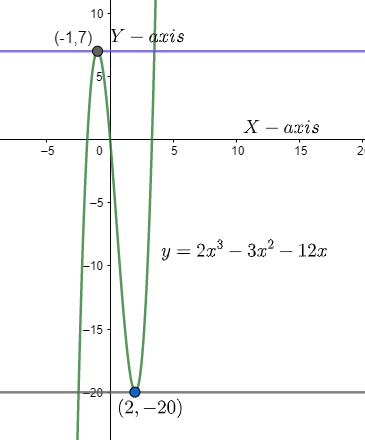
Therefore, the correct option is (B) \[-3,-12\text{ and 0}\]
Note: The above solution should be done in a stepwise manner else the solution might get complex. Also, the calculations should be done correctly. The equations formed should be carefully solved and substituted values should also be carefully done in order to obtain the correct values of the variables.
Complete step-by-step solution:
According to the given question, we are given the equation for a curve having three variables ‘a’, ‘b’ and ‘c’ and that it passes through the origin and the tangents drawn to it at \[x=-1\] and \[x=2\] are parallel to the x – axis and we are asked to find the value of ‘a’, ‘b’ and ‘c’.
The equation of the curve that we have is,
\[y=2{{x}^{3}}+a{{x}^{2}}+bx+c\]
We are given that the curve passes through the origin, that is, at origin both x and y axis have the value as 0, so substituting the values in the equation of the curve, we get the expression as,
\[\begin{align}
& \Rightarrow 0=2{{\left( 0 \right)}^{3}}+a{{\left( 0 \right)}^{2}}+b\left( 0 \right)+c \\
& \Rightarrow c=0 \\
\end{align}\]
We get the value of \[c=0\]
We will now calculate the derivative of the given equation of the curve, we get,
\[\dfrac{dy}{dx}=\dfrac{d}{dx}\left( 2{{x}^{3}}+a{{x}^{2}}+bx+c \right)\]
\[\Rightarrow \dfrac{dy}{dx}=6{{x}^{2}}+2ax+b\]
At tangent, \[\dfrac{dy}{dx}=0\]
For \[x=-1\], we have,
\[6{{x}^{2}}+2ax+b=0\]
\[\begin{align}
& \Rightarrow 6{{\left( -1 \right)}^{2}}+2a\left( -1 \right)+b=0 \\
& \Rightarrow 6-2a+b=0 \\
\end{align}\]
\[\Rightarrow 2a-b=6\] ---(1)
Now, for \[x=2\], we have,
\[\begin{align}
& \Rightarrow 6{{\left( 2 \right)}^{2}}+2a\left( 2 \right)+b=0 \\
& \Rightarrow 24+4a+b=0 \\
\end{align}\]
\[\Rightarrow 4a+b=-24\] ---(2)
Adding up the equations (1) and (2), we have the expression as,
\[\begin{align}
& 6a=-18 \\
& \Rightarrow a=-3 \\
\end{align}\]
Substituting the value of ‘a’ in equation (1), we get,
\[\begin{align}
& 2\left( -3 \right)-b=6 \\
& \Rightarrow -6-b=6 \\
& \Rightarrow b=-12 \\
\end{align}\]
So, the values of \[a=-3,b=-12,c=0\]
Therefore, the correct option is (B) \[-3,-12\text{ and 0}\]
Note: The above solution should be done in a stepwise manner else the solution might get complex. Also, the calculations should be done correctly. The equations formed should be carefully solved and substituted values should also be carefully done in order to obtain the correct values of the variables.
Recently Updated Pages
Master Class 11 Computer Science: Engaging Questions & Answers for Success

Master Class 11 Business Studies: Engaging Questions & Answers for Success
Master Class 11 Economics: Engaging Questions & Answers for Success
Master Class 11 Social Science: Engaging Questions & Answers for Success
Master Class 11 Chemistry: Engaging Questions & Answers for Success
Master Class 11 English: Engaging Questions & Answers for Success
Trending doubts
One Metric ton is equal to kg A 10000 B 1000 C 100 class 11 physics CBSE
Discuss the various forms of bacteria class 11 biology CBSE
Draw a diagram of a plant cell and label at least eight class 11 biology CBSE
State the laws of reflection of light
Explain zero factorial class 11 maths CBSE
10 examples of friction in our daily life