




If the conduction-electron density in copper wire is $n$, the area of cross-section of wire is $A$ and the average drift speed of electron ${{V}_{d}}$, then the resultant number of electrons crossing a cross-section of the wire in a unit time interval $t$ will be given as,
$\begin{align}
& A.n{{V}_{d}}At \\
& B.ne{{V}_{d}}At \\
& C.ne{{V}_{d}}A \\
& D.n{{V}_{d}}A \\
\end{align}$
Answer
 Verified
598.5k+ views
Hint: The distance travelled by the electrons can be calculated by taking the product of the drift velocity and time taken. The volume of this cylinder will be the product of the area of cross section and the distance travelled by the electron. The net number of electrons crossing the area of cross section wire will be the product of the conduction electron density and the volume of the cylinder. These all may help you to solve this question.
Complete answer:
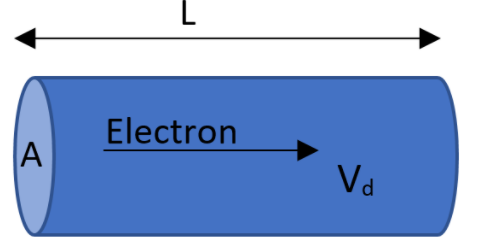
Let the length of the elementary cylindrical wire can be taken as $L$. The distance covered by the electrons in a time $t$can be written as,
$L={{V}_{d}}t$
Volume of this cylinder can be found as,
$V=AL$
Where $A$be the area of cross section. Substituting the values in it will give,
$V=A{{V}_{d}}t$
Therefore the resultant number of electrons crossing the wire can be written as,
$N=nV$
Where $n$be the conduction electron density in the copper wire. Substituting the volume in it will give,
$N=n{{V}_{d}}At$
Therefore the answer has been obtained.
The answer is given as option A.
Note:
Subatomic particles such as electrons can move in different directions all the time. If electrons are provided with an electric field, then they do move randomly, and gradually they drift into one direction, in the direction of the electric field applied. The resultant velocity at which these electrons are drifting in one direction is called drift velocity. This drift velocity of an electron for a unit electric field is called the mobility of the electron.
Complete answer:
Let the length of the elementary cylindrical wire can be taken as $L$. The distance covered by the electrons in a time $t$can be written as,
$L={{V}_{d}}t$
Volume of this cylinder can be found as,
$V=AL$
Where $A$be the area of cross section. Substituting the values in it will give,
$V=A{{V}_{d}}t$
Therefore the resultant number of electrons crossing the wire can be written as,
$N=nV$
Where $n$be the conduction electron density in the copper wire. Substituting the volume in it will give,
$N=n{{V}_{d}}At$
Therefore the answer has been obtained.
The answer is given as option A.
Note:
Subatomic particles such as electrons can move in different directions all the time. If electrons are provided with an electric field, then they do move randomly, and gradually they drift into one direction, in the direction of the electric field applied. The resultant velocity at which these electrons are drifting in one direction is called drift velocity. This drift velocity of an electron for a unit electric field is called the mobility of the electron.
Recently Updated Pages
Understanding the Sun's Density: Exploring the Mass Density of a Hot Plasma - FAQs and Data Analysis

The magnetic field in a plane electromagnetic wave class 11 physics CBSE
The branch of science which deals with nature and natural class 10 physics CBSE
Where is the Centre for Environmental Education Located?
How is Abiogenesis Theory Disproved Experimentally?
Which country won UEFA Euro 2020 tournament (played in 2021)?
Trending doubts
One Metric ton is equal to kg A 10000 B 1000 C 100 class 11 physics CBSE
What are the examples of C3 and C4 plants class 11 biology CBSE
What is charge mass and charge to mass ratio of an class 11 chemistry CBSE
State and prove Bernoullis theorem class 11 physics CBSE
Difference Between Prokaryotic Cells and Eukaryotic Cells
1 ton equals to A 100 kg B 1000 kg C 10 kg D 10000 class 11 physics CBSE