




If the circumference of a circle of a circle be divided into $5$ parts which are in A.P and if the greatest part be $6$ times the least, find in radians the magnitude of the angles that the parts subtended at the centre of the circle.
Answer
 Verified
503.7k+ views
Hint: In this question we will first assume the first five terms of an A.P . We have to keep in mind that “d” is the common difference between the terms. We have assumed the standard form of A.P as $a - 2d,a - d,a,a + d,a + 2d$ . Here $a - 2d$ is the first term of the arithmetic progression. Using this standard form of assumption makes the calculation easy. And then we calculate the angles in the radians.
Complete step by step answer:
Let us assume the five parts of a circle which divides the circumference are:
$a - 2d,a - d,a,a + d,a + 2d$
In the question it is given that ‘the greatest part be $6$ times the least’, so we have greatest part $a + 2d$
And the smallest part is
$a - 2d$
So according to the question we can write
$a + 2d = 6(a - 2d)$
We will break down the bracket
$ \Rightarrow a + 2d = 6a - 12d$
By grouping the similar terms together, it gives
$ \Rightarrow 2d + 12d = 6a - a$
On further solving
$ \Rightarrow 14d = 5a$
$ \Rightarrow a = \dfrac{{14}}{5}d$
We can now put the value of $a$ in all the terms, so the first part of the circle
$a - 2d = \dfrac{{14}}{5}d - 2d$
It gives the value
$ \Rightarrow \dfrac{{14d - 10d}}{5} = \dfrac{{4d}}{5}$
Second part of the circle
$a - d = \dfrac{{14}}{5}d - d$
Upon subtraction:
$\dfrac{{14d - 5d}}{5} = \dfrac{{9d}}{5}$
The third term of the A.P or the third part of the circle
$a = \dfrac{{14}}{5}d$
The fourth part of the circle
$a + 2d = \dfrac{{14}}{5}d + 2d$
By adding the term, it gives
$ \Rightarrow \dfrac{{14d + 5d}}{5} = \dfrac{{19d}}{5}$
Fifth or the largest part of the circle
$a + 2d = \dfrac{{14}}{5}d + 2d$
On adding the value, it gives
$ \Rightarrow \dfrac{{14d + 10d}}{5} = \dfrac{{24d}}{5}$
Now we can write the ratio of all the five parts
$\dfrac{4}{5}d:\dfrac{9}{5}d:\dfrac{{14}}{5}d:\dfrac{{19}}{5}d:\dfrac{{24}}{5}d$
We can see that the denominator of all the fractions are same and “d” is also the same in all the terms, so we can eliminate and write them as
$4:9:14:19:24$
Now we know that the angle subtended at the centre of the circle is ${360^ \circ }$
But we have to find the value in radians. So we will convert ${360^ \circ }$ into radians.
We know that to convert any degree into radians we multiply it with
$\dfrac{\pi }{{180}}$
So we can convert ${360^ \circ }$ into radians,
$360 \times \dfrac{\pi }{{180}} = 2\pi $.
So we have to multiply the terms with $2\pi $ to get into radians.
Now we first calculate the angle subtended by the first or smaller part i.e. $4$. Since the numbers are in the ratio, we can calculate each term by adding all the terms as the denominator in the fractions. So by applying the above, angle subtended by first or smaller part:
$\dfrac{4}{{4 + 9 + 14 + 19 + 24}} \times 2\pi $
On solving we have
$\dfrac{4}{{70}} \times 2\pi $
It gives us the value $\dfrac{{4\pi }}{{35}}$ radians.
Similarly we can calculate the rest part, So the angle subtended by the second part
$\dfrac{9}{{4 + 9 + 14 + 19 + 24}} \times 2\pi $
On solving we have
$\dfrac{9}{{70}} \times 2\pi $
It gives us the value
$\dfrac{{9\pi }}{{35}}$ radians.
Now the angle subtended by the third part is
$\dfrac{{14}}{{4 + 9 + 14 + 19 + 24}} \times 2\pi $
On solving we have
$\dfrac{{14}}{{70}} \times 2\pi $
It gives us the value $\dfrac{{14\pi }}{{35}}$ radians.
Again angle subtended by the fourth part
$\dfrac{{19}}{{4 + 9 + 14 + 19 + 24}} \times 2\pi $
On solving it gives the value
$ \Rightarrow \dfrac{{19}}{{70}} \times 2\pi = \dfrac{{19\pi }}{{35}}$ radians
And angle subtended by the fifth part is
$\dfrac{{24}}{{4 + 9 + 14 + 19 + 24}} \times 2\pi $
On solving it gives the value:
$ \Rightarrow \dfrac{{24}}{{70}} \times 2\pi = \dfrac{{24\pi }}{{35}}$ radians
Hence these are the required values of the angles in radians.
Note:We should always note that the angle subtended at the centre of the circle is always ${360^ \circ }$ . It is also referred to as the central angle.
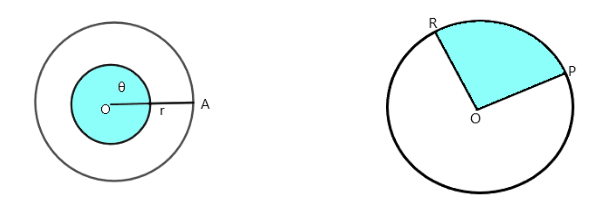
Here in the above image $\theta $ is the angle subtended at the centre and we can see that it is a one full round i.e. $\theta = {360^ \circ }$ and $OA$ is the radius of the circle. So the angle subtended at the centre is the angle subtended by an arc or a chord or a sector at the centre of a circle. In the second image we can see that $ROP$ is a sector which subtends the angle at the centre.
Complete step by step answer:
Let us assume the five parts of a circle which divides the circumference are:
$a - 2d,a - d,a,a + d,a + 2d$
In the question it is given that ‘the greatest part be $6$ times the least’, so we have greatest part $a + 2d$
And the smallest part is
$a - 2d$
So according to the question we can write
$a + 2d = 6(a - 2d)$
We will break down the bracket
$ \Rightarrow a + 2d = 6a - 12d$
By grouping the similar terms together, it gives
$ \Rightarrow 2d + 12d = 6a - a$
On further solving
$ \Rightarrow 14d = 5a$
$ \Rightarrow a = \dfrac{{14}}{5}d$
We can now put the value of $a$ in all the terms, so the first part of the circle
$a - 2d = \dfrac{{14}}{5}d - 2d$
It gives the value
$ \Rightarrow \dfrac{{14d - 10d}}{5} = \dfrac{{4d}}{5}$
Second part of the circle
$a - d = \dfrac{{14}}{5}d - d$
Upon subtraction:
$\dfrac{{14d - 5d}}{5} = \dfrac{{9d}}{5}$
The third term of the A.P or the third part of the circle
$a = \dfrac{{14}}{5}d$
The fourth part of the circle
$a + 2d = \dfrac{{14}}{5}d + 2d$
By adding the term, it gives
$ \Rightarrow \dfrac{{14d + 5d}}{5} = \dfrac{{19d}}{5}$
Fifth or the largest part of the circle
$a + 2d = \dfrac{{14}}{5}d + 2d$
On adding the value, it gives
$ \Rightarrow \dfrac{{14d + 10d}}{5} = \dfrac{{24d}}{5}$
Now we can write the ratio of all the five parts
$\dfrac{4}{5}d:\dfrac{9}{5}d:\dfrac{{14}}{5}d:\dfrac{{19}}{5}d:\dfrac{{24}}{5}d$
We can see that the denominator of all the fractions are same and “d” is also the same in all the terms, so we can eliminate and write them as
$4:9:14:19:24$
Now we know that the angle subtended at the centre of the circle is ${360^ \circ }$
But we have to find the value in radians. So we will convert ${360^ \circ }$ into radians.
We know that to convert any degree into radians we multiply it with
$\dfrac{\pi }{{180}}$
So we can convert ${360^ \circ }$ into radians,
$360 \times \dfrac{\pi }{{180}} = 2\pi $.
So we have to multiply the terms with $2\pi $ to get into radians.
Now we first calculate the angle subtended by the first or smaller part i.e. $4$. Since the numbers are in the ratio, we can calculate each term by adding all the terms as the denominator in the fractions. So by applying the above, angle subtended by first or smaller part:
$\dfrac{4}{{4 + 9 + 14 + 19 + 24}} \times 2\pi $
On solving we have
$\dfrac{4}{{70}} \times 2\pi $
It gives us the value $\dfrac{{4\pi }}{{35}}$ radians.
Similarly we can calculate the rest part, So the angle subtended by the second part
$\dfrac{9}{{4 + 9 + 14 + 19 + 24}} \times 2\pi $
On solving we have
$\dfrac{9}{{70}} \times 2\pi $
It gives us the value
$\dfrac{{9\pi }}{{35}}$ radians.
Now the angle subtended by the third part is
$\dfrac{{14}}{{4 + 9 + 14 + 19 + 24}} \times 2\pi $
On solving we have
$\dfrac{{14}}{{70}} \times 2\pi $
It gives us the value $\dfrac{{14\pi }}{{35}}$ radians.
Again angle subtended by the fourth part
$\dfrac{{19}}{{4 + 9 + 14 + 19 + 24}} \times 2\pi $
On solving it gives the value
$ \Rightarrow \dfrac{{19}}{{70}} \times 2\pi = \dfrac{{19\pi }}{{35}}$ radians
And angle subtended by the fifth part is
$\dfrac{{24}}{{4 + 9 + 14 + 19 + 24}} \times 2\pi $
On solving it gives the value:
$ \Rightarrow \dfrac{{24}}{{70}} \times 2\pi = \dfrac{{24\pi }}{{35}}$ radians
Hence these are the required values of the angles in radians.
Note:We should always note that the angle subtended at the centre of the circle is always ${360^ \circ }$ . It is also referred to as the central angle.
Here in the above image $\theta $ is the angle subtended at the centre and we can see that it is a one full round i.e. $\theta = {360^ \circ }$ and $OA$ is the radius of the circle. So the angle subtended at the centre is the angle subtended by an arc or a chord or a sector at the centre of a circle. In the second image we can see that $ROP$ is a sector which subtends the angle at the centre.
Recently Updated Pages
Master Class 11 English: Engaging Questions & Answers for Success

Master Class 11 Maths: Engaging Questions & Answers for Success
Master Class 11 Biology: Engaging Questions & Answers for Success
Master Class 11 Social Science: Engaging Questions & Answers for Success
Master Class 11 Physics: Engaging Questions & Answers for Success
Master Class 11 Accountancy: Engaging Questions & Answers for Success
Trending doubts
One Metric ton is equal to kg A 10000 B 1000 C 100 class 11 physics CBSE
There are 720 permutations of the digits 1 2 3 4 5 class 11 maths CBSE
Discuss the various forms of bacteria class 11 biology CBSE
Draw a diagram of a plant cell and label at least eight class 11 biology CBSE
State the laws of reflection of light
Explain zero factorial class 11 maths CBSE