



If the circumference of a circle is 88cm, then the area of the circle (in sq.cm) is (take $\pi =\dfrac{22}{7}$)
\[\begin{align}
& A.196\pi \\
& B.92\pi \\
& C.64\pi \\
& D.48\pi \\
\end{align}\]
Answer
 Verified
612.6k+ views
Hint: We are going to apply the concept and formula regarding circle. Here, we know the circumference of the circle and the formula $\Rightarrow 2\pi r$. So, with the help of given data of circumference, we will calculate the radius of the circle and further put this value of radius into the formula of area of the circle. Use the value of $\pi $ as given in the question.
Complete step-by-step answer:
Now, look at the solution, we have given data as:
Circumference of circle = 88 cm
Now, we have to find, area of the circle = ?
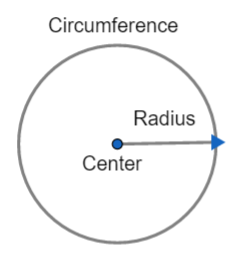
In other words, circumference or perimeter of the circle is the measurement of the boundary of the circle. Whereas the area of a circle defines the region occupied by it.
The circumference (or) perimeter of a circle $\Rightarrow 2\pi r$
Where, r = radius of the circle and $\pi =\dfrac{22}{7}$ (Given)
\[\begin{align}
& \therefore c=2\pi r \\
& \Rightarrow 88=2\times \dfrac{22}{7}\times r \\
& \Rightarrow 8=2\times \dfrac{2}{7}\times r \\
& \Rightarrow r=\dfrac{8\times 7}{4} \\
& \Rightarrow r=14cm \\
\end{align}\]
Now, the formula to find the area of a circle is:
\[\begin{align}
& A=\pi {{r}^{2}} \\
& \Rightarrow A=\dfrac{22}{7}\times {{r}^{2}} \\
\end{align}\]
Now, put the value of r,
\[\begin{align}
& \therefore A=\dfrac{22}{7}\times {{\left( 14 \right)}^{2}} \\
& \Rightarrow \dfrac{22}{7}\times 14\times 14 \\
& \Rightarrow 22\times 14\times 2 \\
& \Rightarrow 22\times 28 \\
& \Rightarrow 616c{{m}^{2}} \\
\end{align}\]
But according to the options, we don't have to eliminate $\pi $ from area A.
\[\begin{align}
& A=\pi {{r}^{2}} \\
& \Rightarrow A=\pi \times {{\left( 14 \right)}^{2}} \\
& \Rightarrow A=196\pi c{{m}^{2}} \\
\end{align}\]
So, the correct answer is “Option A”.
Note: Sometimes, in question, given data is diameter instead of radius, so don't get confused with the formula of area. Just use the base conversion rules of radius and diameter and get radius in terms of diameter.
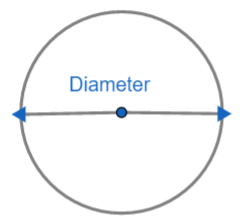
$\begin{align}
& d=2r \\
& \therefore r=\left( \dfrac{d}{2} \right) \\
\end{align}$
Hence,
\[\begin{align}
& A=\pi {{r}^{2}} \\
& A=\pi {{\left( \dfrac{d}{2} \right)}^{2}}\left( \text{in terms of d} \right) \\
\end{align}\]
Sometimes in the question, we have been given radius in variable form, like $r=\left( x+7 \right)\Rightarrow d=\left( x+3 \right)$. In this case, you can still solve for the area or circumference but your final answer will also have that variable in it.
Complete step-by-step answer:
Now, look at the solution, we have given data as:
Circumference of circle = 88 cm
Now, we have to find, area of the circle = ?
In other words, circumference or perimeter of the circle is the measurement of the boundary of the circle. Whereas the area of a circle defines the region occupied by it.
The circumference (or) perimeter of a circle $\Rightarrow 2\pi r$
Where, r = radius of the circle and $\pi =\dfrac{22}{7}$ (Given)
\[\begin{align}
& \therefore c=2\pi r \\
& \Rightarrow 88=2\times \dfrac{22}{7}\times r \\
& \Rightarrow 8=2\times \dfrac{2}{7}\times r \\
& \Rightarrow r=\dfrac{8\times 7}{4} \\
& \Rightarrow r=14cm \\
\end{align}\]
Now, the formula to find the area of a circle is:
\[\begin{align}
& A=\pi {{r}^{2}} \\
& \Rightarrow A=\dfrac{22}{7}\times {{r}^{2}} \\
\end{align}\]
Now, put the value of r,
\[\begin{align}
& \therefore A=\dfrac{22}{7}\times {{\left( 14 \right)}^{2}} \\
& \Rightarrow \dfrac{22}{7}\times 14\times 14 \\
& \Rightarrow 22\times 14\times 2 \\
& \Rightarrow 22\times 28 \\
& \Rightarrow 616c{{m}^{2}} \\
\end{align}\]
But according to the options, we don't have to eliminate $\pi $ from area A.
\[\begin{align}
& A=\pi {{r}^{2}} \\
& \Rightarrow A=\pi \times {{\left( 14 \right)}^{2}} \\
& \Rightarrow A=196\pi c{{m}^{2}} \\
\end{align}\]
So, the correct answer is “Option A”.
Note: Sometimes, in question, given data is diameter instead of radius, so don't get confused with the formula of area. Just use the base conversion rules of radius and diameter and get radius in terms of diameter.
$\begin{align}
& d=2r \\
& \therefore r=\left( \dfrac{d}{2} \right) \\
\end{align}$
Hence,
\[\begin{align}
& A=\pi {{r}^{2}} \\
& A=\pi {{\left( \dfrac{d}{2} \right)}^{2}}\left( \text{in terms of d} \right) \\
\end{align}\]
Sometimes in the question, we have been given radius in variable form, like $r=\left( x+7 \right)\Rightarrow d=\left( x+3 \right)$. In this case, you can still solve for the area or circumference but your final answer will also have that variable in it.
Recently Updated Pages
Master Class 9 General Knowledge: Engaging Questions & Answers for Success

Master Class 9 Maths: Engaging Questions & Answers for Success
Master Class 9 Science: Engaging Questions & Answers for Success
Master Class 9 English: Engaging Questions & Answers for Success
Master Class 9 Social Science: Engaging Questions & Answers for Success
Class 9 Question and Answer - Your Ultimate Solutions Guide
Trending doubts
Find the sum of series 1 + 2 + 3 + 4 + 5 + + 100 class 9 maths CBSE
Difference Between Plant Cell and Animal Cell
Fill the blanks with the suitable prepositions 1 The class 9 english CBSE
What is pollution? How many types of pollution? Define it
Name 10 Living and Non living things class 9 biology CBSE
What is the full form of pH?