




If the circle ${{x}^{2}}+{{y}^{2}}={{a}^{2}}$ cut off an intercept of length $2l$ units from the line $y=mx+c$ then
$\begin{align}
& A.\,\,{{c}^{2}}=({{a}^{2}}+{{l}^{2}})(1+{{m}^{2}}) \\
& B.\,{{c}^{2}}=({{a}^{2}}-{{l}^{2}})(1+{{m}^{2}}) \\
& C.\,{{a}^{2}}=({{c}^{2}}+{{l}^{2}})(1+{{m}^{2}}) \\
& D.\,{{a}^{2}}=({{c}^{2}}+{{l}^{2}})(1+{{m}^{2}}) \\
\end{align}$
Answer
 Verified
581.4k+ views
Hint:
In such a type of question, first compare the given circle equation with the standard equation of the circle then conclude what is the centre and radius. At last apply the formula length of the intercept cut off and calculate it.
Complete step by step solution:
We know that standard equation of circle is ${{(x-h)}^{2}}+{{(y-k)}^{2}}={{r}^{2}}$, where $h,k$ are the .centres and $r$ is the radius.
On comparing the given equation with standard form , we get
$h=0\,\,and\,\,k=0$, $r=a$
It means the equation passing through the origin centre coordinates are $(h,k)=(0,0)$ and its radius is $a$.
It is also given that the length of intercept is $2l$ cut off from the line $y=mx+c$.
Formula of length of intercept =$2\sqrt{{{a}^{2}}-\dfrac{{{c}^{2}}}{1-{{m}^{2}}}}$
$2\sqrt{{{a}^{2}}-\dfrac{{{c}^{2}}}{1-{{m}^{2}}}}=2l$
$2$ cancel out with $2$ and on squaring both sides, we get
${{a}^{2}}-\dfrac{{{c}^{2}}}{1-{{m}^{2}}}={{l}^{2}}$
On transferring ${{a}^{2}}$ other side, we get
$-\dfrac{{{c}^{2}}}{1-{{m}^{2}}}={{l}^{2}}-{{a}^{2}}or-({{a}^{2}}-{{l}^{2}})$
On rearranging the terms, we get
${{c}^{2}}=(1+{{m}^{2}})({{a}^{2}}-{{l}^{2}})$
Therefore option B is the correct option.
Additional information:
When a straight line passes through the circle then the straight line is called the chord of the circle.
Intercepts are the crossing points made by a circle in the axes.
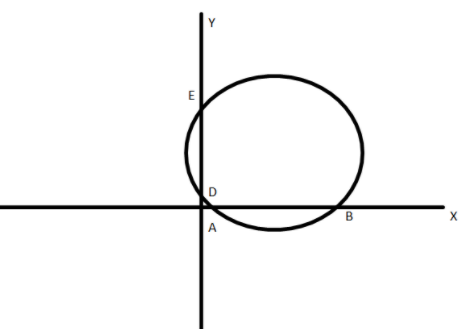
Line equation- A straight line on the coordinate plane can be described by the equation
$y=mx+c $
Where $m$ is slope and $c$ is intercept, where the line crosses the y-axis.
Note:
We can solve this question by using Pythagoras theorem and distance formula. For some students Circle and its concept is difficult but if we go step by step for solution or to understand the solution, it will become easy for us.
In such a type of question, first compare the given circle equation with the standard equation of the circle then conclude what is the centre and radius. At last apply the formula length of the intercept cut off and calculate it.
Complete step by step solution:
We know that standard equation of circle is ${{(x-h)}^{2}}+{{(y-k)}^{2}}={{r}^{2}}$, where $h,k$ are the .centres and $r$ is the radius.
On comparing the given equation with standard form , we get
$h=0\,\,and\,\,k=0$, $r=a$
It means the equation passing through the origin centre coordinates are $(h,k)=(0,0)$ and its radius is $a$.
It is also given that the length of intercept is $2l$ cut off from the line $y=mx+c$.
Formula of length of intercept =$2\sqrt{{{a}^{2}}-\dfrac{{{c}^{2}}}{1-{{m}^{2}}}}$
$2\sqrt{{{a}^{2}}-\dfrac{{{c}^{2}}}{1-{{m}^{2}}}}=2l$
$2$ cancel out with $2$ and on squaring both sides, we get
${{a}^{2}}-\dfrac{{{c}^{2}}}{1-{{m}^{2}}}={{l}^{2}}$
On transferring ${{a}^{2}}$ other side, we get
$-\dfrac{{{c}^{2}}}{1-{{m}^{2}}}={{l}^{2}}-{{a}^{2}}or-({{a}^{2}}-{{l}^{2}})$
On rearranging the terms, we get
${{c}^{2}}=(1+{{m}^{2}})({{a}^{2}}-{{l}^{2}})$
Therefore option B is the correct option.
Additional information:
When a straight line passes through the circle then the straight line is called the chord of the circle.
Intercepts are the crossing points made by a circle in the axes.
Line equation- A straight line on the coordinate plane can be described by the equation
$y=mx+c $
Where $m$ is slope and $c$ is intercept, where the line crosses the y-axis.
Note:
We can solve this question by using Pythagoras theorem and distance formula. For some students Circle and its concept is difficult but if we go step by step for solution or to understand the solution, it will become easy for us.
Recently Updated Pages
Master Class 11 Computer Science: Engaging Questions & Answers for Success

Master Class 11 Business Studies: Engaging Questions & Answers for Success
Master Class 11 Economics: Engaging Questions & Answers for Success
Master Class 11 English: Engaging Questions & Answers for Success
Master Class 11 Maths: Engaging Questions & Answers for Success
Master Class 11 Biology: Engaging Questions & Answers for Success
Trending doubts
One Metric ton is equal to kg A 10000 B 1000 C 100 class 11 physics CBSE
There are 720 permutations of the digits 1 2 3 4 5 class 11 maths CBSE
Discuss the various forms of bacteria class 11 biology CBSE
Draw a diagram of a plant cell and label at least eight class 11 biology CBSE
State the laws of reflection of light
Explain zero factorial class 11 maths CBSE