




If the circle ${{x}^{2}}+{{y}^{2}}+2gx+2fy+c=0$ bisects the circumference of the circle ${{x}^{2}}+{{y}^{2}}+2{{g}_{1}}x+2{{f}_{1}}y+{{c}_{1}}=0$, then the length of the common chord of the circles is
(a) $2\sqrt{g_{1}^{2}+f_{1}^{2}-{{c}_{1}}}$
(b) $\sqrt{g_{1}^{2}+f_{1}^{2}-{{c}_{1}}}$
(c) $\sqrt{{{g}^{2}}+{{f}^{2}}-c}$
(d) $2\sqrt{{{g}^{2}}+{{f}^{2}}-c}$
Answer
 Verified
630k+ views
Hint: To solve the above question, we have to know the concept of the length of common chords of circles. As we can see ${{x}^{2}}+{{y}^{2}}+2gx+2fy+c=0$ bisect the circumference of the circle with equation
${{x}^{2}}+{{y}^{2}}+2{{g}_{1}}x+2{{f}_{1}}y+{{c}_{1}}=0$ Then the length of common chord will be equal to the diameter of circle equation ${{x}^{2}}+{{y}^{2}}+2{{g}_{1}}x+2{{f}_{1}}y+{{c}_{1}}=0$ .
Complete step-by-step solution:
We can see that when two circles intersect, then we can connect the two intersection points and made a common chord.
Since we have the circle with equation ${{x}^{2}}+{{y}^{2}}+2gx+2fy+c=0$ bisect the circumference of the circle with equation ${{x}^{2}}+{{y}^{2}}+2{{g}_{1}}x+2{{f}_{1}}y+{{c}_{1}}=0$ then the length of common chord will be equal to
Diameter of circle of common chord.
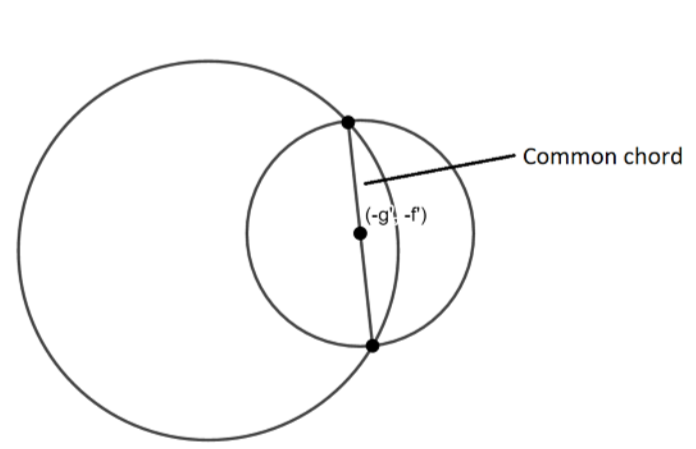
Now we can see how to find diameter of a circle
If we consider the equation the circle equation ${{x}^{2}}+{{y}^{2}}+2gx+2fy+d=0$ whose center is $\left( -g,-f \right)$
So, ${{x}^{2}}+{{y}^{2}}+2gx+2fy+d=0$
Now make it square form
$\Rightarrow \left( {{x}^{2}}+2gx+{{g}^{2}} \right)+\left( {{y}^{2}}+2fy+{{f}^{2}} \right)={{g}^{2}}+{{f}^{2}}-d$
Now make it simplify and we will get the equation as,
${{\left( x+g \right)}^{2}}+{{\left( y+f \right)}^{2}}={{g}^{2}}+{{f}^{2}}-d$
Now we make it in circle form like ${{\left( x-a \right)}^{2}}+{{\left( y-b \right)}^{2}}={{r}^{2}}$
So, we will get the equation as,
${{\left\{ x-\left( -g \right) \right\}}^{2}}+{{\left\{ y-\left( -f \right) \right\}}^{2}}={{\left( \sqrt{{{g}^{2}}+{{f}^{2}}-d} \right)}^{2}}$
So, here we can see the center is $\left( -g,-f \right)$ and diameter is = $2\times \sqrt{{{g}^{2}}+{{f}^{2}}-d}\ldots \left( 1 \right)$
Now if we consider our equation ${{x}^{2}}+{{y}^{2}}+2{{g}_{1}}x+2{{f}_{1}}y+{{c}_{1}}=0$
Here if we comparing with $\left( 1 \right)$ We will get,
$g={{g}_{1,}}f={{f}_{1}}$ And $d={{c}_{1}}$
So, we will get the length of common chord as,
$2\times \sqrt{g_{1}^{2}+f_{1}^{2}-{{c}_{1}}}$
Hence, the correct option is (a)$2\sqrt{g_{1}^{2}+f_{1}^{2}-{{c}_{1}}}$
Note: Here students must take care of the concept of length of common chords of circles. Student sometimes did a mistake because they are only considering the formula of radii $\sqrt{g_{1}^{2}+f_{1}^{2}-{{c}_{1}}}$
Forget to multiply with $2$ as $Diameter=2\times Radii$. So, the Student has to take care of it.
${{x}^{2}}+{{y}^{2}}+2{{g}_{1}}x+2{{f}_{1}}y+{{c}_{1}}=0$ Then the length of common chord will be equal to the diameter of circle equation ${{x}^{2}}+{{y}^{2}}+2{{g}_{1}}x+2{{f}_{1}}y+{{c}_{1}}=0$ .
Complete step-by-step solution:
We can see that when two circles intersect, then we can connect the two intersection points and made a common chord.
Since we have the circle with equation ${{x}^{2}}+{{y}^{2}}+2gx+2fy+c=0$ bisect the circumference of the circle with equation ${{x}^{2}}+{{y}^{2}}+2{{g}_{1}}x+2{{f}_{1}}y+{{c}_{1}}=0$ then the length of common chord will be equal to
Diameter of circle of common chord.
Now we can see how to find diameter of a circle
If we consider the equation the circle equation ${{x}^{2}}+{{y}^{2}}+2gx+2fy+d=0$ whose center is $\left( -g,-f \right)$
So, ${{x}^{2}}+{{y}^{2}}+2gx+2fy+d=0$
Now make it square form
$\Rightarrow \left( {{x}^{2}}+2gx+{{g}^{2}} \right)+\left( {{y}^{2}}+2fy+{{f}^{2}} \right)={{g}^{2}}+{{f}^{2}}-d$
Now make it simplify and we will get the equation as,
${{\left( x+g \right)}^{2}}+{{\left( y+f \right)}^{2}}={{g}^{2}}+{{f}^{2}}-d$
Now we make it in circle form like ${{\left( x-a \right)}^{2}}+{{\left( y-b \right)}^{2}}={{r}^{2}}$
So, we will get the equation as,
${{\left\{ x-\left( -g \right) \right\}}^{2}}+{{\left\{ y-\left( -f \right) \right\}}^{2}}={{\left( \sqrt{{{g}^{2}}+{{f}^{2}}-d} \right)}^{2}}$
So, here we can see the center is $\left( -g,-f \right)$ and diameter is = $2\times \sqrt{{{g}^{2}}+{{f}^{2}}-d}\ldots \left( 1 \right)$
Now if we consider our equation ${{x}^{2}}+{{y}^{2}}+2{{g}_{1}}x+2{{f}_{1}}y+{{c}_{1}}=0$
Here if we comparing with $\left( 1 \right)$ We will get,
$g={{g}_{1,}}f={{f}_{1}}$ And $d={{c}_{1}}$
So, we will get the length of common chord as,
$2\times \sqrt{g_{1}^{2}+f_{1}^{2}-{{c}_{1}}}$
Hence, the correct option is (a)$2\sqrt{g_{1}^{2}+f_{1}^{2}-{{c}_{1}}}$
Note: Here students must take care of the concept of length of common chords of circles. Student sometimes did a mistake because they are only considering the formula of radii $\sqrt{g_{1}^{2}+f_{1}^{2}-{{c}_{1}}}$
Forget to multiply with $2$ as $Diameter=2\times Radii$. So, the Student has to take care of it.
Recently Updated Pages
Master Class 11 English: Engaging Questions & Answers for Success

Master Class 11 Social Science: Engaging Questions & Answers for Success
Master Class 11 Maths: Engaging Questions & Answers for Success
Master Class 11 Biology: Engaging Questions & Answers for Success
Master Class 11 Physics: Engaging Questions & Answers for Success
Master Class 11 Chemistry: Engaging Questions & Answers for Success
Trending doubts
Explain the Treaty of Vienna of 1815 class 10 social science CBSE
What is the Total Duration of Football Match?
First Cotton Mill of India
In which year voting age was reduced from 21 to 18?
10 examples of evaporation in daily life with explanations
What planets have no moons Which one has only one moon class 10 physics CBSE