




If the cardinality of set A is $4$ and that of a set B is $3$ then what is the cardinality of the set $A\Delta B$.
A. $1$
B. $5$
C. $7$
D. Cannot be determined
Answer
 Verified
613.5k+ views
Hint: Here we need to know what $A\Delta B$ means. It refers to all the elements that are there in the set A or the set B but not in their intersection or we can say that all the elements that are there in either set A or set B nut we don’t need to include the elements common to both the set A and B.
Complete Step by Step Solution:
Here we are given that the cardinality of set A is $4$ and that of a set B is $3$.
We must know the meaning of cardinality. It is actually the number of elements that are there in the set. As here we are given that the cardinality of set A is $4$ and that of a set B is $3$ this means that there are $4$ elements in the set A and there are $3$ elements in the set B.
So we can write it as:
$
n\left( A \right) = 4 \\
n\left( B \right) = 3 \\
$
So we need to find the cardinality of $A\Delta B$ set.
Let us see through Venn diagram that:
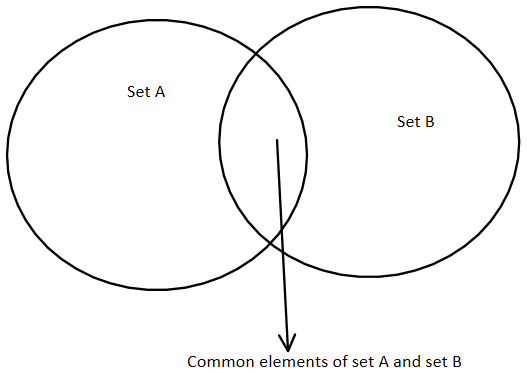
We know that $A\Delta B$ means all the elements that are there in the set A or the set B but not in their intersection or we can say that all the elements that are there in either set A or set B nut we don’t need to include the elements common to both the set A and B.
We can write that:
$n\left( {A\Delta B} \right) = n\left( A \right) + n\left( B \right) - n\left( {A \cap B} \right)$
Here we know the values of $n\left( A \right){\text{ and }}n\left( B \right)$ but not the elements that are common to ${\text{A and B}}$.
Hence we do not know what $n\left( {A \cap B} \right)$ is. Therefore the value of $n\left( {A\Delta B} \right)$ cannot be determined.
Hence we can say that D) is the correct option.
Note:
Here in these types of problems we must know all the symbols that are used in the sets related problems. If we are given the set $\left( {B - A} \right)$ then this would mean that all the elements that are there in set B but not in the set A. These problems can be easily solved by using the Venn diagram.
Complete Step by Step Solution:
Here we are given that the cardinality of set A is $4$ and that of a set B is $3$.
We must know the meaning of cardinality. It is actually the number of elements that are there in the set. As here we are given that the cardinality of set A is $4$ and that of a set B is $3$ this means that there are $4$ elements in the set A and there are $3$ elements in the set B.
So we can write it as:
$
n\left( A \right) = 4 \\
n\left( B \right) = 3 \\
$
So we need to find the cardinality of $A\Delta B$ set.
Let us see through Venn diagram that:
We know that $A\Delta B$ means all the elements that are there in the set A or the set B but not in their intersection or we can say that all the elements that are there in either set A or set B nut we don’t need to include the elements common to both the set A and B.
We can write that:
$n\left( {A\Delta B} \right) = n\left( A \right) + n\left( B \right) - n\left( {A \cap B} \right)$
Here we know the values of $n\left( A \right){\text{ and }}n\left( B \right)$ but not the elements that are common to ${\text{A and B}}$.
Hence we do not know what $n\left( {A \cap B} \right)$ is. Therefore the value of $n\left( {A\Delta B} \right)$ cannot be determined.
Hence we can say that D) is the correct option.
Note:
Here in these types of problems we must know all the symbols that are used in the sets related problems. If we are given the set $\left( {B - A} \right)$ then this would mean that all the elements that are there in set B but not in the set A. These problems can be easily solved by using the Venn diagram.
Recently Updated Pages
Master Class 11 Social Science: Engaging Questions & Answers for Success

Master Class 11 English: Engaging Questions & Answers for Success
Master Class 11 Accountancy: Engaging Questions & Answers for Success
Master Class 11 Physics: Engaging Questions & Answers for Success
Master Class 11 Computer Science: Engaging Questions & Answers for Success
Master Class 11 Business Studies: Engaging Questions & Answers for Success
Trending doubts
Find the value of the expression given below sin 30circ class 11 maths CBSE
One Metric ton is equal to kg A 10000 B 1000 C 100 class 11 physics CBSE
Draw a diagram of nephron and explain its structur class 11 biology CBSE
The teeth used for biting and cutting food are called class 11 biology CBSE
Frogs heart when taken out of the body continues to class 11 biology CBSE
Draw a diagram of a plant cell and label at least eight class 11 biology CBSE