




If the area of the parallelogram ABCD is $ 80c{{m}^{2}} $ , then $ ar\left( \Delta ADP \right) $ is:
A. $ 80c{{m}^{2}} $
B. $ 60c{{m}^{2}} $
C. $ 50c{{m}^{2}} $
D. $ 40c{{m}^{2}} $
Answer
 Verified
549.9k+ views
Hint: We will use the theorem stating “if a triangle and a parallelogram lie on the same base and between the same parallels, then the area of the triangle is half the area of the parallelogram”. Through this theorem, we will find the required area.
Complete step by step answer:
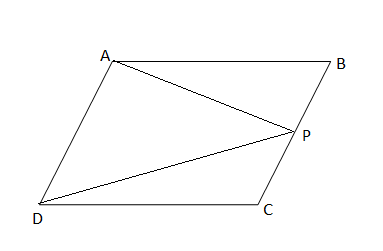
Here, we have been given that the $ |{{|}^{gm}}ABCD $ and $ \Delta APD $ lie on the same base AD and between the same parallels AB and CD.
Hence, using the above-mentioned theorem, we can say that area of the required triangle will be half of the area of a given parallelogram.
Therefore, $ ar\left( \Delta ADP \right)=\dfrac{1}{2}ar\left( |{{|}^{gm}}ABCD \right) $
Here, it is given that $ ar\left( |{{|}^{gm}}ABCD \right)=80c{{m}^{2}} $
Therefore, substituting in the known relation, we get
$ \begin{align}
& ar\left( \Delta ADP \right)=\dfrac{1}{2}\left( 80 \right)c{{m}^{2}} \\
& \Rightarrow ar\left( \Delta ADP \right)=40c{{m}^{2}} \\
\end{align} $
Therefore, option (D) is the correct option.
Note:
Proof of the theorem “if a triangle and a parallelogram lie on the same base and between the same parallels, then the area of the triangle is half the area of the parallelogram” is given here as follows:
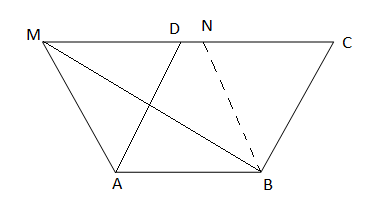
Here, we have a $ |{{|}^{gm}}ABCD $ and a $ \Delta ABM $ which lie on the same base (AB) and between the same parallels (AB and MC).
To prove this theorem, we have also constructed a line BN which is parallel to our line SM, and cut the line MC at N.
Since,
$ \begin{align}
& AB||MC \\
& AM||BN \\
\end{align} $
$ \Rightarrow $ ABNM is a parallelogram.
Therefore, $ |{{|}^{gmABCD}} $ and $ |{{|}^{gm}}ABNM $ have the same areas as their bases are the same (AB) and their heights will also be equal since they lie between the same parallels (AB and MC).
Therefore, $ ar\left( |{{|}^{gm}}ABCD \right)=ar\left( |{{|}^{gm}}ABNM \right) $ ....(1)
Now, in $ |{{|}^{gm}}ABNM $ , the diagonal BM divides the parallelogram into two triangles $ (\Delta ABM $ and $ \Delta BNM) $ and these triangles will be congruent.
Congruent triangles have equal areas.
Therefore, $ ar\left( \Delta ABM \right)=ar\left( \Delta BNM \right) $
Areas of these triangles will be equal to half the area of the parallelogram ABNM
Thus, $ ar\left( \Delta ABM \right)=\dfrac{1}{2}ar\left( |{{|}^{gm}}ABNM \right) $ .....(2)
From equations (1) and (2) we get that:
$ ar\left( \Delta ABM \right)=\dfrac{1}{2}ar\left( |{{|}^{gm}}ABCD \right) $
Hence, proved.
Complete step by step answer:
Here, we have been given that the $ |{{|}^{gm}}ABCD $ and $ \Delta APD $ lie on the same base AD and between the same parallels AB and CD.
Hence, using the above-mentioned theorem, we can say that area of the required triangle will be half of the area of a given parallelogram.
Therefore, $ ar\left( \Delta ADP \right)=\dfrac{1}{2}ar\left( |{{|}^{gm}}ABCD \right) $
Here, it is given that $ ar\left( |{{|}^{gm}}ABCD \right)=80c{{m}^{2}} $
Therefore, substituting in the known relation, we get
$ \begin{align}
& ar\left( \Delta ADP \right)=\dfrac{1}{2}\left( 80 \right)c{{m}^{2}} \\
& \Rightarrow ar\left( \Delta ADP \right)=40c{{m}^{2}} \\
\end{align} $
Therefore, option (D) is the correct option.
Note:
Proof of the theorem “if a triangle and a parallelogram lie on the same base and between the same parallels, then the area of the triangle is half the area of the parallelogram” is given here as follows:
Here, we have a $ |{{|}^{gm}}ABCD $ and a $ \Delta ABM $ which lie on the same base (AB) and between the same parallels (AB and MC).
To prove this theorem, we have also constructed a line BN which is parallel to our line SM, and cut the line MC at N.
Since,
$ \begin{align}
& AB||MC \\
& AM||BN \\
\end{align} $
$ \Rightarrow $ ABNM is a parallelogram.
Therefore, $ |{{|}^{gmABCD}} $ and $ |{{|}^{gm}}ABNM $ have the same areas as their bases are the same (AB) and their heights will also be equal since they lie between the same parallels (AB and MC).
Therefore, $ ar\left( |{{|}^{gm}}ABCD \right)=ar\left( |{{|}^{gm}}ABNM \right) $ ....(1)
Now, in $ |{{|}^{gm}}ABNM $ , the diagonal BM divides the parallelogram into two triangles $ (\Delta ABM $ and $ \Delta BNM) $ and these triangles will be congruent.
Congruent triangles have equal areas.
Therefore, $ ar\left( \Delta ABM \right)=ar\left( \Delta BNM \right) $
Areas of these triangles will be equal to half the area of the parallelogram ABNM
Thus, $ ar\left( \Delta ABM \right)=\dfrac{1}{2}ar\left( |{{|}^{gm}}ABNM \right) $ .....(2)
From equations (1) and (2) we get that:
$ ar\left( \Delta ABM \right)=\dfrac{1}{2}ar\left( |{{|}^{gm}}ABCD \right) $
Hence, proved.
Recently Updated Pages
Master Class 10 Computer Science: Engaging Questions & Answers for Success

Master Class 10 General Knowledge: Engaging Questions & Answers for Success
Master Class 10 English: Engaging Questions & Answers for Success
Master Class 10 Social Science: Engaging Questions & Answers for Success
Master Class 10 Maths: Engaging Questions & Answers for Success
Master Class 10 Science: Engaging Questions & Answers for Success
Trending doubts
What is the median of the first 10 natural numbers class 10 maths CBSE
Which women's tennis player has 24 Grand Slam singles titles?
Who is the Brand Ambassador of Incredible India?
Why is there a time difference of about 5 hours between class 10 social science CBSE
Write a letter to the principal requesting him to grant class 10 english CBSE
A moving boat is observed from the top of a 150 m high class 10 maths CBSE