



If the area of rectangle is equal to \[32c{{m}^{2}}\] and the length of rectangle is equal to 8 cm, then the value of breadth is equal to
Answer
 Verified
647.7k+ views
Hint: We should know that the area of the rectangle is equal to the product of length of rectangle and breadth of rectangle. Let us assume the length of the rectangle is equal to L, the breadth of the rectangle is equal to B and the area of the rectangle is equal to A. Then we get \[A=LB\]. Let us assume the length of the rectangle is equal to A, breadth of rectangle is equal to B and area of the rectangle is equal to A. We know that the length of the rectangle is equal to 8 cm and the area of the rectangle is equal to \[32c{{m}^{2}}\]. Now by using the formula, \[A=LB\] we can get the value of breadth.
Complete step by step answer:
Before solving the question, we should know that the area of the rectangle is equal to the product of length of rectangle and breadth of rectangle. Let us assume the length of the rectangle is equal to L, breadth of the rectangle is equal to B and the area of the rectangle is equal to A. Then we get \[A=LB\].
From the question, it was given that the area of the rectangle is equal to \[32c{{m}^{2}}\] and the length of the rectangle is equal to 8 cm. We know that if the length of the rectangle is L and the breadth of the rectangle is B then the area of the rectangle is equal to A where \[A=LB\].
So, we get
\[\begin{align}
& L=8....(1) \\
& A=32....(2) \\
\end{align}\]
Let us assume the breadth of the rectangle is equal to B.
\[\Rightarrow A=LB\]
By using cross multiplication, we get
\[\Rightarrow B=\dfrac{A}{L}....(3)\]
Now we will substitute equation (1) and equation (2) in equation (3).
\[\begin{align}
& \Rightarrow B=\dfrac{32}{8} \\
& \Rightarrow B=4....(4) \\
\end{align}\]
So, the breadth of the rectangle is equal to 4 cm.
Note: We know that the perimeter of a polygon is equal to the sum of all sides of a polygon. In the same way, the perimeter of the rectangle is equal to the sum of all sides of the rectangle. We know that opposite sides of a rectangle are equal but adjacent sides of the rectangle are not equal.
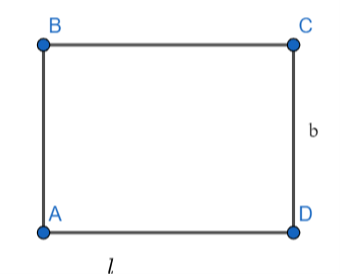
So, it is clear that if the length of the rectangle is L and the breadth of the rectangle is B, then the perimeter is equal to \[2(L+B)\].
Complete step by step answer:
Before solving the question, we should know that the area of the rectangle is equal to the product of length of rectangle and breadth of rectangle. Let us assume the length of the rectangle is equal to L, breadth of the rectangle is equal to B and the area of the rectangle is equal to A. Then we get \[A=LB\].
From the question, it was given that the area of the rectangle is equal to \[32c{{m}^{2}}\] and the length of the rectangle is equal to 8 cm. We know that if the length of the rectangle is L and the breadth of the rectangle is B then the area of the rectangle is equal to A where \[A=LB\].
So, we get
\[\begin{align}
& L=8....(1) \\
& A=32....(2) \\
\end{align}\]
Let us assume the breadth of the rectangle is equal to B.
\[\Rightarrow A=LB\]
By using cross multiplication, we get
\[\Rightarrow B=\dfrac{A}{L}....(3)\]
Now we will substitute equation (1) and equation (2) in equation (3).
\[\begin{align}
& \Rightarrow B=\dfrac{32}{8} \\
& \Rightarrow B=4....(4) \\
\end{align}\]
So, the breadth of the rectangle is equal to 4 cm.
Note: We know that the perimeter of a polygon is equal to the sum of all sides of a polygon. In the same way, the perimeter of the rectangle is equal to the sum of all sides of the rectangle. We know that opposite sides of a rectangle are equal but adjacent sides of the rectangle are not equal.
So, it is clear that if the length of the rectangle is L and the breadth of the rectangle is B, then the perimeter is equal to \[2(L+B)\].
Recently Updated Pages
Basicity of sulphurous acid and sulphuric acid are

Master Class 12 Economics: Engaging Questions & Answers for Success
Master Class 12 Biology: Engaging Questions & Answers for Success
Master Class 11 English: Engaging Questions & Answers for Success
Master Class 11 Physics: Engaging Questions & Answers for Success
Master Class 11 Computer Science: Engaging Questions & Answers for Success
Trending doubts
What is BLO What is the full form of BLO class 8 social science CBSE
One cusec is equal to how many liters class 8 maths CBSE
Citizens of India can vote at the age of A 18 years class 8 social science CBSE
Full form of STD, ISD and PCO
Give me the opposite gender of Duck class 8 english CBSE
What is roughage Give two examples class 8 biology CBSE