




If the area of an isosceles right triangle is\[8\text{c}{{\text{m}}^{\text{2}}}\], what is the perimeter of the triangle?
A. \[8+\sqrt{2}\,\,\text{c}{{\text{m}}^{\text{2}}}\]
B. \[8+4\sqrt{2}\,\,\text{c}{{\text{m}}^{\text{2}}}\]
C. \[4+8\sqrt{2}\,\,\text{c}{{\text{m}}^{\text{2}}}\]
D. \[12\sqrt{2}\,\,\text{c}{{\text{m}}^{\text{2}}}\]
Answer
 Verified
534.3k+ views
Hint: We need to know the lengths of all three sides to compute the perimeter. Because the length of two equal sides of an isosceles triangle is ‘a’, assume that the length of two equal sides is a. We can obtain the value of ‘a' by applying the area formula, then calculating the length of the hypotenuse and equating the value of ‘a'. To get the perimeter, find the sum of all three sides.
Complete step by step answer:
Given triangle is a right isosceles triangle, figure is given below:
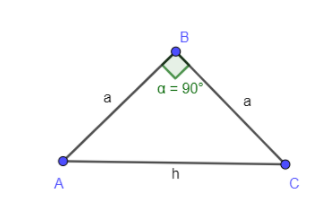
Above figure \[\Delta \text{ABC}\] is a right angled triangle.
We need to find the perimeter of the given triangle
Perimeter of a triangle is defined as the sum of the lengths of all sides of a triangle.
So, for finding the perimeter, we need to find the length of all sides of the triangle.
Area of a triangle is given, so we need to find the two sides of a triangle which is equal in case of isosceles right angle triangle that means \[\text{Base}=\text{Height}=a\]
By using the formula for area of triangle we get:
\[\text{Area}=\dfrac{1}{2}\times \text{Base}\times \text{Height}\]
Area is given that is equal to\[8\text{c}{{\text{m}}^{\text{2}}}\] substitute all the values we get:
\[\text{8}=\dfrac{1}{2}\times a\times a\]
By simplifying further we get:
\[{{a}^{2}}=16\]
So, we get two values of ‘a’ that is \[a=4\]or \[a=-4\]as we know that \[a\ne -4\] because the length of the two sides cannot be negative.
Therefore, we get the values of two sides that is\[a=4\]
We have to find the hypotenuse for that we have to use the Pythagoras theorem that is
\[{{\left( hypotenuse \right)}^{2}}={{(altitude)}^{2}}+{{\left( base \right)}^{2}}\]
Putting all the values we get:
\[{{\left( h \right)}^{2}}={{(4)}^{2}}+{{\left( 4 \right)}^{2}}\]
After simplifying this we get:
\[h=\sqrt{32}\text{cm}\]
It can also be written as \[h=4\sqrt{2}\text{cm}\]
Now, perimeter of right angle isosceles triangle formula is given by
\[\text{perimeter}=\text{sum of all three sides}\]
\[\text{perimeter}=4\sqrt{2}+4+4\]
By simplifying we get:
\[\text{perimeter}=8+4\sqrt{2}\]
So, the correct answer is “Option B”.
Note:
We know that the first two sides of an isosceles triangle are the same length, but the third side is different. Because it has a right angle isosceles triangle, we assumed the two sides of the triangles, base and altitude, are equal in our answer. Why haven't we assumed the hypotenuse's length and either of the length's sides? Because we know that the hypotenuse will always be longer than the other two sides, according to Pythagoras' theorem. As a result, it can't be the same length as any of the sides.
Complete step by step answer:
Given triangle is a right isosceles triangle, figure is given below:
Above figure \[\Delta \text{ABC}\] is a right angled triangle.
We need to find the perimeter of the given triangle
Perimeter of a triangle is defined as the sum of the lengths of all sides of a triangle.
So, for finding the perimeter, we need to find the length of all sides of the triangle.
Area of a triangle is given, so we need to find the two sides of a triangle which is equal in case of isosceles right angle triangle that means \[\text{Base}=\text{Height}=a\]
By using the formula for area of triangle we get:
\[\text{Area}=\dfrac{1}{2}\times \text{Base}\times \text{Height}\]
Area is given that is equal to\[8\text{c}{{\text{m}}^{\text{2}}}\] substitute all the values we get:
\[\text{8}=\dfrac{1}{2}\times a\times a\]
By simplifying further we get:
\[{{a}^{2}}=16\]
So, we get two values of ‘a’ that is \[a=4\]or \[a=-4\]as we know that \[a\ne -4\] because the length of the two sides cannot be negative.
Therefore, we get the values of two sides that is\[a=4\]
We have to find the hypotenuse for that we have to use the Pythagoras theorem that is
\[{{\left( hypotenuse \right)}^{2}}={{(altitude)}^{2}}+{{\left( base \right)}^{2}}\]
Putting all the values we get:
\[{{\left( h \right)}^{2}}={{(4)}^{2}}+{{\left( 4 \right)}^{2}}\]
After simplifying this we get:
\[h=\sqrt{32}\text{cm}\]
It can also be written as \[h=4\sqrt{2}\text{cm}\]
Now, perimeter of right angle isosceles triangle formula is given by
\[\text{perimeter}=\text{sum of all three sides}\]
\[\text{perimeter}=4\sqrt{2}+4+4\]
By simplifying we get:
\[\text{perimeter}=8+4\sqrt{2}\]
So, the correct answer is “Option B”.
Note:
We know that the first two sides of an isosceles triangle are the same length, but the third side is different. Because it has a right angle isosceles triangle, we assumed the two sides of the triangles, base and altitude, are equal in our answer. Why haven't we assumed the hypotenuse's length and either of the length's sides? Because we know that the hypotenuse will always be longer than the other two sides, according to Pythagoras' theorem. As a result, it can't be the same length as any of the sides.
Recently Updated Pages
Master Class 11 English: Engaging Questions & Answers for Success

Master Class 11 Social Science: Engaging Questions & Answers for Success
Master Class 11 Maths: Engaging Questions & Answers for Success
Master Class 11 Biology: Engaging Questions & Answers for Success
Master Class 11 Physics: Engaging Questions & Answers for Success
Master Class 11 Chemistry: Engaging Questions & Answers for Success