




If the angle between two tangents drawn from an external point $P$ to a circle of radius $r$ and center $O$ is ${60^\circ }$ then find the length of $OP$.
Answer
 Verified
642k+ views
Hint: We have given a circle with radius and center. Then there is an external point and two tangents drawn from the external point and the angle between two tangents is given. In this problem students are asked to find the length between the center of the circle and the external point.
Formula used: $\sin \theta = \dfrac{{{\text{opposite side}}}}{{{\text{Hypotenuse}}}}$
Complete step-by-step answer:
Given that, $P$ be the external point, $O$ be the center of the circle, $r$ be the radius of the circle.
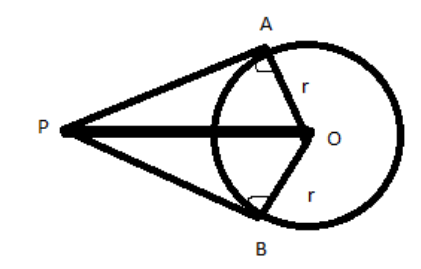
Let $A{\text{ and }}B$ be the two tangents drawn from the external point $P$ and angle between the two tangents from $P$ to the circle is ${60^\circ }$
That is, $\angle APB = {60^\circ }$
Now our aim is to claim the length of$OP$.
Now, in $\vartriangle OPA$ and $\vartriangle OPB$
$\vartriangle OAP = \vartriangle OBP$.
Since both ${90^\circ }$, as radius is perpendicular to tangent.
$OP = OP$ (Common), since $OP$ is common to both right angles $A$ and $B$
$OA = OB$, since both are radius.
$\vartriangle OPA \cong \vartriangle OPB$ (Right angle Hypotenuse Side congruency)
$\therefore \angle OPA = \angle OPB$
So, we can write $\angle OPA = \angle OPB = \dfrac{1}{2}\angle APB$
Since $\angle APB = {60^\circ }$
So, $\dfrac{1}{2}\angle APB = {30^\circ }$
$\therefore \angle OPA = {30^\circ }$
Now, in $\angle OPA$, $\sin P = \dfrac{{{\text{opposite side}}}}{{{\text{Hypotenuse}}}}$
$ \Rightarrow \sin P = \dfrac{{OA}}{{OP}}$
$ \Rightarrow \sin {30^\circ } = \dfrac{r}{{OP}}$
$\because \sin {30^\circ } = \dfrac{1}{2}$
$\therefore \dfrac{1}{2} = \dfrac{r}{{OP}}$
$ \Rightarrow OP = 2r$
The length of OP is 2r.
Note: In a right triangle, the hypotenuse is the longest side, an opposite side is the one across from a given angle, and an adjacent side is next to a given angle. The hypotenuse of a right triangle is always the side opposite the right angle. It is the longest side in a right triangle. In two right – angled triangles, if the length of the hypotenuse and one side of one triangle, is equal to the length of the hypotenuse and corresponding side of the triangle, then the two triangles are congruent.
Formula used: $\sin \theta = \dfrac{{{\text{opposite side}}}}{{{\text{Hypotenuse}}}}$
Complete step-by-step answer:
Given that, $P$ be the external point, $O$ be the center of the circle, $r$ be the radius of the circle.
Let $A{\text{ and }}B$ be the two tangents drawn from the external point $P$ and angle between the two tangents from $P$ to the circle is ${60^\circ }$
That is, $\angle APB = {60^\circ }$
Now our aim is to claim the length of$OP$.
Now, in $\vartriangle OPA$ and $\vartriangle OPB$
$\vartriangle OAP = \vartriangle OBP$.
Since both ${90^\circ }$, as radius is perpendicular to tangent.
$OP = OP$ (Common), since $OP$ is common to both right angles $A$ and $B$
$OA = OB$, since both are radius.
$\vartriangle OPA \cong \vartriangle OPB$ (Right angle Hypotenuse Side congruency)
$\therefore \angle OPA = \angle OPB$
So, we can write $\angle OPA = \angle OPB = \dfrac{1}{2}\angle APB$
Since $\angle APB = {60^\circ }$
So, $\dfrac{1}{2}\angle APB = {30^\circ }$
$\therefore \angle OPA = {30^\circ }$
Now, in $\angle OPA$, $\sin P = \dfrac{{{\text{opposite side}}}}{{{\text{Hypotenuse}}}}$
$ \Rightarrow \sin P = \dfrac{{OA}}{{OP}}$
$ \Rightarrow \sin {30^\circ } = \dfrac{r}{{OP}}$
$\because \sin {30^\circ } = \dfrac{1}{2}$
$\therefore \dfrac{1}{2} = \dfrac{r}{{OP}}$
$ \Rightarrow OP = 2r$
The length of OP is 2r.
Note: In a right triangle, the hypotenuse is the longest side, an opposite side is the one across from a given angle, and an adjacent side is next to a given angle. The hypotenuse of a right triangle is always the side opposite the right angle. It is the longest side in a right triangle. In two right – angled triangles, if the length of the hypotenuse and one side of one triangle, is equal to the length of the hypotenuse and corresponding side of the triangle, then the two triangles are congruent.
Recently Updated Pages
What are the two major island groups in India class 9 social science CBSE

What is Jhum cultivation class 9 biology CBSE
Write an Article on Save Earth Save Life
Silk is obtained from of the silk moth APupa BLarva class 9 chemistry CBSE
Write chemical formulas of the following compounds class 9 chemistry CBSE
The Indo Gangetic Plains of India are fertile due to class 9 social science CBSE
Trending doubts
Fill the blanks with the suitable prepositions 1 The class 9 english CBSE
Who was referred to as Amitraghata by the Greeks AChandragupta class 9 social science CBSE
Difference Between Plant Cell and Animal Cell
Name 10 Living and Non living things class 9 biology CBSE
What is the full form of pH?
On an outline map of India show its neighbouring c class 9 social science CBSE