




If the action and reaction forces are always equal in magnitude, then these forces
(A). Will produce accelerations of equal magnitudes
(B). May not produce accelerations of equal magnitudes.
(C). Produce velocities of equal magnitudes.
(D). Will not produce accelerations of equal magnitudes
Answer
 Verified
548.1k+ views
Hint: In order to solve the question we know about newton’s law
Whenever one body exerts a force on a second body, the first body experiences a force that is equal in magnitude and opposite in direction to the force that it exerts. Mathematically, if a body A exerts a force $\overrightarrow F $ on body B, then B simultaneously exerts a force $ - \overrightarrow F $ on A, or in vector equation form
$\overrightarrow {{F_{AB}}} = - \overrightarrow {{F_{BA}}} $
Newton’s third law represents a certain symmetry in nature: Forces always occur in pairs, and one body cannot exert a force on another without experiencing a force itself. We sometimes refer to this law loosely as “action-reaction,” where the force exerted is the action and the force experienced as a consequence is the reaction. Newton’s third law has practical uses in analyzing the origin of forces and understanding which forces are external to a system.
Complete Step By Step Solution
Let us take an example
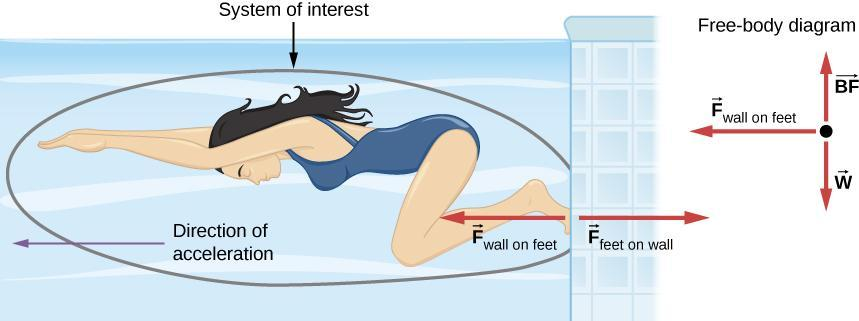
Here $\overrightarrow F $(wall on the feet)=$ - \overrightarrow F $(feet on the wall)
Focus only these forces
Here we see both forces are equal in magnitude but both force will act on different body So we can not say the their acceleration will be equal
the only condition when their acceleration will be same is when they have equal mass
so the correct option is (b)
Note
her examples of Newton’s third law are easy to find
(A) As a professor paces in front of a whiteboard, he exerts a force backward on the floor. The floor exerts a reaction force forward on the professor that causes him to accelerate forward.
(B) A car accelerates forward because the ground pushes forward on the drive wheels, in reaction to the drive wheels pushing backward on the ground. You can see evidence of the wheels pushing backward when tires spin on a gravel road and throw the rocks backward.
(C) Rockets move forward by expelling gas backward at high velocity. This means the rocket exerts a large backward force on the gas in the rocket combustion chamber; therefore, the gas exerts a large reaction force forward on the rocket. This reaction force, which pushes a body forward in response to a backward force, is called thrust. It is a common misconception that rockets propel themselves by pushing on the ground or on the air behind them. They actually work better in a vacuum, where they can more readily expel the exhaust gases.
(D) Helicopters create lift by pushing air down, thereby experiencing an upward reaction force.
Whenever one body exerts a force on a second body, the first body experiences a force that is equal in magnitude and opposite in direction to the force that it exerts. Mathematically, if a body A exerts a force $\overrightarrow F $ on body B, then B simultaneously exerts a force $ - \overrightarrow F $ on A, or in vector equation form
$\overrightarrow {{F_{AB}}} = - \overrightarrow {{F_{BA}}} $
Newton’s third law represents a certain symmetry in nature: Forces always occur in pairs, and one body cannot exert a force on another without experiencing a force itself. We sometimes refer to this law loosely as “action-reaction,” where the force exerted is the action and the force experienced as a consequence is the reaction. Newton’s third law has practical uses in analyzing the origin of forces and understanding which forces are external to a system.
Complete Step By Step Solution
Let us take an example
Here $\overrightarrow F $(wall on the feet)=$ - \overrightarrow F $(feet on the wall)
Focus only these forces
Here we see both forces are equal in magnitude but both force will act on different body So we can not say the their acceleration will be equal
the only condition when their acceleration will be same is when they have equal mass
so the correct option is (b)
Note
her examples of Newton’s third law are easy to find
(A) As a professor paces in front of a whiteboard, he exerts a force backward on the floor. The floor exerts a reaction force forward on the professor that causes him to accelerate forward.
(B) A car accelerates forward because the ground pushes forward on the drive wheels, in reaction to the drive wheels pushing backward on the ground. You can see evidence of the wheels pushing backward when tires spin on a gravel road and throw the rocks backward.
(C) Rockets move forward by expelling gas backward at high velocity. This means the rocket exerts a large backward force on the gas in the rocket combustion chamber; therefore, the gas exerts a large reaction force forward on the rocket. This reaction force, which pushes a body forward in response to a backward force, is called thrust. It is a common misconception that rockets propel themselves by pushing on the ground or on the air behind them. They actually work better in a vacuum, where they can more readily expel the exhaust gases.
(D) Helicopters create lift by pushing air down, thereby experiencing an upward reaction force.
Recently Updated Pages
Master Class 11 Computer Science: Engaging Questions & Answers for Success

Master Class 11 Business Studies: Engaging Questions & Answers for Success
Master Class 11 Economics: Engaging Questions & Answers for Success
Master Class 11 English: Engaging Questions & Answers for Success
Master Class 11 Maths: Engaging Questions & Answers for Success
Master Class 11 Biology: Engaging Questions & Answers for Success
Trending doubts
One Metric ton is equal to kg A 10000 B 1000 C 100 class 11 physics CBSE
There are 720 permutations of the digits 1 2 3 4 5 class 11 maths CBSE
Discuss the various forms of bacteria class 11 biology CBSE
Draw a diagram of a plant cell and label at least eight class 11 biology CBSE
State the laws of reflection of light
Explain zero factorial class 11 maths CBSE