




If $\tan \theta =\dfrac{1}{\sqrt{5}}$ and $\theta $ lies in the first quadrant, then find the value of $\cos \theta $.
A. $\dfrac{1}{\sqrt{6}}$
B. $\dfrac{\sqrt{5}}{\sqrt{6}}$
C. $\dfrac{-1}{\sqrt{6}}$
D. $\dfrac{-\sqrt{5}}{\sqrt{6}}$
Answer
 Verified
602.4k+ views
Hint: We have the value of $\tan \theta $ and the $\theta$ lies in the first quadrant. Now we will assume a triangle $ABC$ and calculate the value of $\tan \theta $ and equate it to the given value. From the Pythagoras theorem we can calculate the length of the other side and then we will have all the lengths of the sides of the triangle. For this we can calculate any trigonometric ratio and after finding the ratios, according to the quadrant that $\theta $ lies, we will change the sign of the trigonometric ratio.
Complete step by step answer:
Given that, $\tan \theta =\dfrac{1}{\sqrt{5}}$ and $\theta $ lies in first quadrant.
Let us assume a triangle $ABC$ as shown in figure.
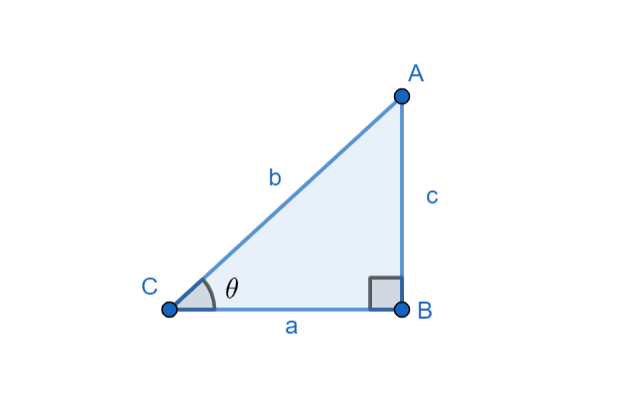
In the above triangle the value of $\tan \theta $ is given by calculating the ratio of the opposite side to $\theta$ and the adjacent side to $\theta$, mathematically
$\begin{align}
& \tan \theta =\dfrac{\text{opposite side to }\theta }{\text{Adjacent side to }\theta } \\
& \Rightarrow \tan \theta =\dfrac{BA}{BC} \\
& \Rightarrow \tan \theta =\dfrac{c}{a} \\
\end{align}$
But we have the value of $\tan \theta $ equal to $\dfrac{1}{\sqrt{5}}$.
$\begin{align}
& \therefore \tan \theta =\dfrac{1}{\sqrt{5}} \\
& \Rightarrow \dfrac{c}{a}=\dfrac{1}{\sqrt{5}} \\
& \Rightarrow c:a=1:\sqrt{5} \\
\end{align}$
We can write the values of $c$ and $a$ as $c=1\times x=x$, $a=\sqrt{5}\times x=\sqrt{5}x$.
In the triangle $ABC$, using Pythagoras theorem
${{b}^{2}}={{a}^{2}}+{{c}^{2}}$
Substituting the values of $c$ and $a$ in the above equation, then we will get
$\begin{align}
& {{b}^{2}}={{\left( \sqrt{5}x \right)}^{2}}+{{x}^{2}} \\
& \Rightarrow {{b}^{2}}=5{{x}^{2}}+{{x}^{2}} \\
& \Rightarrow {{b}^{2}}=6{{x}^{2}} \\
& \Rightarrow b=\sqrt{6{{x}^{2}}} \\
& \Rightarrow b=\sqrt{6}x \\
\end{align}$
In the triangle $ABC$, we have the lengths of the sides as
$AB=c=x$
$BC=a=\sqrt{5}x$
$CD=b=\sqrt{6}x$
From the above values we can find the all trigonometric ratios. Now the value of $\cos \theta $ can be obtained by taking the ratio of adjacent side to $\theta$ and hypotenuse of the triangle.
$\begin{align}
& \therefore \cos \theta =\dfrac{\text{adjacent side to }\theta }{\text{hypotenuse}} \\
& \Rightarrow \cos \theta =\dfrac{CB}{CA} \\
& \Rightarrow \cos \theta =\dfrac{a}{b} \\
& \Rightarrow \cos \theta =\dfrac{\sqrt{5}x}{\sqrt{6}x} \\
& \Rightarrow \cos \theta =\dfrac{\sqrt{5}}{\sqrt{6}} \\
\end{align}$
Given that the $\theta$ lies in the first quadrant, the values of all trigonometric ratios for $\theta$ lies in the first quadrant are positive.
$\therefore \cos \theta =\dfrac{\sqrt{5}}{\sqrt{6}}$
So, the correct answer is “Option B”.
Note: We can simply calculate this problem by knowing trigonometric identity. We have the trigonometric identity ${{\sec }^{2}}\theta -{{\tan }^{2}}\theta =1$, from this relation the value of $\sec \theta $ is given by
$\begin{align}
& {{\sec }^{2}}\theta -{{\tan }^{2}}\theta =1 \\
& \Rightarrow {{\sec }^{2}}\theta =1+{{\tan }^{2}}\theta \\
& \Rightarrow {{\sec }^{2}}\theta =1+{{\left( \dfrac{1}{\sqrt{5}} \right)}^{2}} \\
& \Rightarrow {{\sec }^{2}}\theta =1+\dfrac{1}{5} \\
& \Rightarrow {{\sec }^{2}}\theta =\dfrac{1\times 5+1}{5} \\
& \Rightarrow {{\sec }^{2}}\theta =\dfrac{6}{5} \\
& \Rightarrow \sec \theta =\dfrac{\sqrt{6}}{\sqrt{5}} \\
\end{align}$
We know that $\sec \theta $ is the inverse trigonometric ratio of $\cos \theta $.
$\begin{align}
& \therefore \cos \theta =\dfrac{1}{\sec \theta } \\
& \Rightarrow \cos \theta =\dfrac{1}{\dfrac{\sqrt{6}}{\sqrt{5}}} \\
& \Rightarrow \cos \theta =\dfrac{\sqrt{5}}{\sqrt{6}} \\
\end{align}$
From both the methods we got the same result.
Complete step by step answer:
Given that, $\tan \theta =\dfrac{1}{\sqrt{5}}$ and $\theta $ lies in first quadrant.
Let us assume a triangle $ABC$ as shown in figure.
In the above triangle the value of $\tan \theta $ is given by calculating the ratio of the opposite side to $\theta$ and the adjacent side to $\theta$, mathematically
$\begin{align}
& \tan \theta =\dfrac{\text{opposite side to }\theta }{\text{Adjacent side to }\theta } \\
& \Rightarrow \tan \theta =\dfrac{BA}{BC} \\
& \Rightarrow \tan \theta =\dfrac{c}{a} \\
\end{align}$
But we have the value of $\tan \theta $ equal to $\dfrac{1}{\sqrt{5}}$.
$\begin{align}
& \therefore \tan \theta =\dfrac{1}{\sqrt{5}} \\
& \Rightarrow \dfrac{c}{a}=\dfrac{1}{\sqrt{5}} \\
& \Rightarrow c:a=1:\sqrt{5} \\
\end{align}$
We can write the values of $c$ and $a$ as $c=1\times x=x$, $a=\sqrt{5}\times x=\sqrt{5}x$.
In the triangle $ABC$, using Pythagoras theorem
${{b}^{2}}={{a}^{2}}+{{c}^{2}}$
Substituting the values of $c$ and $a$ in the above equation, then we will get
$\begin{align}
& {{b}^{2}}={{\left( \sqrt{5}x \right)}^{2}}+{{x}^{2}} \\
& \Rightarrow {{b}^{2}}=5{{x}^{2}}+{{x}^{2}} \\
& \Rightarrow {{b}^{2}}=6{{x}^{2}} \\
& \Rightarrow b=\sqrt{6{{x}^{2}}} \\
& \Rightarrow b=\sqrt{6}x \\
\end{align}$
In the triangle $ABC$, we have the lengths of the sides as
$AB=c=x$
$BC=a=\sqrt{5}x$
$CD=b=\sqrt{6}x$
From the above values we can find the all trigonometric ratios. Now the value of $\cos \theta $ can be obtained by taking the ratio of adjacent side to $\theta$ and hypotenuse of the triangle.
$\begin{align}
& \therefore \cos \theta =\dfrac{\text{adjacent side to }\theta }{\text{hypotenuse}} \\
& \Rightarrow \cos \theta =\dfrac{CB}{CA} \\
& \Rightarrow \cos \theta =\dfrac{a}{b} \\
& \Rightarrow \cos \theta =\dfrac{\sqrt{5}x}{\sqrt{6}x} \\
& \Rightarrow \cos \theta =\dfrac{\sqrt{5}}{\sqrt{6}} \\
\end{align}$
Given that the $\theta$ lies in the first quadrant, the values of all trigonometric ratios for $\theta$ lies in the first quadrant are positive.
$\therefore \cos \theta =\dfrac{\sqrt{5}}{\sqrt{6}}$
So, the correct answer is “Option B”.
Note: We can simply calculate this problem by knowing trigonometric identity. We have the trigonometric identity ${{\sec }^{2}}\theta -{{\tan }^{2}}\theta =1$, from this relation the value of $\sec \theta $ is given by
$\begin{align}
& {{\sec }^{2}}\theta -{{\tan }^{2}}\theta =1 \\
& \Rightarrow {{\sec }^{2}}\theta =1+{{\tan }^{2}}\theta \\
& \Rightarrow {{\sec }^{2}}\theta =1+{{\left( \dfrac{1}{\sqrt{5}} \right)}^{2}} \\
& \Rightarrow {{\sec }^{2}}\theta =1+\dfrac{1}{5} \\
& \Rightarrow {{\sec }^{2}}\theta =\dfrac{1\times 5+1}{5} \\
& \Rightarrow {{\sec }^{2}}\theta =\dfrac{6}{5} \\
& \Rightarrow \sec \theta =\dfrac{\sqrt{6}}{\sqrt{5}} \\
\end{align}$
We know that $\sec \theta $ is the inverse trigonometric ratio of $\cos \theta $.
$\begin{align}
& \therefore \cos \theta =\dfrac{1}{\sec \theta } \\
& \Rightarrow \cos \theta =\dfrac{1}{\dfrac{\sqrt{6}}{\sqrt{5}}} \\
& \Rightarrow \cos \theta =\dfrac{\sqrt{5}}{\sqrt{6}} \\
\end{align}$
From both the methods we got the same result.
Recently Updated Pages
Master Class 12 Economics: Engaging Questions & Answers for Success

Master Class 12 English: Engaging Questions & Answers for Success
Master Class 12 Social Science: Engaging Questions & Answers for Success
Master Class 12 Maths: Engaging Questions & Answers for Success
Master Class 12 Physics: Engaging Questions & Answers for Success
Master Class 9 General Knowledge: Engaging Questions & Answers for Success
Trending doubts
Explain the Treaty of Vienna of 1815 class 10 social science CBSE
Who Won 36 Oscar Awards? Record Holder Revealed
Why is it 530 pm in india when it is 1200 afternoon class 10 social science CBSE
Make a sketch of the human nerve cell What function class 10 biology CBSE
What is the full form of POSCO class 10 social science CBSE
Define Potential, Developed, Stock and Reserved resources