




If \[\tan {\theta _1}.\tan {\theta _2} = - \dfrac{{{a^2}}}{{{b^2}}}\] then the chord joining two points \[{\theta _1}\] & \[{\theta _2}\] on the ellipse \[\dfrac{{{x^2}}}{{{a^2}}} + \dfrac{{{y^2}}}{{{b^2}}} = 1\] will subtend a right angle at:
A. Focus
B. Centre
C. End of the major axis
D. End of the minor axis
Answer
 Verified
635.4k+ views
Hint:An ellipse can be defined as the locus of all points that satisfy the equations: \[x = a\cos \theta \] and \[y = b\sin \theta \] . So, any point on the ellipse is of the form \[x = a\cos \theta \] and \[y = b\sin \theta \] . Using this, we can find two points given in question and also find their slope.
Complete step-by-step answer:
In the question, the ellipse is given with the equation \[\dfrac{{{x^2}}}{{{a^2}}} + \dfrac{{{y^2}}}{{{b^2}}} = 1\] with origin at point $O(0,0)$ .
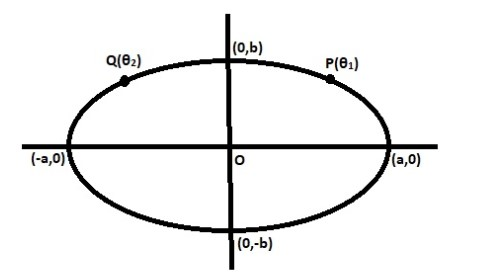
Let us take two points \[P({\theta _1})\] and \[Q({\theta _2})\] as shown in the figure.
Now, as we know that an ellipse can be defined as the locus of all points that satisfy the equations: \[x = a\cos \theta \] and \[y = b\sin \theta \] .
Therefore, according to the definition stated above,
Point \[P({\theta _1}) = (a\cos {\theta _1},b\sin {\theta _1})\]
Point \[Q({\theta _2}) = (a\cos {\theta _2},b\sin {\theta _2})\]
Now, to find the slope \[m\] of points \[({x_1},{y_1})\] and \[({x_2},{y_2})\] , we can use the following formula: \[m = \dfrac{{{y_2} - {y_1}}}{{{x_2} - {x_1}}}\]
Therefore, slope of line \[OP = m(OP) = \dfrac{{b\sin {\theta _1} - 0}}{{a\cos {\theta _1} - 0}} = \dfrac{b}{a}\tan {\theta _1}\]
Slope of line \[OQ = m(OQ) = \dfrac{{b\sin {\theta _2} - 0}}{{a\cos {\theta _2} - 0}} = \dfrac{b}{a}\tan {\theta _2}\]
Now, multiplying and \[m(OQ)\] as we are given that \[\tan {\theta _1}.\tan {\theta _2} = - \dfrac{{{a^2}}}{{{b^2}}}\] , we get
\[m(OP) \times m(OQ) = \dfrac{b}{a}\tan {\theta _1} \times \dfrac{b}{a}\tan {\theta _2} = \dfrac{{{b^2}}}{{{a^2}}}\tan {\theta _1}\tan {\theta _2} = \dfrac{{{b^2}}}{{{a^2}}} \times - \dfrac{{{a^2}}}{{{b^2}}}\]
Or, \[m(OP) \times m(OQ) = - 1\]
Since, the product of slope comes out to be \[ - 1\], so it represents a perpendicular pair of straight lines.
Therefore, chord PQ subtends the right angle at the centre of the ellipse.
Therefore, Centre is the required answer.
So, the correct answer is “Option B”.
Note:The two points can be taken in any of the quadrants in general, as it does not matter because the angle will be different and will make up for it. The important thing to remember is that any point on the ellipse should be known in parametric form to solve such types of questions.
Complete step-by-step answer:
In the question, the ellipse is given with the equation \[\dfrac{{{x^2}}}{{{a^2}}} + \dfrac{{{y^2}}}{{{b^2}}} = 1\] with origin at point $O(0,0)$ .
Let us take two points \[P({\theta _1})\] and \[Q({\theta _2})\] as shown in the figure.
Now, as we know that an ellipse can be defined as the locus of all points that satisfy the equations: \[x = a\cos \theta \] and \[y = b\sin \theta \] .
Therefore, according to the definition stated above,
Point \[P({\theta _1}) = (a\cos {\theta _1},b\sin {\theta _1})\]
Point \[Q({\theta _2}) = (a\cos {\theta _2},b\sin {\theta _2})\]
Now, to find the slope \[m\] of points \[({x_1},{y_1})\] and \[({x_2},{y_2})\] , we can use the following formula: \[m = \dfrac{{{y_2} - {y_1}}}{{{x_2} - {x_1}}}\]
Therefore, slope of line \[OP = m(OP) = \dfrac{{b\sin {\theta _1} - 0}}{{a\cos {\theta _1} - 0}} = \dfrac{b}{a}\tan {\theta _1}\]
Slope of line \[OQ = m(OQ) = \dfrac{{b\sin {\theta _2} - 0}}{{a\cos {\theta _2} - 0}} = \dfrac{b}{a}\tan {\theta _2}\]
Now, multiplying and \[m(OQ)\] as we are given that \[\tan {\theta _1}.\tan {\theta _2} = - \dfrac{{{a^2}}}{{{b^2}}}\] , we get
\[m(OP) \times m(OQ) = \dfrac{b}{a}\tan {\theta _1} \times \dfrac{b}{a}\tan {\theta _2} = \dfrac{{{b^2}}}{{{a^2}}}\tan {\theta _1}\tan {\theta _2} = \dfrac{{{b^2}}}{{{a^2}}} \times - \dfrac{{{a^2}}}{{{b^2}}}\]
Or, \[m(OP) \times m(OQ) = - 1\]
Since, the product of slope comes out to be \[ - 1\], so it represents a perpendicular pair of straight lines.
Therefore, chord PQ subtends the right angle at the centre of the ellipse.
Therefore, Centre is the required answer.
So, the correct answer is “Option B”.
Note:The two points can be taken in any of the quadrants in general, as it does not matter because the angle will be different and will make up for it. The important thing to remember is that any point on the ellipse should be known in parametric form to solve such types of questions.
Recently Updated Pages
Master Class 12 Business Studies: Engaging Questions & Answers for Success

Master Class 12 Chemistry: Engaging Questions & Answers for Success
Master Class 12 Biology: Engaging Questions & Answers for Success
Class 12 Question and Answer - Your Ultimate Solutions Guide
Master Class 11 English: Engaging Questions & Answers for Success
Master Class 11 Social Science: Engaging Questions & Answers for Success
Trending doubts
Which are the Top 10 Largest Countries of the World?
The total number of vertebrae in man is a30 b31 c32 class 12 biology CBSE
Draw a labelled sketch of the human eye class 12 physics CBSE
The number of cranial nerves in a frog is A 10 pairs class 12 biology CBSE
Differentiate between homogeneous and heterogeneous class 12 chemistry CBSE
Differentiate between Pyramid of energy and pyramid class 12 biology CBSE